In April 2026, Nigerian commuters faced rising transport costs, with the average intercity bus fare climbing to N9,607.41, according to the latest National Bureau of Statistics (NBS) Transport Fare Watch report.
The report paints a sobering picture of how persistent inflationary pressures, elevated fuel prices, and rising operational expenses are squeezing the pockets of ordinary Nigerians who rely on various modes of transportation for work, business, and family obligations.
From bustling urban centers to rural routes, the cost of mobility has become significantly more burdensome, even as some segments of the broader economy show tentative signs of easing inflation.
Year-on-year, intercity bus fares jumped by a sharp 21.58% from N7,901.70 recorded in April 2025. While the month-on-month increase was relatively moderate, the cumulative effect over the past year has been substantial.
Other transport categories followed a similar trajectory. Intra-city bus fares rose to N1,397.27 per drop, representing a 1.73% increase from March and a staggering 39.83% leap from N999.27 a year earlier.
Motorcycle (popularly known as Okada) transport recorded one of the most dramatic surges, climbing 56.20% year-on-year to N1,035.69. Water transport fares increased by 30.85% to N2,222.99, while air travel, though seeing only a marginal 0.08% month-on-month rise to N157,355.87, was still 20.82% higher than the N130,243.90 recorded in April 2025.
These increases come despite mixed month-on-month movements across categories, underscoring that while the pace of monthly hikes may be slowing in some areas, the baseline costs remain markedly elevated compared to last year.
The NBS data reveals striking variations in transport costs across Nigeria’s states and geopolitical zones, reflecting differences in infrastructure, demand, fuel distribution challenges, and local economic conditions.
Abia State had the highest average intercity bus fare at N10,998.89, while Kwara State offered some relief with the lowest at N7,900.10. In intra-city transport, Zamfara State topped the list at N1,803.10 per trip, closely followed by the economic powerhouse Lagos at N1,704.03. Conversely, Abia recorded the cheapest intra-city fare at N850.98.
For air travel, Kano State had the highest average fare at N183,835.21, while Gombe posted the lowest at N135,650.75. Kaduna State led in motorcycle fares with N1,690.91, and Rivers State dominated water transport costs at a hefty N6,777.45.
At the regional level, the South-West zone, home to some of Nigeria’s busiest commercial hubs, including Lagos, recorded the highest average fares for both intra-city and intercity transport.
This highlights the acute cost pressures facing millions of daily commuters in one of the country’s most economically active regions, where high population density and intense commercial activity drive constant demand for transportation services.
For the average Nigerian household, these rising transport costs translate directly into higher living expenses. A worker in Lagos commuting daily via intra-city buses now spends considerably more just to get to and from work, reducing disposable income for food, healthcare, and education.
Small businesses that rely on intercity movement of goods and personnel are also absorbing higher logistics costs, which are inevitably passed on to consumers.
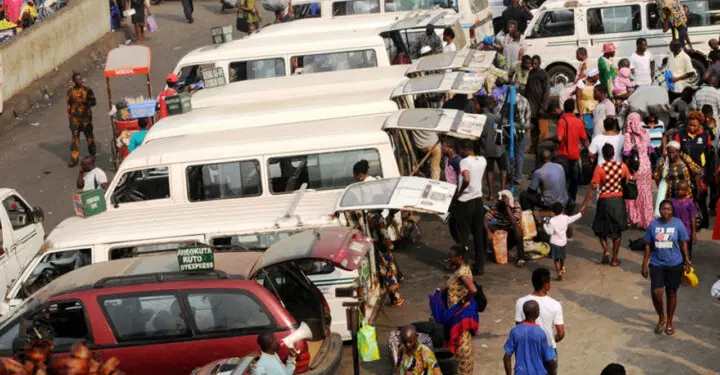
The situation is particularly challenging for vulnerable groups of students, market women, and low-income earners, who depend heavily on affordable public transport options like okadas and danfo buses.
Analysts attribute the sustained pressure to a combination of factors: the ripple effects of fuel subsidy removal that occurred years ago, volatility in global oil prices, naira depreciation affecting spare parts and vehicle maintenance costs, and inadequate investment in mass transit infrastructure.
While the government has pointed to various interventions aimed at stabilizing the economy, the transport sector continues to reflect the tough realities on the ground for millions of citizens.
As Nigeria navigates its economic recovery path, the April 2026 Transport Fare Watch serves as a critical barometer of how macroeconomic policies are translating into everyday costs for the people.
For now, commuters are left hoping that easing inflation and potential improvements in fuel availability and infrastructure will eventually translate into more affordable mobility in the months ahead.
WHAT YOU SHOULD KNOW
Transport costs across Nigeria continued their upward trajectory in April 2026, with average intercity bus fares reaching N9,607.41, a 21.58% increase from the previous year.