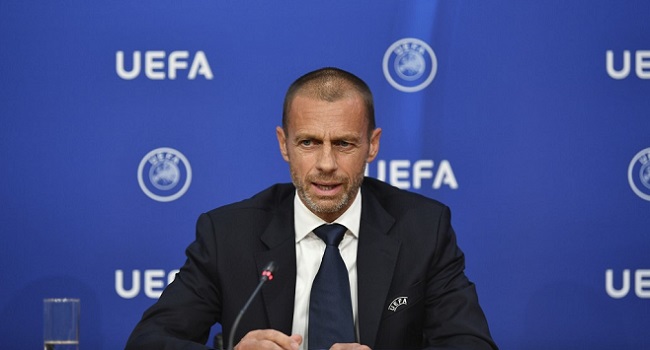
Aleksander Ceferin has no interest in the FIFA presidency. But he is in no doubt that Gianni Infantino’s hold on it is now genuinely at risk.
In an appearance on The Rest Is Politics podcast on Monday, the UEFA president delivered his most direct assessment yet of the crisis engulfing world football’s governing body, insisting he has “no interest” in succeeding Infantino while warning that the FIFA chief will either have to walk away voluntarily or fight off a rival candidate at the federation’s congress in Rabat, Morocco, next March.
It marks the clearest sign yet that a power struggle once thought unthinkable, a serious challenge to an Infantino presidency that has run essentially unopposed since 2016, has become a live possibility.
The rupture between FIFA and its most powerful confederation traces back to Infantino’s push to bring outside capital into the organization, reportedly a proposal worth billions of dollars that would have handed private investors a stake in a company overseeing FIFA’s flagship events, including the men’s and women’s World Cups.
The scheme drew fierce resistance from multiple confederations and was ultimately shelved. But the damage to Infantino’s standing did not disappear with the proposal.
UEFA, which governs European football and wields outsized influence within FIFA’s political structure, responded by threatening to boycott FIFA competitions altogether, an extraordinary escalation from the continent that had once been Infantino’s most reliable base of support.
Several national federations and other confederations have since distanced themselves from the FIFA president as well, leaving what was once considered an unassailable position looking suddenly precarious.
Speculation had inevitably turned to Ceferin himself, given his central role in organizing the pushback and his long-standing rivalry with Infantino, a former UEFA secretary general who has led FIFA since replacing the disgraced Sepp Blatter a decade ago. The 58-year-old Slovenian shut that speculation down firmly.
Ceferin offered two reasons for staying out of the race. The first was personal: his affection for UEFA and a sense that, after years in the role, some space to step back and enjoy life held real appeal.
The second was strategic: he argued that his credibility as a critic of Infantino is strongest precisely because he is not positioning himself as a beneficiary of Infantino’s downfall.
It is a calculated piece of positioning. By removing any suspicion that his criticism is self-interested, Ceferin frames himself as a voice of the wider “football community” rather than a rival plotting a takeover.
Despite ruling himself out, Ceferin was unambiguous about what he believes lies ahead for Infantino. He described the FIFA president as facing two paths.
The first is a voluntary exit, driven by recognition that he no longer commands support not just among the federations that formally vote at FIFA congresses, but among fans, players, coaches, and the broader football establishment.
The second is standing for re-election in March and facing an organized opposition candidate, whose identity Ceferin said he did not yet know.
Notably, Ceferin revealed the two men have not spoken since the investment controversy erupted, a striking admission given their shared history at UEFA and years of, at times uneasy, collaboration atop European and world football.
Any challenge would represent uncharted territory for FIFA’s modern era. Infantino has faced no serious opposition since his first, closely contested election in 2016, having since been returned unopposed.
Candidates for the March vote must formally declare by mid-November, and attention has already turned to two figures seen as plausible challengers: CONCACAF president Victor Montagliani, a Canadian administrator with deep ties to the North and Central American game, and Sheikh Salman bin Ebrahim Al Khalifa, the long-serving president of the Asian Football Confederation who lost narrowly to Infantino in that 2016 vote.
Whether either man ultimately enters the race remains uncertain. But Ceferin’s remarks confirm what has been building for weeks: an Infantino coronation that once looked inevitable is now, for the first time in a decade, genuinely in doubt.
WHAT YOU SHOULD KNOW
Infantino’s once-unchallengeable grip on FIFA is now genuinely at risk. Ceferin won’t run himself, but by ruling himself out, he’s positioning himself as a credible voice of the football world rather than a rival, and his message is blunt: Infantino either steps aside or faces a real contest in March 2027, with Montagliani and Sheikh Salman as possible challengers. A decade of unopposed re-elections is over.