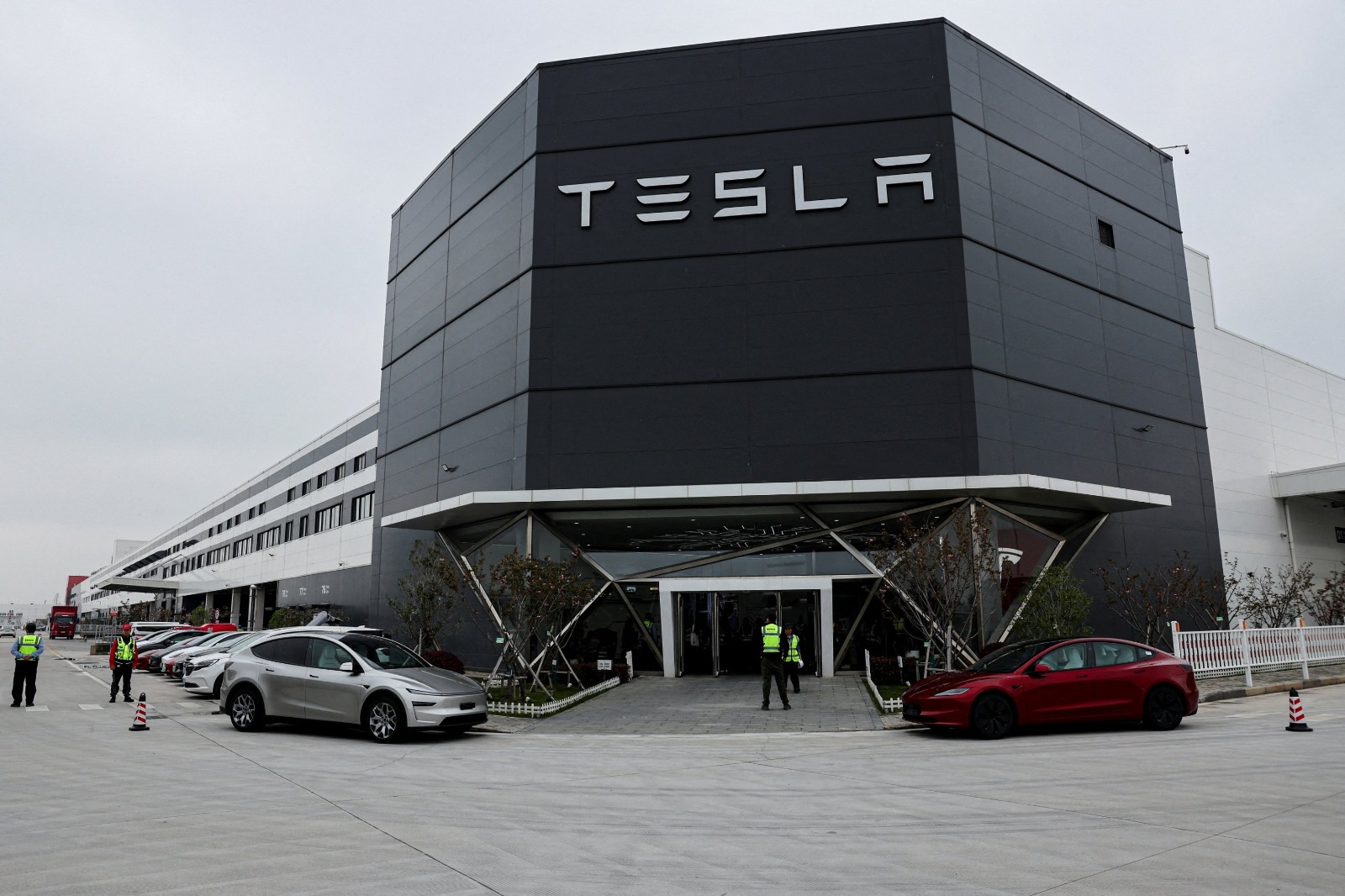
Tesla is recalling nearly three million vehicles in China after regulators found that a hallmark feature of the electric-car maker’s design sleek, flush interior door handles could trap occupants inside during a crash, according to an announcement by China’s State Administration for Market Regulation (SAMR).
The recall, one of the largest ever ordered in China’s fast-growing EV market, is not an isolated action against the American automaker.
Eight Chinese carmakers, including some of the country’s biggest EV brands, filed matching recalls the same day, pointing to an industry-wide design flaw that regulators say has been quietly baked into millions of vehicles built for speed, style, and aerodynamic efficiency rather than emergency accessibility.
At the center of the recall is a simple but potentially deadly flaw: emergency door releases that are colored to match the interior trim, rendering them nearly invisible to panicked occupants after a crash.
In Tesla’s Model 3, for instance, rear-seat passengers must reach into a compartment tucked inside the door pocket and locate a manual release cable by feel, a task the company’s own website describes as necessary in situations where the vehicle loses power.
SAMR did not mince words about the danger this poses. In its statement, the regulator warned that in “extreme situations such as severe collisions causing the vehicle’s low-voltage system to fail,” the disguised handles “may affect passengers’ ability to quickly open car doors for escape and rescue operations outside the vehicle.”
In other words: in the exact moment a mechanical backup is needed, most after a crash has knocked out the car’s electronics, occupants may not even be able to find it.
Tesla’s exposure is enormous. The recall covers 2.9 million domestically produced Model 3 and Model Y vehicles built at the company’s Shanghai gigafactory, plus roughly 46,000 imported Model 3, Model X, and Model S units. The fix will begin rolling out September 25.
Notably, SAMR also disclosed a second, separate Tesla recall affecting 2.7 million domestically built Model 3 and Model Y vehicles, this time over concerns about how the cars monitor drivers while steering-assist features are engaged.
Regulators did not clarify whether the two recall populations overlap, leaving open the possibility that some Tesla owners in China are receiving notices for both issues at once.
Tesla is far from alone. A cluster of Chinese EV makers, including Xiaomi, XPeng, Geely, Chery, and Leapmotor, among them are recalling vehicles with the same category of hard-to-locate emergency handles, underscoring how widely the design was copied across the industry after Tesla popularized it.
Xiaomi began recalling about 390,000 units of its 2024 SU7 sedan on Friday. XPeng followed a day later, pulling in nearly 265,000 vehicles.
Beijing-based BAIC BluePark, a subsidiary of state-owned BAIC, started recalling roughly 46,000 Arcfox Kaola EVs on Saturday over what regulators described as a “lack of dedicated text prompts” near the emergency release on the vehicle’s right rear sliding door. Geely’s premium Zeekr brand began recalling about 92,000 cars on Monday.
As remedies, the automakers have largely converged on the same low-cost fixes: free warning labels affixed near the hidden handles and, in some cases, remote software updates that automatically lower vehicle windows following a crash, giving occupants another way out even if they can’t locate the manual release.
The recalls land amid growing unease in China over automotive designs that prioritize aesthetics and aerodynamics over crash-scenario usability.
Flush, retractable door handles, which fold into the body of the car to reduce drag while driving, became a signature feature after Tesla introduced them with the 2012 launch of the Model S. Chinese EV brands, eager to project a high-tech image, adopted the styling cue widely in the years since.
But the same qualities that make these handles look futuristic their concealment, their blending into the door panel are precisely what regulators now say can turn deadly when a car’s electrical system fails, and occupants must rely on manual backups they may never have consciously located before.
The mass recalls align with a broader regulatory shift already underway. China’s Ministry of Industry and Information Technology announced in February that it will ban fully hidden door handles on new cars starting January 1, 2027.
Under the incoming rules, all vehicles will be required to feature both interior and exterior mechanical releases that are readily identifiable, effectively forcing automakers to rethink a design language that has come to define the look of modern EVs.
For now, the recalls stand as a stark reminder that in the rush to reimagine the automobile for the electric age, some decades-old safety fundamentals like being able to find your way out of a car cannot be designed away.
WHAT YOU SHOULD KNOW
Tesla’s recall of nearly 3 million cars, part of a broader industry-wide action affecting eight Chinese automakers, comes down to one critical safety gap: door handles designed to look sleek can become invisible in an emergency.
When a crash knocks out a vehicle’s power, occupants may not be able to find, let alone operate, the manual releases meant to save their lives.
As China moves to ban these hidden handles by 2027, the takeaway is, style should never come at the cost of a passenger’s ability to get out of a car when it matters most.