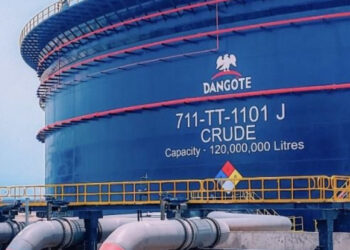
Oil markets pulled back on Friday after a blistering rally, but crude was still on pace for one of its steepest weekly gains in years as traders weighed the risk of a broader conflagration across the Middle East’s most vital energy corridors.
Brent crude slipped $1.82, or 1.81%, to $98.87 a barrel by 07:47 GMT, a retreat from Thursday’s dramatic session, when the benchmark surged more than 7% to around $101 per barrel, its highest level since May 22, as fears of supply disruption intensified.
Even with Friday’s pullback, Brent remained on course for roughly a 12% weekly advance, while WTI fell $1.60, or 1.74%, to $90.59 a barrel, still tracking a near-10% gain for the week.
The rally was set off after Houthi rebels struck two Saudi oil tankers identified as the Encelia and Layla in the Red Sea, sparking a fire aboard the Encelia, though all crew were reported safe. The strikes came days after the Iran-aligned group declared a maritime blockade against Saudi Arabia and prompted at least five Saudi tankers to reverse course in the Red Sea to avoid the danger zone.
“Major hubs of oil production or supply routes are surrounded by war,” PVM Oil Associates analyst John Evans said, adding that the short-term outlook remains bullish for crude.
President Trump escalated his rhetoric in response, warning that the U.S. would hold Iran responsible for any future Houthi attacks on commercial shipping and threatening “major military punishment” against Tehran and the Yemen-based militants, while saying he was considering a “massive attack” on Iran.
That warning followed on the heels of the U.S. completing its 12th consecutive night of strikes on Iranian targets, hitting missile storage sites, drone facilities, and coastal surveillance installations.
The Bab el-Mandeb Strait, the gateway between the Red Sea and the Gulf of Aden, has taken on outsized importance as Iran’s closure of the Strait of Hormuz has forced Saudi Arabia to reroute crude via alternative channels.
Traffic through Hormuz, through which nearly one-fifth of the world’s oil once transited before the war began, has slowed to a trickle, with ship-tracking data showing barely a vessel or two crossing on some days this week, the lowest levels since May.
Wall Street banks are bracing for further pain if the conflict drags on. Goldman Sachs has forecast that Brent could rally above $120 a barrel by the fourth quarter if supply disruptions persist, while RBC Capital Markets’ Helima Croft warned prices could ultimately test the 2022 post-invasion high of $128 a barrel, or even breach the 2008 record of $146, in a worst-case scenario of full-scale regional war.
Adding to the supply squeeze, Kazakhstan’s energy ministry said this week that producers had trimmed output after suspected Ukrainian drone strikes forced a temporary shutdown of the country’s main Black Sea export terminal, a reminder that the Russia-Ukraine war continues to weigh on global energy flows even as attention has shifted to the Gulf.
The turmoil is already being felt at the pump, with the U.S. national average reaching $4.09 a gallon, a level that could climb further if the standoff in the Red Sea and the Gulf shows no signs of easing.
WHAT YOU SHOULD KNOW
Oil is spiking because two of the world’s most critical energy chokepoints, the Strait of Hormuz and now the Red Sea’s Bab el-Mandeb Strait, are both under threat at the same time, as the U.S.-Iran war spreads to Houthi attacks on Saudi tankers.
Brent is up roughly 12% this week alone, and analysts warn prices could keep climbing sharply, potentially toward $120–$146 a barrel the longer these shipping routes stay disrupted.
Watch Hormuz traffic and any further Houthi/Iran escalation: that’s what will determine whether this is a temporary spike or the start of a much longer, costlier energy crisis.