Nigeria has signed a revised Bilateral Air Services Agreement (BASA) with the Kingdom of Morocco, officials announced on Thursday.
The pact, inked by Nigeria’s Minister of Aviation and Aerospace Development, Festus Keyamo, during the ongoing Global Implementation Support Symposium (GISS) in Marrakech, is designed to dramatically expand flight operations between the two nations while strengthening tourism, trade, and people-to-people links across West and North Africa.
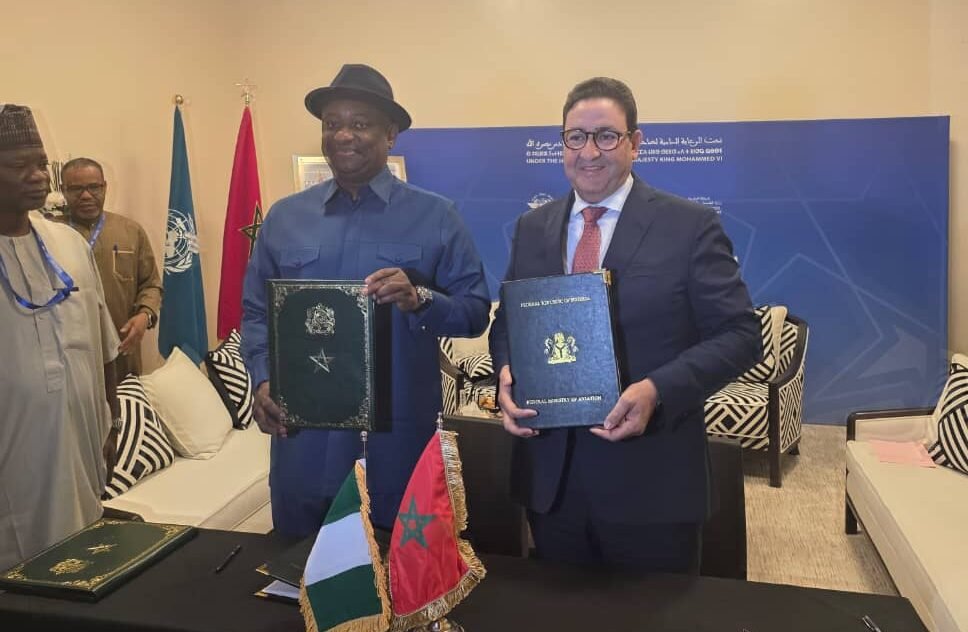
The revised agreement updates an earlier framework, creating what Nigerian officials describe as a “modern and forward-looking” structure for air connectivity. It opens the door for increased frequencies, new routes, and greater operational flexibility for carriers on both sides, while also benefiting airports and aviation regulators.
“It establishes a modern and forward-looking framework that enhances connectivity, deepens commercial cooperation, and expands operational opportunities for airlines, airports, and regulatory institutions,” said a statement issued by Keyamo’s media aide, Tunde Moshood.
Beyond the runway, the deal is expected to deliver a major lift to tourism and economic exchanges. Morocco, already a popular destination for Nigerian travelers drawn to its historic cities, beaches, and cultural heritage, stands to see even stronger visitor flows once direct flight options improve.
In turn, Nigerian destinations from Lagos and Abuja to emerging tourism hubs could attract more Moroccan investors and holidaymakers.
The agreement explicitly targets growth in trade, investment, and broader people-to-people relations, aligning with continental aviation priorities and sustainability goals.
The signing took place on the sidelines of the high-profile GISS forum, where Keyamo also held strategic meetings with leaders of the International Civil Aviation Organization (ICAO) and the European Union.
ICAO Council President Toshiyuki Onuma commended Nigeria’s Civil Aviation Masterplan and Keyamo’s presentation on “The Future of Aviation’s Workforce,” pledging continued support for capacity building.
Discussions with the EU delegation focused on technical assistance, safety oversight, and regulatory modernization—underscoring Abuja’s push to position Nigeria as a regional aviation powerhouse.
Aviation industry watchers see the revised BASA as part of a wider push under President Bola Tinubu’s administration to liberalize Nigeria’s skies and unlock the sector’s potential.
With passenger traffic rebounding and new airport infrastructure projects underway, the Morocco pact arrives at a moment when enhanced regional connectivity is viewed as critical for economic diversification.
For Morocco, the deal complements its own ambitious aviation strategy and its deepening ties with sub-Saharan Africa. The two countries have already been strengthening relations in energy, most notably through the proposed $25 billion Nigeria-Morocco Gas Pipeline, and this aviation breakthrough adds another pillar to a burgeoning strategic partnership.
While exact new flight schedules have yet to be announced, industry sources anticipate that carriers such as Royal Air Maroc and potential Nigerian operators could soon add capacity on the popular Lagos–Casablanca and Abuja–Casablanca corridors, possibly extending to other Moroccan gateways.
As the ink dries on the revised BASA, both governments are framing it as more than a technical aviation document—it is a concrete step toward a more integrated and prosperous Africa, where easier travel translates into stronger economic bonds and shared prosperity.
For Nigerian and Moroccan travelers alike, the skies between the two nations are about to get considerably busier.
WHAT YOU SHOULD KNOW
Nigeria and Morocco have signed a revised Bilateral Air Services Agreement (BASA) that will significantly boost flight operations between the two countries.
The key point to know: This updated deal is set to increase flight frequencies, open new routes, and make travel easier and more frequent, directly strengthening tourism, trade, and people-to-people ties—a concrete step toward deeper economic integration between West and North Africa.
In short, expect more direct flights and stronger bilateral relations in the near future.