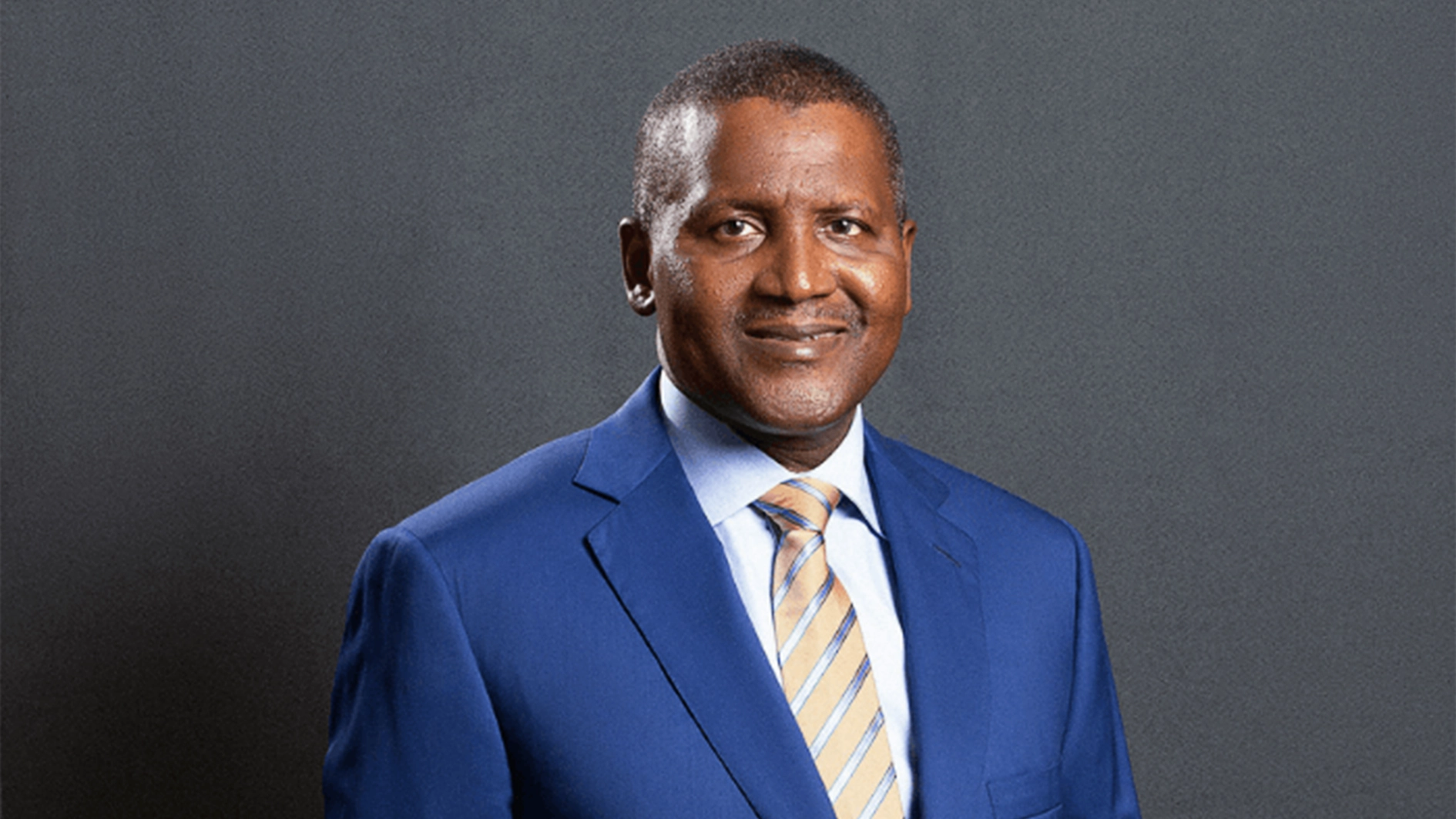
TIME Magazine’s 2026 list of the 100 most influential people features Nigerian billionaire Aliko Dangote in its “Titans” category, recognizing his unstoppable push to industrialize Africa.
This marks Dangote’s second appearance on the prestigious annual ranking. His first came in 2014, when Microsoft co-founder Bill Gates penned a tribute highlighting the industrialist’s business acumen and philanthropic vision.
Twelve years later, the honor has come full circle: this time, the tribute was written by fellow Nigerian business titan Tony Elumelu, chairman of Heirs Holdings and United Bank for Africa (UBA), who once received a similar accolade from Dangote himself.
In a warm and deeply personal essay published on the TIME website, Elumelu described his longtime friend and peer as “indefatigable, resilient, and foresighted.” He praised Dangote’s vast business empire—spanning cement, sugar, fertilizer, and now petroleum refining—as a powerful demonstration of what Africans can achieve when they harness local resources for continental development.
“His business footprint demonstrates the capacity of Africans to create value using local resources on the continent,” Elumelu wrote. He singled out the landmark commissioning of the Dangote Refinery in Lagos—Nigeria’s largest single investment project and one of the world’s biggest refineries—as a “significant milestone in advancing industrialization in Africa.”
Elumelu, who has collaborated with Dangote on numerous pan-African initiatives, added that the billionaire’s success is matched only by his humility. “He has inspired a generation of entrepreneurs, continues to inspire his friends, and can always be counted on to return a phone call,” he noted. “A great man, creating a great legacy.”
Dangote is the only Nigerian featured on the 2026 list and one of a handful of Africans recognized this year. He shares the Titans category with an eclectic mix of global figures like fashion icon Ralph Lauren (profiled by Oprah Winfrey), Microsoft co-founder and philanthropist Michael Dell and his wife Susan (by Ray Dalio), Google and Alphabet CEO Sundar Pichai, supermodel Anok Yai, and NASA astronaut Reid Wiseman, among others.
The broader 2026 TIME100 reflects a world in flux, blending political heavyweights, cultural icons, technological disruptors, and pioneering leaders. Among the prominent names are U.S. President Donald Trump, Chinese President Xi Jinping, Israeli Prime Minister Benjamin Netanyahu, Canadian Prime Minister Mark Carney, and Pope Francis XIV—the first North American-born pontiff in history.
TIME Editor-in-Chief Sam Jacobs explained that the list is not driven by a single metric of power or fame but by the stories shaping the world in the current moment. “Our selections are led by the stories that are shaping the world each year and the people who write them,” Jacobs said.
The magazine draws on input from its global network of editors, reporters, and sources, deliberately mixing household names with influential figures known primarily within their fields.
In recent years, Jacobs noted, TIME has expanded the TIME100’s focus to include emerging domains such as artificial intelligence, climate action, health, philanthropy, and digital creation—areas where individual impact can now rival that of traditional institutions.
For Dangote, 68, the recognition arrives at a pivotal moment. The Dangote Refinery, a $20-billion-plus mega-project long plagued by delays, regulatory hurdles, and logistical challenges, has finally begun operations, promising to transform Nigeria from a major importer of refined petroleum products into a potential exporter.
The facility is emblematic of Dangote’s broader philosophy: that Africa must move beyond raw commodity exports toward value-added manufacturing if it is to break cycles of poverty and dependence.
Throughout his career, Dangote has navigated Nigeria’s notoriously difficult business environment — power shortages, infrastructure deficits, policy inconsistencies, and occasional political friction — while building one of the most diversified industrial conglomerates on the continent. His companies employ tens of thousands directly and support millions more through supply chains.
He has also quietly become one of Africa’s most significant philanthropists, contributing to health, education, and disaster relief efforts across the region.
Elumelu captured the deeper significance in his tribute: both men share a profound belief in “driving Africa’s development from within.” In an era when global attention often fixates on Africa’s challenges, debt burdens, governance issues, and youth unemployment, Dangote stands as a counter-narrative: a homegrown capitalist who bets big on the continent’s potential even when the odds appear stacked against him.
For now, the TIME100 honor serves as international validation of that audacity. In a list that spans Hollywood stars, world leaders, and moonshot astronauts, Dangote’s inclusion underscores a simple but powerful truth: in the emerging multipolar world, influence is increasingly measured not only by political office or cultural reach but also by the ability to build tangible industries that reshape economies and inspire a generation.
Below is the list of 100 people on the list:
Artists
Luke Combs (by Ed Sheeran)
Jennie (by Gracie Abrams)
Keke Palmer (by Brian Grazer)
Noah Wyle (by LeVar Burton)
Dakota Johnson (by Taylor Swift)
Jafar Panahi (by Nazanin Boniadi)
Claire Danes (by Jesse Eisenberg)
Benicio Del Toro (by Paul Thomas Anderson)
Jonathan Groff (by Sutton Foster)
Ranbir Kapoor (by Ayushmann Khurrana)
Tayari Jones (by Imani Perry)
Noah Kahan (by Marcus Mumford)
Anderson Paak (by Natasha Lyonne)
Rhea Seehorn (by Britt Lower)
Coco Jones (by Jaylen Barron)
Freida McFadden (by E.L. James)
Titans
Zoe Saldaña (by James Cameron)
Ben Stiller (by Bob Odenkirk)
Aliko Dangote (by Tony Elumelu)
Scottie Scheffler (by Tony Romo)
Anok Yai (by Chanel Iman)
Ralph Lauren (by Oprah Winfrey)
Lynsey Addario (by Katie Couric)
Susan Dell and Michael Dell (by Ray Dalio)
Sundar Pichai (by Andrew Ng)
David Ellison (by Jerry Bruckheimer)
Precious Matsoso and Anne-Claire Amprou (by Ngozi Okonjo-Iweala)
Lip-Bu Tan (by Harry Booth)
Innovators
Nikki Glaser (by Chris Rock)
Hilary Knight (by Malala Yousafzai)
Vikas Khanna (by Eric Ripert)
Lando Norris (by Paris Hilton)
Mashama Bailey (by Kamala Harris)
Matthieu Blazy (by Margaret Qualley)
Dario Amodei and Daniela Amodei (by Billy Perrigo)
Noah Lyles (by Willy Chavarria)
Yiyun Li (by Salman Rushdie)
Tony Tyson (by Risa Wechsler)
Cao Fei (by Miuccia Prada)
John Furner (by Brian Niccol)
Jeremy Allaire (by Denelle Dixon)
Mari Luz Canaquiri Murayari (by Kyla Mandel)
Luciano Moreira (by Scott O’Neill)
Neal Mohan (by Belinda Luscombe)
Sabrina Walter (by Anna Mutavati)
Icons
Wagner Moura (by Jeremy Strong)
Kate Hudson (by Mindy Kaling)
Alysa Liu (by Bowen Yang)
Hilary Duff (by Nicole Richie)
Alan Cumming (by Lisa Kudrow)
Sterling Brown (By Kristen Bell)
Ethan Hawke
Chloe Kim
Shirin Ebadi
Walter Hood
Victoria Beckham
Rauw Alejandro
Kica Matos
Leaders
Pope Leo XIV
Claudia Sheinbaun
Marco Rubio
Donald Trump
Mark Carney
Zohran Mamdani
Xi Jinping
Sanae Takaichi
Benjamin Netanyahu
Netumbo Nandi-Ndaitwah
Steve Witkoff
Gavin Newsom
Gwynne Shotwell
Balendra Shah
Susie Wiles
Tarique Rahman
Mark Kelly
Heather Gerken
Dan Caine
Henna Virkkunen
Rafael Mariano Grossi
Mette Frederiksen
Jacob Frey
Fatih Biro
Pioneers
Dolores Huerta
Reid Wiseman
Josh D’Amaro
Mamadou Amadou Ly
Nancy Silverton
MrBeast
Mariangela Hungria
C Wei
Lauren Hersh
Rachel Foster
Shannon Minter
Zabib Musa Loro
Sarah Friar
Kiran Musunuru
Rebecca Ahrens-Nicklas
WHAT YOU SHOULD KNOW
Aliko Dangote has been named on TIME Magazine’s 2026 list of the 100 most influential people in the world, placed in the “Titans” category. The key takeaway is that his inclusion is not merely a personal honor—it is a validation of a bigger idea: that Africa can industrialize from within.
His $20 billion Dangote Refinery, now operational, symbolizes a shift from raw commodity export to value-added manufacturing, directly challenging Africa’s cycle of economic dependence.
In a world that often highlights Africa’s problems, Dangote is proof that homegrown vision, resilience, and bold investment can reshape economies and inspire a generation.