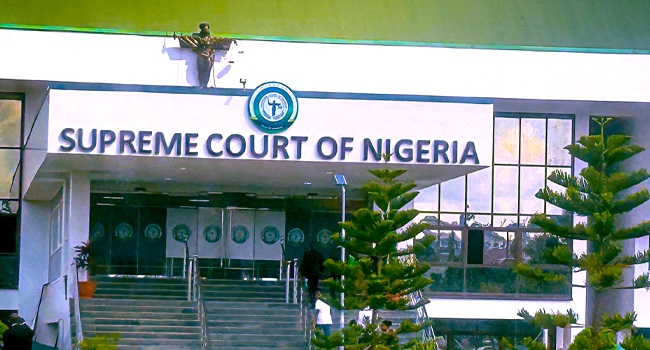
The Supreme Court of Nigeria has set aside an order by the Court of Appeal freezing the assets of prominent oil companies Neconde Energy Limited and Nestoil Limited, along with those of their principal promoters.
A five-member panel of the apex court, in a decision delivered on Monday in Abuja, held that the Court of Appeal overreached its authority by granting an ex parte (without notice) injunction against the companies when the matter was not properly before it.
Presiding Justice Stephen Adah sharply criticized the appellate court, stating that it “assumed jurisdiction and granted an injunction against Neconde and Nestoil when the dispute was not properly before the court.”
The Supreme Court further rebuked the lower court for what it described as a misuse of the judicial process, particularly in granting a stay of proceedings at the Federal High Court in Lagos.
The high-stakes dispute revolves around efforts by FBN Quest Merchant Bank and First Trustees Limited to recover a colossal debt allegedly owed by the two oil firms and their promoters, businessmen Azudialu Obiejesi and Nnenna Azudialu-Obiejesi, put at over $1 billion and N430 billion.
As part of the aggressive recovery drive, the financial institutions appointed Abubakar Sulu-Gambari as receiver/manager over Nestoil and Neconde. Justice Deinde Dipeolu of the Federal High Court, Lagos, subsequently issued a far-reaching Mareva injunction, freezing the companies’ accounts and shareholdings in more than 20 financial and corporate institutions nationwide. Security agencies were also directed to assist in enforcing the receivership.
The order gave the receiver sweeping powers, including taking possession of Nestoil’s headquarters and other assets and assuming control of Neconde’s operating interest in Oil Mining Lease (OML) 42, a joint venture with the Nigerian National Petroleum Company Limited (NNPC Ltd.). The receiver indeed took physical possession of Nestoil’s head office on 22 October 2025.
However, the process soon became mired in controversy. Citing allegations of bias and misconduct, the Chief Judge of the Federal High Court, Justice John Tsoho, reassigned the case to another judge. On 20 November 2025, the new judge, Justice J. Osiagor, revoked the earlier receivership enforcement order, dealing a temporary setback to the banks.
FBN Quest and First Trustees promptly appealed the decision on 22 November 2025. Just a week later, on 29 November, the Court of Appeal, in a ruling by Justice Yargata Nimpar, granted a restorative injunction on an ex parte application by the banks.
The order reversed Justice Osiagor’s decision and restrained Nestoil, Neconde, and their agents from interfering with the receiver/manager pending the hearing of the substantive appeal.
The matter eventually reached the Supreme Court, which on 12 January directed all parties to return to the Court of Appeal to first resolve a critical procedural issue concerning legal representation.
On 23 January, the appellate court disqualified senior lawyers Wole Olanipekun (SAN), Muiz Banire (SAN), and others from representing Neconde and Nestoil. It ruled that the receivership had effectively suspended the powers of Mr. Azudialu-Obiejesi, meaning he could no longer authorize legal representation for the companies.
Monday’s Supreme Court decision represents a major victory for Neconde and Nestoil, at least on procedural grounds, by nullifying the Court of Appeal’s asset-freezing order. Legal analysts say the ruling highlights the apex court’s insistence on strict adherence to due process and jurisdictional boundaries, even in complex, high-value commercial litigation involving the oil and gas sector.
The case, which has far-reaching implications for corporate governance, debt recovery mechanisms, and the stability of Nigeria’s upstream oil industry, is expected to return to the lower courts for further hearing on its merits.
Both the financial institutions and the oil companies have yet to issue official statements following the Supreme Court’s intervention.
This protracted legal battle continues to shine a spotlight on the intersection of big finance, judicial oversight, and Nigeria’s strategic energy assets.
WHAT YOU SHOULD KNOW
The Supreme Court of Nigeria delivered a strong affirmation of judicial restraint by setting aside the Court of Appeal’s ex parte asset-freezing order against Neconde Energy and Nestoil Limited.
The appellate court exceeded its jurisdiction and misused the judicial process by granting an injunction when the matter was not properly before it.