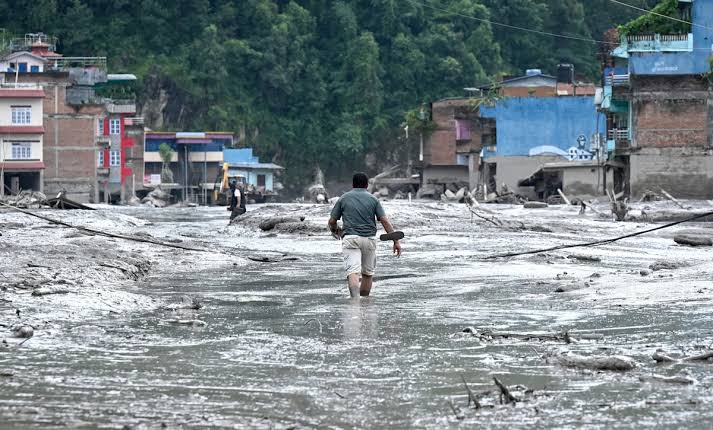
The death toll from this week’s Nepal flash flood has risen to at least 472, officials say, after a second glacial dam burst in Tibet on Friday, forcing rescue teams to retreat to higher ground.
The disaster, now the deadliest to strike Nepal since the 2015 earthquake that killed nearly 9,000 people, began Wednesday when a glacier collapsed high in the Himalayas, unleashing a churning wall of ice, mud, and debris down the Trishuli valley.
The US Geological Survey has identified the trigger as a glacial lake outburst, a phenomenon scientists have long warned would become more frequent as warming temperatures destabilize high-altitude ice formations.
What makes this disaster particularly dangerous, even now, is that the debris flow didn’t simply pass through and dissipate. It dammed itself as it moved, creating unstable pools of meltwater and sediment behind natural barriers of rubble and ice.
One of those barriers gave way early Friday on the Tibetan side, sending a fresh surge toward Gyirong, the hardest-hit area in the region.
Chinese state broadcaster CCTV reported that rescue teams already in the field were ordered to withdraw a full kilometer as the overflow advanced, and Nepali police issued an urgent directive for all rescuers along the border to reach safety immediately.
The scale of the humanitarian crisis is still coming into focus. More than 1,400 people remain unaccounted for on the Nepali side alone, a list that includes trekkers who were deep in the mountains when the flood hit and Hindu pilgrims making the journey to Mount Kailash, the sacred peak revered across Hinduism, Buddhism, Jainism, and the Bön faith.
Among them are 517 foreign tourists; Indian nationals make up the largest single group, followed by dozens of Americans still out of contact.
Perhaps the most harrowing rescue effort is unfolding at the Trishuli 3A hydropower project, where more than 100 workers remain trapped inside a tunnel system the flood sealed off.
Military helicopters have been deployed, but officers on the ground say they’re struggling even to pinpoint the tunnel’s entry points beneath the debris. Roughly 350 people connected to the site have already been pulled to safety.
Survivor accounts paint a picture of a disaster that gave almost no warning. One dam worker, who escaped only because he happened to be inside a tunnel when the water hit, described watching colleagues on the opposite bank get swept away in an instant by men he had been working alongside moments earlier.
At a hospital serving displaced families, the anguish is palpable. Mothers wait for word on missing sons. One woman said she’d lost three homes and cared for nothing but her missing child’s safe return.
Across the border, information remains far scarcer. Tibet is largely closed to foreign press, leaving Chinese state media as the primary source on conditions there, where officials report three confirmed deaths but hundreds still missing.
Authorities say they’ve evacuated more than 1,000 stranded tourists and residents from the region.
President Xi Jinping convened senior officials Friday to address the crisis, with state media quoting leadership warnings about the compounding dangers posed by unstable glaciers and ice-dammed lakes throughout the area, an acknowledgment that the danger to rescuers is far from over.
Meanwhile, downstream in India, authorities have recovered seven bodies from rivers believed to be carrying flood victims from Nepal, a grim signal that the disaster’s toll may extend beyond the two countries’ shared border.
For families like that of the Malaysian pilgrimage group of 17 travelers whose last known contact placed them heading toward the border crossing Wednesday morning, just before the flood struck, the coming days will be defined by an agonizing wait for news, as rescue teams weigh the risk of further collapse against the urgency of finding those still missing.
WHAT YOU SHOULD KNOW
This disaster is not over. A glacial lake outburst has already killed at least 472 people across Nepal and Tibet, but the debris it left behind formed unstable dams that are still bursting, forcing rescuers to retreat mid-search and leaving over 1,400 people, including trapped hydropower workers and Himalayan pilgrims, still unaccounted for.
Rescue operations are being actively hampered by secondary flooding risk, meaning the death toll is likely to rise before it stabilizes, and warming-driven glacial instability makes this kind of cascading disaster more likely to recur.