Peter Obi’s recent exit from the African Democratic Congress amid unresolved internal disputes appears to have led him into fresh political uncertainty, following emerging legal concerns within his new political platform, the Nigerian Democratic Congress.
The controversy centres on Barrister Reuben Egwuaba, who is alleged to be occupying the position of National Legal Adviser in both the NDC and the Allied Peoples Movement.
The development has sparked legal scrutiny and raised questions about possible violations of Nigeria’s electoral laws.
The issue comes at a particularly sensitive time for Obi and former Kano State governor Rabiu Musa Kwankwaso, who recently joined the NDC after distancing themselves from the ADC over prolonged legal and structural disagreements.
Their move had been widely viewed as an attempt to find a more stable political platform ahead of the 2027 general elections.
However, the latest controversy now casts uncertainty over the legal standing of the NDC itself.
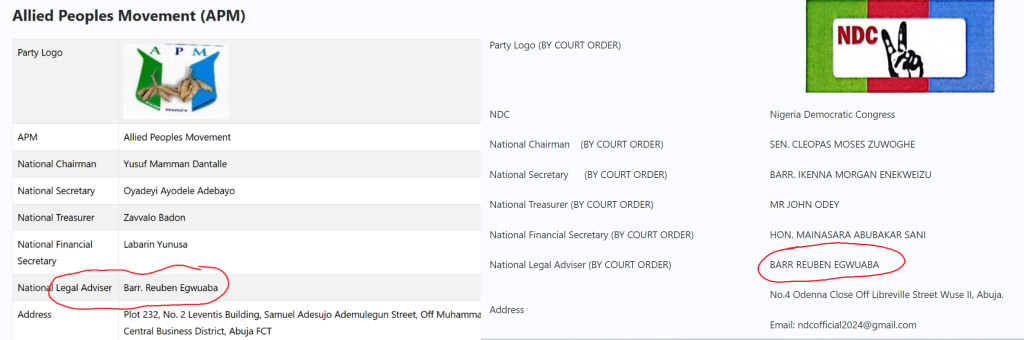
According to documents cited by Verily News and reportedly verified through records on the portal of the Independent National Electoral Commission, Egwuaba is listed as National Legal Adviser in both parties.
Legal analysts say if confirmed, such an arrangement could amount to a breach of Nigeria’s Electoral Act.
Though the alleged infraction directly concerns Egwuaba, observers note that the implications could extend to key political actors associated with the affected parties, including Obi and other recent entrants.
Under Nigeria’s electoral framework, strict compliance with statutory provisions is essential for the legitimacy of party actions and internal decision-making processes.
Reacting to the development, activist Julius Aondowase described the situation as a serious legal contradiction.
He rejected suggestions that the matter could merely be the result of administrative error.
According to him, the amended provisions of Section 77 of the Electoral Act prohibit dual party membership and prescribe sanctions including fines of up to ₦10 million, imprisonment of up to two years, or both.
He stressed that the role of National Legal Adviser is a critical position within a party’s National Executive Committee and cannot legally be held in two political parties simultaneously.
“The position cannot be held in two parties simultaneously without violating the law. This is prima facie evidence of dual membership and potentially a criminal offence,” Aondowase said.
He called on INEC and relevant authorities to urgently investigate the matter.

The legal concerns are not limited to the NDC.
The controversy has also drawn attention to Bauchi State Governor Bala Mohammed, who recently aligned with the APM, placing his political camp under similar scrutiny.
For Obi, the development presents an uncomfortable repeat of recent political instability.
His departure from the ADC was largely attributed to unresolved legal disputes and internal wrangling.
Now, his new political platform is facing questions that could once again test its institutional credibility.
As of the time of filing this report, neither the NDC nor the APM has issued an official statement clarifying the allegations.
The silence has further fuelled speculation and concern among political observers.
The unfolding situation underscores the increasingly litigated nature of Nigeria’s political space, where party stability often depends as much on legal compliance as on political strength.
What You Should Know
This controversy highlights the legal complexities shaping Nigeria’s opposition politics ahead of 2027.
Under Nigerian electoral law, political parties are expected to maintain strict organisational compliance, especially regarding official appointments. If the dual-office allegation is confirmed, it could expose both parties to legal challenges and weaken their political credibility.
For Peter Obi, who recently left the ADC over similar structural concerns, the development raises questions about strategic political alignment.
In Nigeria’s evolving electoral landscape, legal stability is becoming just as important as grassroots popularity for parties hoping to remain viable.