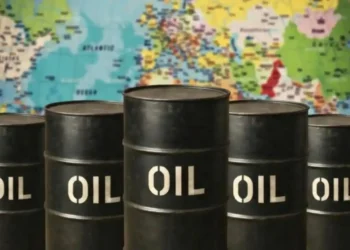
Oil markets opened the week on a cautious but firm footing Monday, with crude prices edging higher as the absence of a U.S.-Iran peace deal continued to strangle supplies through one of the world’s most critical energy corridors.
Brent crude futures climbed 67 cents, or 0.6%, to $108.84 a barrel by 04:00 GMT, clawing back some ground after a bruising $2.23 decline on Friday. U.S. West Texas Intermediate mirrored the move, rising 65 cents to $102.59 a barrel itself, recovering from a steep $3.13 loss at the close of last week’s trading.
Both benchmarks have now held the psychologically significant $100-a-barrel threshold for several consecutive sessions, a floor that analysts say reflects the raw anxiety gripping energy markets.
At the heart of the market’s unease lies the Strait of Hormuz, the narrow Persian Gulf chokepoint through which roughly a fifth of the world’s oil passes daily. The ongoing conflict involving Iran has severely disrupted shipping through the waterway, effectively removing meaningful volumes of crude from global markets and keeping traders on edge.
President Donald Trump confirmed over the weekend that the United States would deploy resources to assist vessels stranded in the Strait, a move that offered brief relief to rattled markets.
But the gesture did little to alter the fundamental calculus: without a ceasefire or a formal peace agreement, the disruption remains very much alive and so does the premium baked into every barrel of crude.
“The broader market remains tightly supported by persistent supply disruptions and geopolitical uncertainty,” said Priyanka Sachdeva, senior analyst at Phillip Nova. “Unless there is a clear and sustained resolution that restores normal flows through the Strait of Hormuz, oil prices are likely to remain elevated, with risks still tilted toward further upside.”
U.S.-Iran negotiations resumed over the weekend, with diplomats on both sides carefully parsing each other’s latest positions. The Trump administration has made securing a nuclear agreement with Tehran a cornerstone of its Middle East policy, a deal that, if struck, could theoretically unlock sanctioned Iranian oil and ease the supply crunch.
But the path to any such deal is littered with obstacles. Tehran has signaled it wants rival blockades on Gulf shipping lifted before it will engage seriously on nuclear issues—a sequencing demand that Washington has so far resisted. The result is a diplomatic standoff that is costing the world economy dearly at the pump, the port, and the factory floor.
Senior administration officials declined to offer a firm timeline for a resolution, and markets appear to have taken the hint: traders are not pricing in a near-term breakthrough.
In a bid to cool prices and demonstrate market stewardship, the Organization of the Petroleum Exporting Countries and its allies, the powerful OPEC+ coalition, announced Sunday that it would raise collective output targets by 188,000 barrels per day in June.
The decision marks the third consecutive monthly production increase. It matches the output hike agreed to for May, adjusted to account for the United Arab Emirates’ formal departure from the group on May 1.
On the surface, the announcement suggests that OPEC+ is willing to open the taps. In practice, however, energy analysts were quick to temper expectations.
As long as the Iran conflict continues to disrupt Gulf oil infrastructure and hamper exports through the Strait of Hormuz, the additional barrels are expected to remain largely theoretical, pledged on paper but physically unreachable by tankers too imperiled to navigate the contested waterway. The gap between declared output capacity and what actually reaches global refineries could remain wide for weeks, if not months.
With diplomacy stalled, shipping constrained, and OPEC+’s output boost facing real-world limitations, the outlook for oil prices in the near term tilts decidedly upward.
Commodity desks across Wall Street and the City of London are watching three variables above all others: the pace of U.S.-Iran negotiations, the security situation in the Strait of Hormuz, and any signs that major consuming nations, particularly the United States, China, and members of the European Union, may tap strategic petroleum reserves in a coordinated effort to stabilize markets.
For now, though, the market’s message is unambiguous. Until the guns fall silent and the tankers move freely, the world will continue to pay a steep price for oil, and the meter is still running.
WHAT YOU SHOULD KNOW
Oil prices remain stubbornly above $100 a barrel, and one factor explains it all: the Strait of Hormuz is effectively closed for business.
Until the U.S.-Iran conflict is resolved and tankers can move freely through that critical waterway, no amount of diplomatic maneuvering or OPEC+ output pledges will meaningfully bring prices down.
The additional barrels OPEC+ promised exist only on paper, and peace talks remain deadlocked. For consumers and economies worldwide, the painful reality is simple — oil stays expensive as long as the war continues.