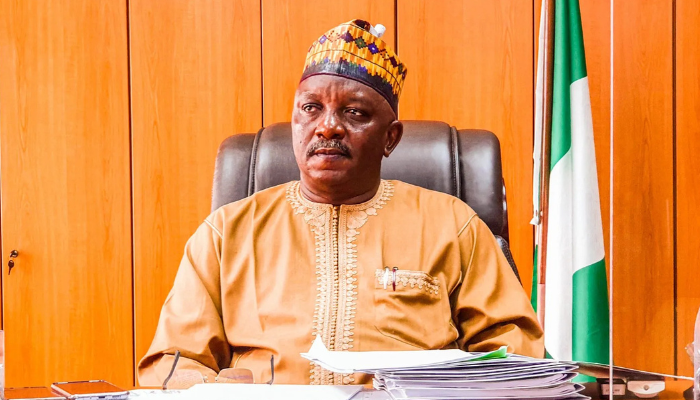
A Federal High Court in Abuja on Thursday convicted former Minister of Power, Mr Saleh Mamman, on 12 counts bordering on fraud and money laundering brought against him by the Economic and Financial Crimes Commission (EFCC).
Delivering judgment, Justice James Omotosho held that the anti-graft agency had successfully proven its case beyond reasonable doubt, leading to Mamman’s conviction on all charges contained in case number FHC/ABJ/CR/273/2024.
Mamman, who served under former President Muhammadu Buhari’s administration, was found guilty of unlawfully diverting public funds amounting to approximately ₦33.8 billion.
The court established that the former minister made a cash payment of $655,700, equivalent to about ₦200 million, for the purchase of landed property in Abuja without passing through any financial institution, contrary to financial regulations.
He was also convicted for criminal breach of trust linked to federal government funds allocated for the Mambilla and Zungeru Hydroelectric Power Plant projects.
According to the court, a substantial portion of the diverted funds was moved through Bureau de Change operators, who converted the money into foreign currencies before handing it over to the defendant.
Justice Omotosho, while delivering the verdict, said the prosecution had presented compelling evidence against Mamman.
“The evidence of the prosecution is overwhelming as against the scanty and almost absent defence of the defendant.
“The defendant did not offer any credible evidence to rebut the prosecution’s case,” the judge ruled.
The judge further criticised Mamman’s handling of public office, stating that rather than making a meaningful contribution to solving Nigeria’s power challenges, he prioritised personal enrichment.
“Rather than creating a legacy to tackle the epileptic power supply in the country, the defendant was living large at the expense of ordinary citizens.
“Little wonder that Nigerians have remained in darkness till today,” Justice Omotosho added.
Mamman was absent from court during the delivery of judgment.
As a result, the court postponed sentencing, while the EFCC requested that a warrant of arrest be issued against him.
Counsel to the defendant, Mr Mohammed Ahmed, informed the court that Mamman’s whereabouts had been unknown since Tuesday when notice of the judgment date was issued.
According to him, the defendant’s personal assistant later claimed that he was unwell.
Attempts by the defence team to secure a postponement of the judgment were rejected by the court.
Justice Omotosho referred to recent media reports suggesting Mamman had remained politically active and had purchased a governorship nomination form to contest the Taraba State election.
Counsel to the EFCC, Mr Rotimi Oyedepo, SAN, urged the court to proceed without delay.
“My Lord should go ahead. If the judgment is in his favour, we know what to do. If it is against him, we also know what to do,” he said.
Mamman was arrested in 2021, about four months after he was removed from office by former President Buhari.
During the trial, the EFCC presented 17 witnesses and tendered 43 exhibits to support its allegations.
The anti-graft agency had accused him of conspiring with ministry officials to divert about ₦22 billion meant for the Zungeru and Mambilla hydroelectric projects.
Investigators also alleged that the diverted funds were used to acquire high-value assets both within Nigeria and abroad.
What You Should Know
Saleh Mamman’s conviction marks one of the most significant anti-corruption rulings involving a former cabinet member in recent years.
The case centred on alleged diversion of billions of naira meant for critical electricity infrastructure projects, including Mambilla and Zungeru. His conviction highlights renewed judicial scrutiny of public office holders accused of financial misconduct.
The court’s strong remarks on Nigeria’s persistent electricity crisis also underscore public frustration over failed power sector reforms.
With sentencing pending and his absence raising fresh questions, the case may become a major reference point in future anti-corruption prosecutions involving high-ranking government officials.