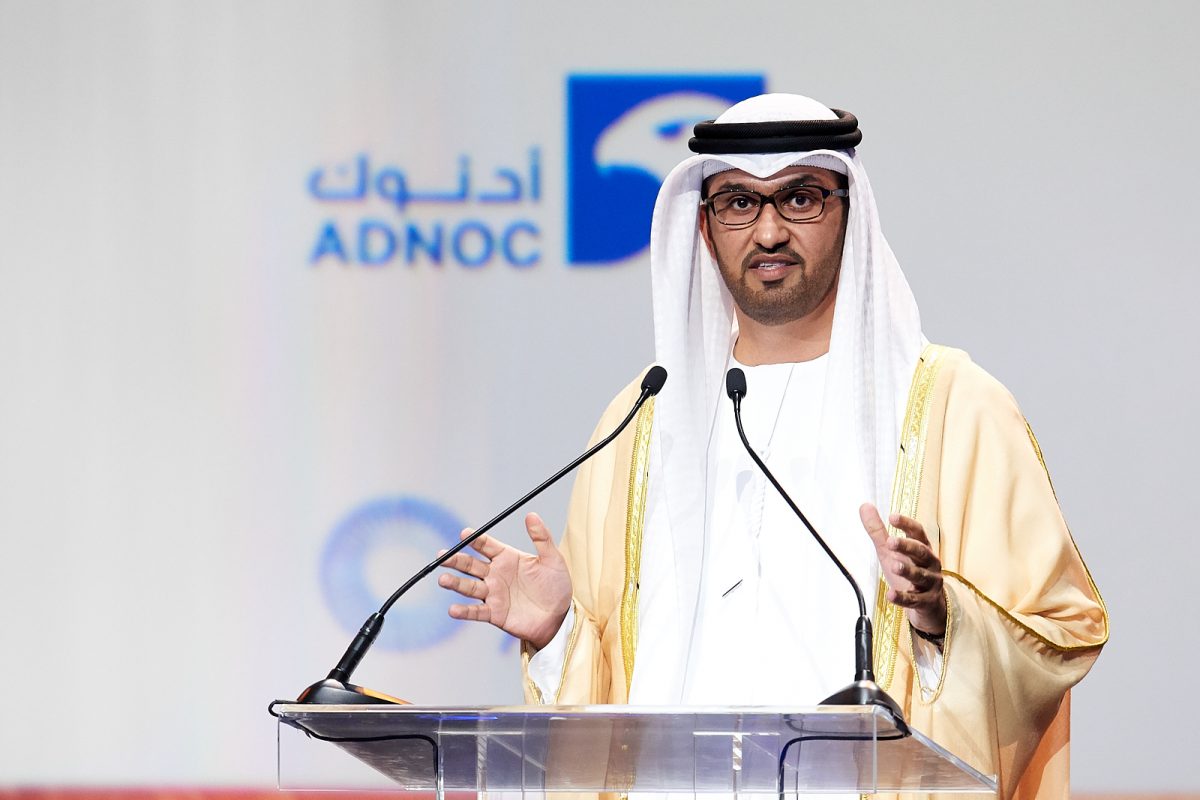
Dr. Sultan Ahmed Al Jaber, the CEO of Abu Dhabi National Oil Company (ADNOC) and UAE Minister of Industry and Advanced Technology, declared that the Strait of Hormuz has “never been Iran’s to close or restrict the navigation through.”
Al Jaber’s statement comes amid escalating tensions in the Gulf, where disruptions since late February have already triggered attacks on shipping, loss of life at sea, and widespread delays in one of the world’s most critical energy arteries.
In his post on X (formerly Twitter), Al Jaber laid out the grim toll of the ongoing crisis: at least 22 ships attacked, 10 crew members killed, around 20,000 seafarers unable to transit safely, and an estimated 800 commercial vessels stranded—including nearly 400 tankers.
He framed any attempt to interfere with the strait not as a localized dispute but as “the disruption of a global economic lifeline and a direct threat to the energy, food, and health security of every nation.”
“Setting such a precedent is illegal, dangerous, and unacceptable,” Al Jaber warned. “The world simply cannot afford it and must not allow it.
The Strait of Hormuz, a narrow waterway between Iran and Oman connecting the Persian Gulf to the Arabian Sea, handles roughly one-fifth of global oil trade and significant volumes of liquefied natural gas. It is a natural passage — not a man-made canal — governed by international maritime law, principally the United Nations Convention on the Law of the Sea (UNCLOS), which guarantees transit rights for all nations.
Al Jaber has repeatedly emphasized this point in recent days, arguing in earlier LinkedIn posts that the strait “was not built, engineered, financed, or constructed by any state” and that conditional or restricted access amounts to coercion, not legitimate navigation.
His Sunday message on X builds on those earlier calls for the waterway to be reopened “fully, unconditionally, and without restriction,” underscoring that the UAE—a major oil producer and exporter whose own tankers and production have faced constraints—views the issue as existential for global stability.
The remarks arrive against a backdrop of heightened regional conflict involving Iran, the United States, Israel, and Gulf states. Disruptions escalated after February 28, with reports of Iranian forces or proxies targeting vessels, leading to a fragile ceasefire that has evidently failed to restore free passage.
Earlier this week, Al Jaber described the strait as still effectively closed despite diplomatic efforts, warning of tightening markets, rising prices, and compounding economic damage with every day of delay.
For ADNOC, the stakes are direct. The company has spoken of expanding production even while contending with damaged facilities and delayed cargoes. But Al Jaber’s intervention carries weight far beyond corporate interests: as a senior UAE official deeply embedded in both energy diplomacy and climate efforts (including his past role chairing COP28), his voice signals a unified Gulf position that freedom of navigation in Hormuz is non-negotiable.
Analysts note that prolonged interference could send shockwaves through energy markets, inflate shipping costs, disrupt supply chains for everything from fuel to fertilizers, and ultimately threaten food security in import-dependent nations across Asia, Europe, and beyond. Health supply lines could also suffer if pharmaceutical and medical goods face rerouting or delays.
Al Jaber’s language is uncompromising: this is not merely an Iranian-U.S. or Iranian-Gulf standoff. It is, in his view, an assault on the rules-based international order at sea — one that no responsible actor can tolerate.
Whether his call galvanizes diplomatic pressure, naval escorts, or broader international consensus remains to be seen. What is clear is that one of the Gulf’s most influential energy figures has drawn a firm red line: the Strait of Hormuz belongs to global commerce, not to any single nation’s leverage.
As vessels continue to idle and markets watch nervously, the world will be listening closely to whether this latest warning translates into concrete action to restore unimpeded flow through the chokepoint the planet cannot live without.
WHAT YOU SHOULD KNOW
Dr. Sultan Ahmed Al Jaber, the CEO of Abu Dhabi National Oil Company (ADNOC), said the Strait of Hormuz has never belonged to Iran to close or restrict—it is a vital international waterway essential for global energy, food, and health security. Any disruption sets a dangerous precedent that the world cannot afford and must not allow.
Freedom of navigation through the Strait must be restored fully, unconditionally, and immediately.