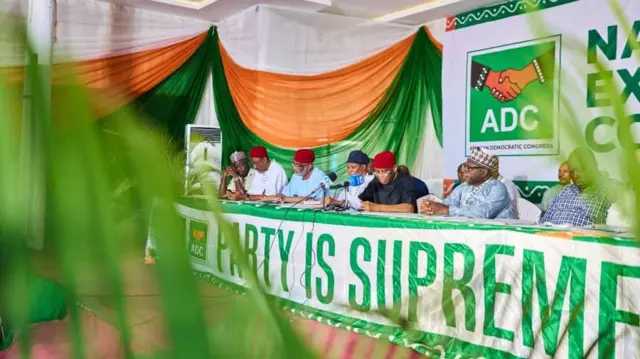
The African Democratic Congress (ADC) has declared its national convention valid, accusing the Independent National Electoral Commission (INEC) of failing in its legal responsibility by refusing to attend and monitor the exercise.
Speaking at the convention in Abuja, the party’s National Secretary, Rauf Aregbesola, defended the legitimacy of the process, insisting that all constitutional and legal requirements were met.

“The approval of the various committees proposed by the outgoing NWC to support the Caretaker Committee during the transition period; the swearing-in of the Caretaker Committee; and the new executives of the party were all administered the oath of office by competent authorities at that NEC,” he said.
Aregbesola maintained that decisions taken at a prior National Executive Committee meeting, including the dissolution of the former leadership, had already been communicated to INEC and acknowledged by the commission.
“The report of that NEC meeting was submitted to INEC by Chief Ralph Nwosu and Alhaji Baba Abdullahi. It was on this basis that INEC recognised the new leadership and uploaded the principal officers on its electronic portal,” he stated.
He further argued that the removal of the previous National Working Committee followed due process and remains binding.
“No member, I repeat, no member of the former NWC of the ADC therefore has any right or claim to any office thereafter. A dead horse cannot rise again,” Aregbesola said.
Turning to the legal aspect, he insisted that INEC had a mandatory obligation under the Electoral Act to monitor party conventions once properly notified.
“The duty of attending and monitoring congresses and conventions of political parties is a mandatory one imposed on INEC by the Electoral Act… it is mandatory and not discretionary,” he said.
According to him, the ADC fulfilled all requirements, including issuing the statutory 21-day notice and submitting necessary documentation ahead of time.
“The ADC gave INEC the required 21 days’ notice through a December 2025 letter. The last one was the one I gave, which was received by INEC on the 13th of March 2026,” he added.
Aregbesola described INEC’s absence as a serious breach.
“INEC’s failure to meet its lawful duty is hereby declared an abdication of responsibility and a breach of the law,” he said.
He went further to allege political bias, warning of broader implications for Nigeria’s democracy.
“The decision of INEC to refuse to attend and monitor our convention amounts to dereliction of duty, bordering on a dangerously partisan outlook aimed at unlawfully delegitimising the otherwise legitimate actions of our party,” he said.
“There is no other legitimate ground that INEC can rely on to refuse monitoring our convention, except if INEC is on a mission to destroy the ADC and pave the way for the APC to coast to victory without any serious challenge,” he added.
Aregbesola dismissed claims that a Court of Appeal ruling justified INEC’s stance, stating that the judgment did not prohibit the commission from monitoring ADC activities.
“I have read the order of the Court of Appeal. It did not make any reference to attending or monitoring ADC conventions,” he said.
He emphasised that the ADC remains a legally recognised political party with nationwide structures.
“The ADC remains a registered political party. It has not been proscribed by any law in Nigeria or by any court order,” he noted.
Beyond the legal dispute, Aregbesola warned against any drift toward a one-party system, stressing the importance of opposition in a democracy.
“Democracy without opposition is autocracy. Opposition is the institutional conscience of the republic. No coronation. No coronation in Nigeria,” he said.
He also called on the international community to monitor developments in Nigeria’s political space.
Away from the controversy, the party highlighted internal reforms, including relocation to a new national secretariat in Abuja, a constitutional review, and a nationwide membership drive launched in February 2026.
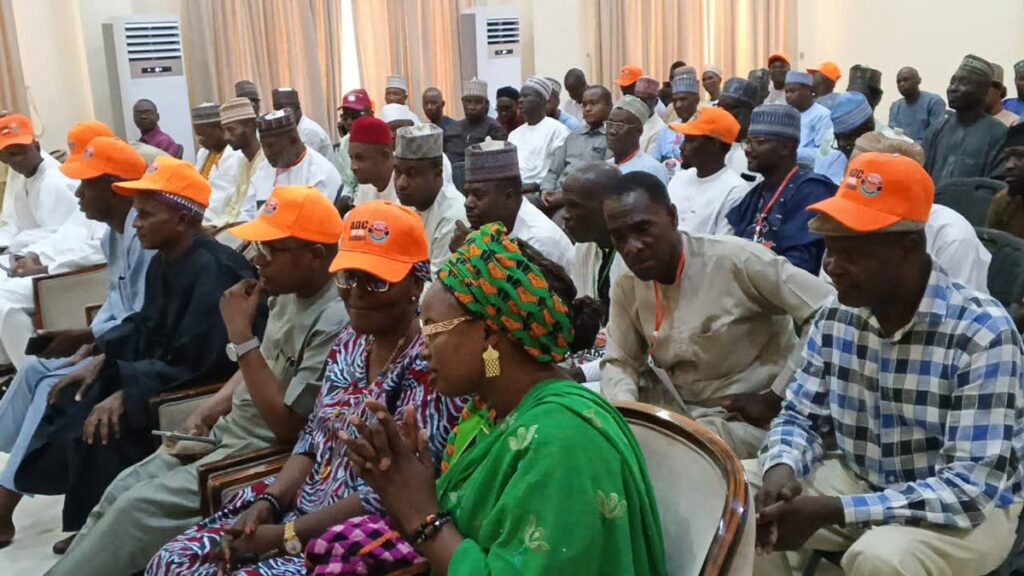
The ADC confirmed participation in recent elections, including the Anambra governorship poll and FCT area council elections, acknowledging losses but attributing them to incumbency advantages, monetisation, and internal challenges.
It also revealed ongoing consultations with other political parties such as the Peoples Democratic Party(PDP), the Social Democratic Party (SDP), and the New Nigeria Peoples Party (NNPP) ahead of the 2027 elections.
The convention, themed “A Nigeria that works for freedom, security and prosperity,” followed ward and local government congresses held on April 9 and state congresses on April 11.
Aregbesola urged party members to remain steadfast.
“It is time to stand up for principles, by the grace of God and with the support of the Nigerian people, we shall succeed,” he said.
What you should know
The ADC’s accusation against INEC highlights growing tensions between opposition parties and Nigeria’s electoral body.
At the core is a legal debate over whether INEC is obligated to monitor party conventions once notified. The issue is further complicated by ongoing leadership disputes within the ADC and conflicting court rulings.
Beyond the party, the situation raises broader concerns about electoral fairness, institutional neutrality, and the strength of opposition politics ahead of the 2027 elections.
How this dispute is resolved could significantly influence public confidence in Nigeria’s democratic process.