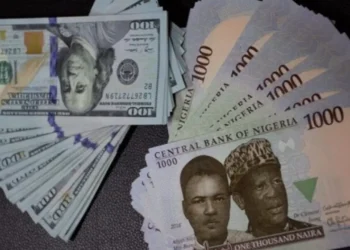
Nigeria’s total public debt hit N159.28 trillion at the end of December 2025, the Debt Management Office (DMO) confirmed on Tuesday, a stark sign of a government heavily dependent on borrowing.
The latest data, described by the DMO as provisional, marks a quarter-on-quarter rise of N5.98 trillion or 3.9% from the N153.29 trillion recorded at the end of September 2025.
More starkly, on a year-on-year basis, the debt stock has surged by N14.61 trillion, or 10.1%, up from N144.67 trillion in December 2024. Converted to dollar terms using the Central Bank of Nigeria’s official exchange rate of N1,435.2571 to the dollar, the country’s total public debt now stands at $110.97 billion, a jump of $16.75 billion from the $94.23 billion recorded a year earlier.
Nigeria’s domestic debt continues to bear the heaviest load, accounting for 53.27% of the country’s total debt portfolio. The domestic component rose from N81.82 trillion in September 2025 to N84.85 trillion in December 2025, a quarter-on-quarter increase of N3.03 trillion, or 3.7%. Year-on-year, the figure represents a sharper climb of N10.47 trillion, or 14.1%, compared to N74.38 trillion in December 2024.
In dollar terms, domestic debt rose from $55.47 billion at the end of the third quarter to $59.12 billion by year’s end and from $48.44 billion in December 2024—a trajectory that analysts say reflects the government’s deepening reliance on the local capital market to plug financing gaps.
The Federal Government remains the dominant borrower on the domestic front, accounting for N80.49 trillion, or 50.53%, of the country’s entire public debt stock. States and the Federal Capital Territory (FCT) together accounted for N4.36 trillion, a comparatively modest share that nonetheless underscores the widening fiscal pressures faced by subnational governments.
On the external side, Nigeria’s foreign debt stood at N74.43 trillion as of December 2025, representing 46.73% of total public debt. This reflects a quarter-on-quarter increase of N2.95 trillion from the N71.48 trillion recorded in September 2025 and a year-on-year rise of N4.14 trillion from N70.29 trillion in December 2024.
In dollar terms, external debt rose from $48.46 billion at the end of the third quarter to $51.86 billion by December—and from $45.78 billion a year earlier—reflecting not only new borrowings but also the complex interplay of exchange rate movements on the naira value of foreign obligations.
The federal government again dominates this segment, accounting for N66.27 trillion of total external debt, while states and the FCT contributed N8.16 trillion to the external liability pool.
Despite the consistent rise in the aggregate debt figure, the DMO noted that the structure of Nigeria’s debt portfolio remained broadly stable over the review period. Domestic debt accounted for 53.27% of total debt in December 2025, marginally down from 53.37% in September 2025, though up from 51.41% a year earlier.
Meanwhile, external debt held at 46.73%, compared to 46.63% in the preceding quarter and 48.59% in December 2024.
This relative stability in the debt composition may offer some comfort to fiscal watchers, suggesting that the government has not dramatically shifted its borrowing strategy.
However, economists warn that the sheer pace of debt accumulation, more than N14 trillion in a single year, demands urgent scrutiny of Nigeria’s debt sustainability framework, particularly as debt servicing costs continue to consume a disproportionate share of government revenues.
One technical nuance in the DMO’s data is the effect of the exchange rate on reported figures. The December 2025 numbers were converted at N1,435.2571 to the dollar, while the September 2025 figures used the then-prevailing rate of N1,474.85 to the dollar.
The slight appreciation of the naira over the period means that the naira-denominated value of external debt, when translated from dollar figures, is marginally lower than it might otherwise appear — a factor that observers say could be masking the true pace of external debt growth in local currency terms.
Nigeria’s rising debt profile comes against the backdrop of the federal government’s ambitious but fiscally demanding reform agenda, which has included the removal of petrol subsidies and a significant devaluation of the naira, both policies that, while widely regarded as necessary, have substantially increased the cost of governance and intensified pressure on the national budget.
With revenue generation still lagging behind expenditure commitments, the government has continued to turn to both local bond markets and multilateral and bilateral creditors abroad to bridge the gap.
The critical question now being asked in Abuja’s fiscal policy circles—and increasingly on the streets of Lagos and Kano—is not whether Nigeria is borrowing, but whether it is borrowing to grow or simply borrowing to survive.
The DMO is expected to release further details alongside a comprehensive debt sustainability analysis in the coming weeks. For now, the numbers offer a clear signal: Nigeria’s debt burden is growing, and the margin for fiscal error is narrowing.
WHAT YOU SHOULD KNOW
Nigeria’s public debt has hit a record N159.28 trillion ($110.97 billion) as of December 2025, a 10.1% jump in just one year. The federal government is the dominant borrower, driving growth on both the domestic and external fronts.
While the debt structure remains relatively stable, the pace of accumulation is the real alarm bell: Nigeria added over N14 trillion in debt in a single year, even as revenue generation continues to lag behind spending.
Until the government can close that revenue gap, borrowing will remain a crutch, and the burden on ordinary Nigerians will only deepen.