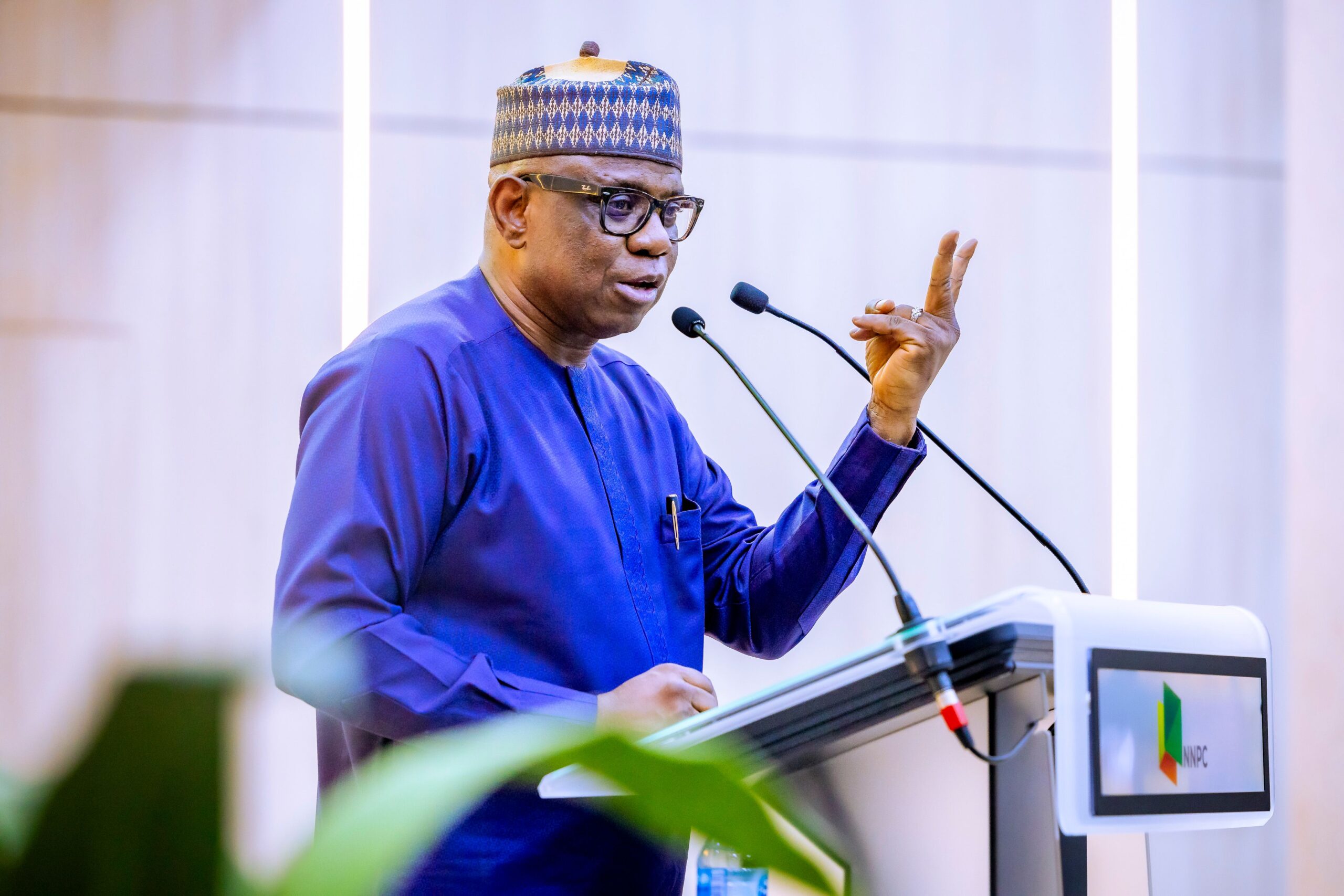
NNPC Ltd. CEO Bayo Ojulari says Nigeria’s oil and gas sector is done with promises—the next decade belongs to execution.
Speaking at the prestigious CERAWeek Leadership Dialogue, hosted by S&P Global in Houston, Texas, one of the world’s most closely watched gatherings of energy executives and investors, Ojulari struck a tone that was equal parts confident and candid—acknowledging Nigeria’s troubled past while making a forceful case for its transformed future.
“We have the resources, the market, and a more investible environment. What matters now is execution—delivering projects on time, on budget, and at performance,” he told the audience, in remarks that underscored a decisive shift in strategic posture at Africa’s largest national oil company.
The NNPC boss was unambiguous: Nigeria has crossed the threshold from legislating change to implementing it. Following the country’s landmark 2021 Petroleum Industry Act (PIA), which restructured NNPC from a government-funded bureaucracy into a commercially driven enterprise, Ojulari said the company has now firmly entered a new phase—one measured not by intent, but by results.
“NNPC’s evolution from a government-funded corporation into a competitive commercial enterprise is now firmly underway,” he said, adding that the company’s internal focus has shifted sharply toward measurable, verifiable outcomes.
To that end, he revealed that a comprehensive portfolio review has been completed and that relationships with some of the world’s most powerful oil majors—including ExxonMobil, Chevron, Shell, TotalEnergies, and ENI—have been deliberately reset. The goal, he explained, was straightforward: rebuild trust, resolve long-standing disputes, and unlock billions of dollars in stalled investment that had been frozen by years of uncertainty, regulatory opacity, and commercial friction.
The early signs, he suggested, are encouraging. Key projects are advancing toward final investment decisions, and the resolution of entrenched disputes is being read by the market as a credible signal that Nigeria is serious about its investment climate.
Perhaps the most strategically significant portion of Ojulari’s address concerned Nigeria’s pivot toward natural gas—a resource the country possesses in extraordinary abundance yet has historically struggled to monetize at scale.
Nigeria sits on more than 200 trillion cubic feet of proven gas reserves, making it one of the most gas-rich nations on earth. Yet for decades, weak fiscal frameworks, poor infrastructure, and unfavorable investment conditions meant that much of this wealth remained stranded underground, even as Nigeria imported refined fuel and grappled with chronic energy poverty at home.
Ojulari acknowledged those failures plainly but argued that the landscape has fundamentally changed. “Pricing transparency, accelerated infrastructure development, and improved project bankability are now the order of the day,” he said, as NNPC repositions gas as the centerpiece of Nigeria’s long-term energy strategy.
On the infrastructure front, he pointed to the Ajaokuta–Kaduna–Kano (AKK) pipeline—a flagship project designed to channel gas from the south into Nigeria’s industrial heartland in the north—as nearing completion, a development that would begin to close the longstanding disconnect between gas supply and industrial demand.
On a question that has long divided energy policymakers across resource-rich developing nations—whether to prioritize export revenues or domestic energy needs—Ojulari was refreshingly direct: Nigeria does not have to choose.
“It’s not a choice. We have enough resources to scale exports and meet domestic demand,” he said.
He noted that Nigeria LNG’s expansion program is ongoing, with Train 7 progressing and additional trains in the pipeline, positioning the country to grow its share of global LNG markets. Simultaneously, NNPC is driving domestic gas utilization through a parallel strategy anchored in industrial parks, gas-based industries, and power generation—sectors that, if properly supplied, could unlock a wave of economic activity that has long been constrained by Nigeria’s notorious energy deficit.
Ojulari also weighed in on what many observers consider the single most consequential development in Nigeria’s downstream sector in a generation—the 650,000-barrel-per-day Dangote Refinery, which has begun to alter the country’s import dependency in real time.
Describing the refinery as a “turning point,” he said its emergence is already helping to stabilize fuel supply, reduce the country’s historically expensive reliance on imported petroleum products, and create a reliable domestic outlet for locally produced crude—a combination that addresses several of Nigeria’s most persistent economic vulnerabilities simultaneously.
But Ojulari’s assessment went beyond the operational. He argued that the Dangote facility carries a broader symbolic and catalytic significance: it demonstrates, to a sometimes skeptical global investment community, that Nigeria is capable of delivering large-scale industrial projects to completion. That demonstration effect, he suggested, should catalyze further investment in Nigerian refining capacity and, in time, position the country as a net exporter of petroleum products within the African continent.
No address on Nigerian energy investment would be complete without confronting the elephant in the room—the decades of security challenges, oil theft, pipeline vandalism, and community conflict in the Niger Delta that have long suppressed production and spooked investors.
Ojulari did not sidestep the issue. He acknowledged Nigeria’s historical reliability problems openly but pointed to measurable improvements in the security landscape, particularly in the Niger Delta, where a closer working relationship between government forces and host communities has led to a sharp increase in pipeline availability.
He also underlined the structural importance of the PIA in providing the kind of regulatory certainty that long-term investors require. Crucially, the operational autonomy now granted to NNPC—allowing it to function as a genuinely commercial entity rather than an instrument of government patronage—means the company can sustain investor confidence across political cycles, insulating long-horizon projects from the volatility that has historically accompanied changes in government.
Stepping back, Ojulari’s Houston appearance amounted to a carefully calibrated message to global capital: Nigeria has done the hard work of reform, and the foundations are now in place. What remains — and what will ultimately determine whether this moment translates into lasting transformation — is the unglamorous, grinding work of project delivery.
For a country that has heard similar promises before, the burden of proof remains high. But in the corridors of CERAWeek, where investment decisions worth hundreds of billions of dollars take shape, Ojulari’s directness and his acknowledgement of past failures appeared to land with an audience that has grown weary of optimism unaccompanied by accountability.
Whether NNPC can convert that credibility into concrete capital flows will be the defining story of Nigeria’s energy sector for years to come.
WHAT YOU SHOULD KNOW
Nigeria’s NNPC, under CEO Bayo Ojulari, is sending a clear message to the world: the time for promises is over.
With sweeping reforms already in place, a reset relationship with global oil majors, vast gas reserves, and the Dangote Refinery reshaping the downstream sector and improving security in the Niger Delta, Nigeria has arguably never been better positioned to unlock its energy potential.
But positioning alone means nothing. Ojulari’s central point — and the one the world should hold Nigeria to — is simple: execution is everything now. The resources exist, the policies are in place, and the partners are re-engaging. What Nigeria owes itself, and its investors, is delivery. Not promises. Not potential. Results.