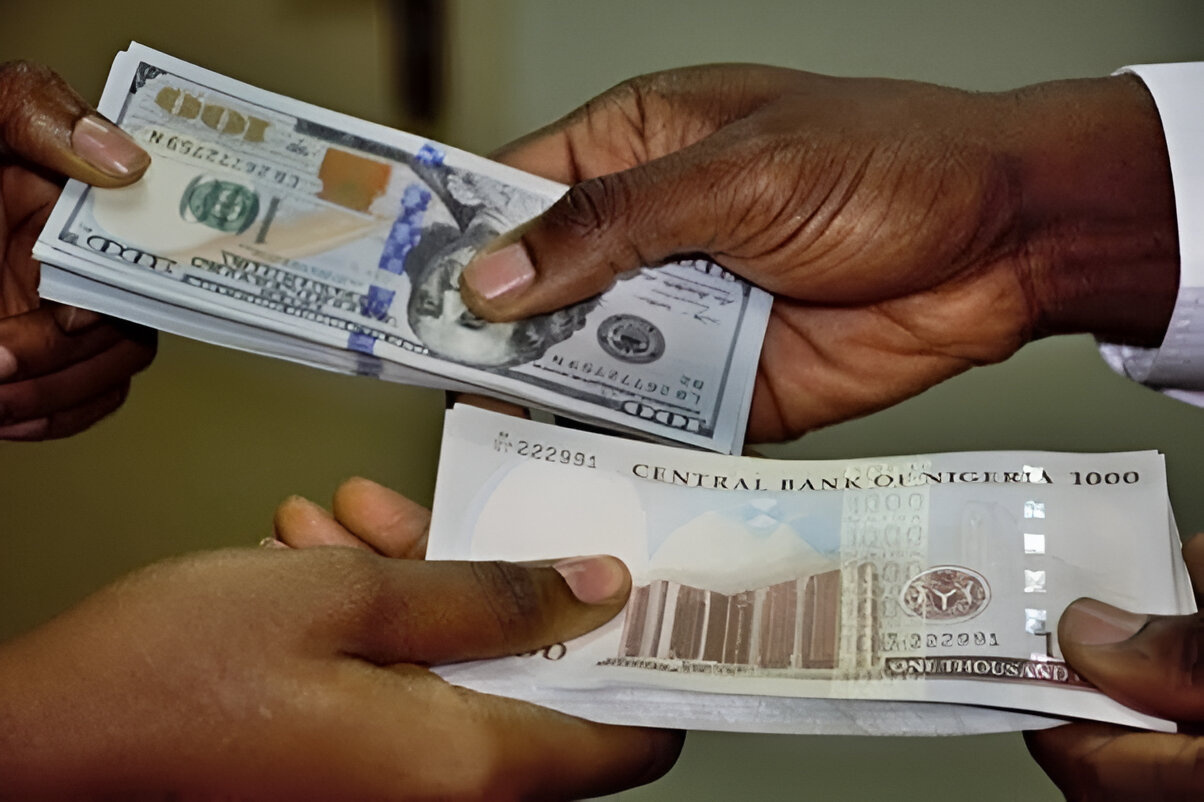
The naira gained slightly against the dollar on Thursday, steadied by a weakening greenback as optimism over a potential Iran-U.S. ceasefire shook global currency and commodity markets.
Data from the Central Bank of Nigeria (CBN) showed the naira appreciated to approximately ₦1,361 per dollar at the Nigerian Foreign Exchange Market (NFEM), a modest but notable improvement from the roughly ₦1,362 recorded in the previous session.
Trading activity also picked up, with the official market recording stronger turnover, a sign that liquidity conditions are gradually improving under the CBN’s sustained intervention framework.
Currency traders on Thursday pointed to the CBN’s ongoing policy measures as the bedrock of the naira’s relative stability. The apex bank has in recent months deployed a mix of liquidity-boosting tools and market-stabilizing interventions designed to tame the chronic volatility that has plagued the naira since the unification of exchange rates.
“The CBN’s consistency in managing liquidity is what is holding the naira at these levels,” one Lagos-based currency dealer said. “Without that, we’d be in a far more precarious position.”
Yet not all signals are benign. Analysts cautioned that structural demand pressures remain intense, with importers, businesses, and travelers continuing to jostle for scarce foreign currency.
While supply-side interventions have helped steady the rate, the underlying demand dynamic continues to pose a latent risk to the naira’s stability if CBN support were to waver.
The naira’s marginal gain coincided with a broader softening in the US dollar, as global markets responded with cautious optimism to signals that the Iran-U.S. conflict may be edging toward a negotiated resolution.
Tehran confirmed on Wednesday that it was reviewing a US peace proposal, one that, according to sources familiar with the matter, would formally end hostilities, though it stops short of resolving core American demands: the suspension of Iran’s nuclear program and the reopening of the Strait of Hormuz, a critical chokepoint for global oil shipments.
The mere prospect of de-escalation was enough to move markets decisively. Oil prices fell nearly 8% overnight, easing inflationary pressures and pulling US Treasury yields lower as investors scaled back expectations of Federal Reserve rate hikes. Brent crude futures, however, held firm at $101.89 per barrel on Thursday, a figure still well above pre-war levels, underscoring the fragility of the peace optimism.
The dollar index slid to as low as 97.902, hovering near a two-week trough and a considerable distance from the 99.092 peak recorded just last week, a dramatic swing that reflects just how heavily the conflict had been priced into currency markets.
The pullback in oil prices proved a particular tailwind for the euro. As a continent far more exposed to imported energy than the United States, Europe stood to benefit disproportionately from falling crude prices. The single currency rose 0.1% to $1.1757, having touched a two-week high of $1.1797 overnight.
The British pound held steady at $1.3594, a level that reflects a remarkable recovery; sterling has gained nearly 7% against the dollar since 2024, buoyed by improving UK economic sentiment and a weakening greenback.
Across the Pacific, the Australian dollar, a currency sensitive to global risk appetite and commodity cycles, inched higher to $0.7242, just a whisker below the four-year high it brushed on Wednesday. The Aussie’s resilience signals growing investor confidence in commodity-linked economies as oil market fears recede.
Perhaps the most dramatic currency move of the session unfolded in Asia, where Japan’s yen surged sharply, fueling intense speculation that Japanese authorities had intervened in the foreign exchange market to arrest a prolonged slide in their currency.
The dollar tumbled as low as 155.00 yen at one point on Wednesday, its strongest level against the dollar in ten weeks, before recovering to trade at 156.15 on Thursday.
Dealers remain on high alert after Japan’s top currency diplomat, Atsushi Mimura, pointedly noted that the country faced no restrictions on intervention — a statement widely interpreted in trading rooms as a veiled warning to speculators.
The yen’s trajectory is set to attract further high-level attention next week, when US Treasury Secretary Scott Bessent is scheduled to meet Japanese Prime Minister Sanae Takaichi.
The Nikkei newspaper reported that the two officials are expected to discuss, among other matters, measures to curb speculative yen selling — a conversation that could have significant implications for dollar-yen dynamics in the weeks ahead.
For Nigeria, the global FX narrative is not without relevance. A weaker dollar, lower oil prices, and easing global risk sentiment can influence capital flows into frontier markets and, by extension, demand dynamics in Nigeria’s own foreign exchange market.
While the naira’s Thursday gain was marginal, the confluence of global and domestic factors suggests that the currency’s near-term trajectory will remain closely tied both to the CBN’s policy resolve and to the rapidly evolving geopolitical landscape thousands of miles away.
WHAT YOU SHOULD KNOW
The naira posted a marginal gain on Thursday, buoyed by CBN liquidity policies and a broadly weaker dollar, the latter driven by cautious optimism over a potential Iran-U.S. ceasefire.
Globally, the yen’s dramatic surge and upcoming US-Japan talks on speculative trading add another layer of uncertainty to currency markets.
The naira is stable for now, but that stability remains fragile, resting on the twin pillars of CBN intervention and shifting geopolitical winds that could change direction at any moment.