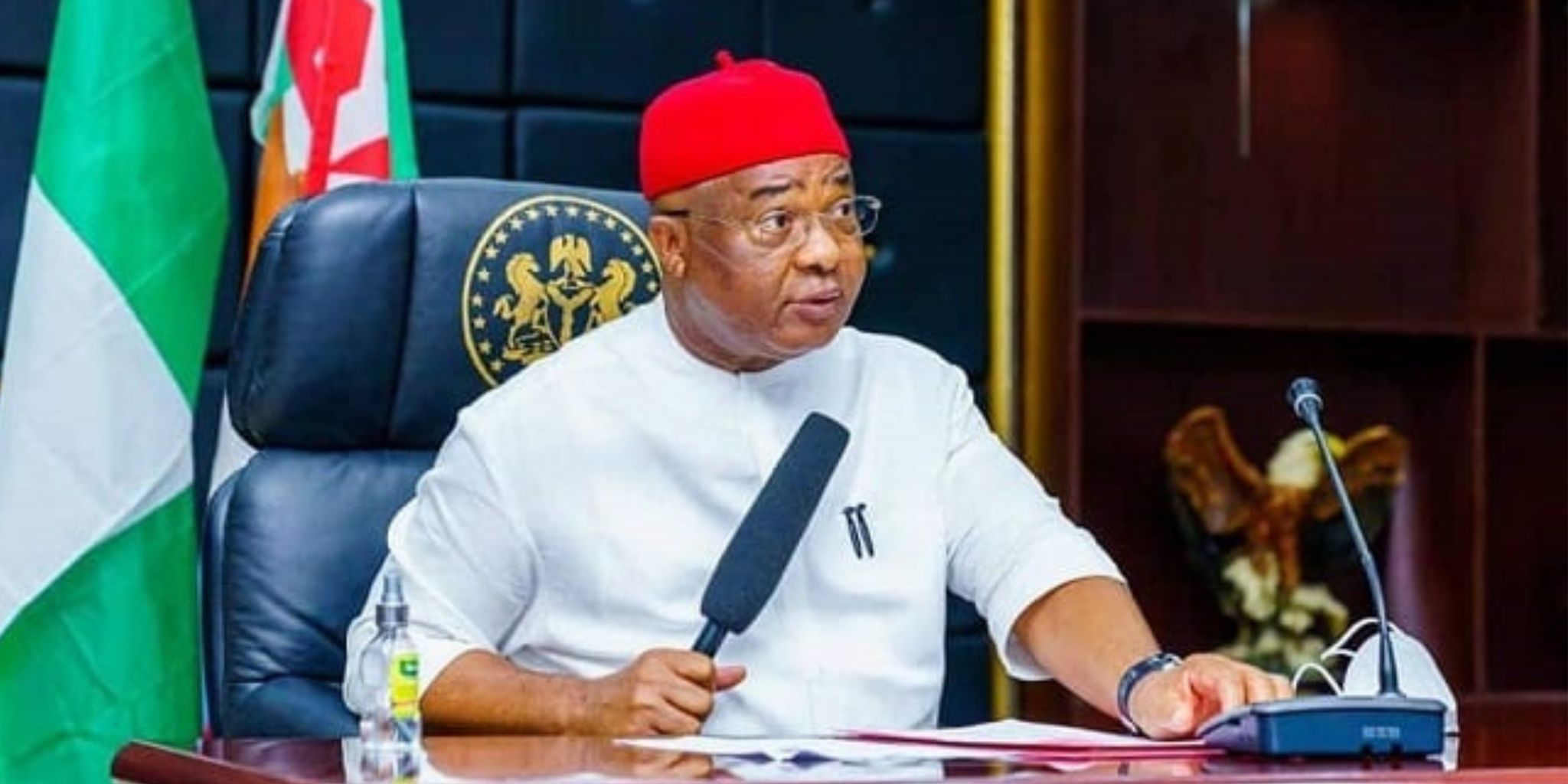
Imo State Governor Hope Uzodimma on Saturday threw his full weight behind President Bola Tinubu’s re-election bid, declaring that the president’s performance in office has more than justified a return to Aso Rock.
Uzodimma, speaking with characteristic assertiveness to a gathering of journalists after casting his participation in the All Progressives Congress (APC) presidential primary at his Omuma ward in Oru East Local Government Area, painted a picture of a party firing on all cylinders and a president, he argued, deserving of renewed public trust.
At the heart of the governor’s address was a striking claim that would raise eyebrows and spark debate in equal measure: that a staggering 35,000 party members had been registered in a single ward in Oru East Local Government Area alone, a figure he offered as evidence of an unprecedented groundswell of support for the APC and its national leader.
“If you look at what is happening at the grassroots and how the grassroots has been stimulated, starting from the membership registration, which was done electronically, to the validation of members, you can see 35,000 human beings in just one ward in Oru East Local Government Area,” Uzodimma told journalists, his tone measured but unmistakably triumphant.
The implications, he suggested, were mathematically decisive. “It means that if only our party members vote for President Bola Tinubu, he has already won the election,” he added.
Political analysts will likely scrutinize those numbers closely. Oru East, a predominantly rural local government area in Imo State, has a population that some demographers place well below what such a ward-level figure would suggest is proportionate.
Nevertheless, the governor remained unyielding in his assertion, presenting the turnout as organic proof of democratic vitality rather than political engineering.
Central to Uzodimma’s argument was the ruling party’s decision to conduct its membership registration and validation process electronically—a move he praised as transformative and forward-thinking.
In a political landscape where opposition parties have long accused the APC of relying on state machinery rather than genuine popular support, the governor framed the electronic exercise as a transparent and inclusive mechanism that has deepened democratic participation at the ward level.
“The APC’s electronic membership registration and validation process has strengthened grassroots participation and positioned the party strongly ahead of future elections,” he said, urging rival parties not to lament the APC’s dominance but to study and replicate its mobilization model.
In what observers might read as a rare moment of magnanimity or a subtle show of political confidence, Uzodimma extended an olive branch of sorts to the opposition, encouraging them to rise to the competitive challenge rather than retreat into grievance.
“Well, it is no longer a democracy if there is no opposition. I also encourage opposition parties to work hard and do what the ruling party has done. And when, by the grace of God, it becomes their turn, they will elect their own president,” he said.
Perhaps the most attention-grabbing remarks of the day came when Uzodimma offered an unsolicited scorecard on the state of Nigeria’s democracy. Deploying the kind of numerical precision more commonly associated with academic assessments than political endorsements, the governor declared that he would score Nigerian democracy at 90 percent and Imo State’s democratic performance at a perfect 100.
“I am particularly delighted that democracy is working in Nigeria. I can score democracy up to 90 per cent in Nigeria and up to 100 per cent in Imo State,” he said, a statement likely to invite both admiration from party faithful and sharp criticism from civil society groups and opposition voices who paint a vastly different portrait of democratic health in the country.
On the economy, arguably the most bruising battleground for the Tinubu administration, which has faced fierce public backlash over inflation, fuel subsidy removal, and the cost-of-living crisis, Uzodimma was equally bullish.
Dismissing the widespread hardship narrative that has defined much of the national conversation since 2023, the governor insisted that the President’s policy choices are already bearing fruit.
“Nigerians are excited and happy that President Bola Tinubu has done well. The outcome of his various policies has brought prosperity to Nigeria. Going forward, Nigeria shall see poverty no more,” he declared.
Saturday’s primary event, while largely ceremonial in nature, carried unmistakable symbolic weight. For Uzodimma and the wider APC establishment, it was an opportunity to demonstrate organizational muscle and project an air of inevitability around Tinubu’s second-term ambitions long before the formal campaign season begins.
With the 2027 elections still roughly two years away, the APC’s decision to begin mobilizing at the ward level this early signals a strategic seriousness that opposition parties, including the Peoples Democratic Party (PDP) and the Labour Party, which made significant inroads in 2023, will need to urgently match if they hope to mount a credible challenge.
Whether Uzodimma’s glowing assessment of Tinubu’s first term resonates beyond the walls of APC strongholds remains to be seen. For millions of Nigerians still grappling with the economic aftershocks of the subsidy removal and naira devaluation, the governor’s declaration that the country “shall see poverty no more” may sound more like political theater than policy reality.
But in the court of APC internal politics, Saturday’s proceedings in Oru East sent one message with unmistakable clarity: the machinery is running, the governor is firmly in the president’s corner, and the road to 2027 has already begun.
WHAT YOU SHOULD KNOW
Imo State Governor Hope Uzodimma’s effusive endorsement of President Tinubu for a second term, delivered against the backdrop of an APC primary exercise in his home ward, reveals less about the state of Nigeria’s democracy and more about the ruling party’s early and calculated march toward 2027.
The headline claim, 35,000 APC members registered in a single ward, is the number that demands the most scrutiny, as it forms the entire foundation of his argument that Tinubu’s re-election is already mathematically guaranteed.
His rosy assessment of the economy, scoring democracy at 90-100% and declaring that Nigeria “shall see poverty no more,” stands in sharp contrast to the daily economic reality facing millions of ordinary Nigerians.