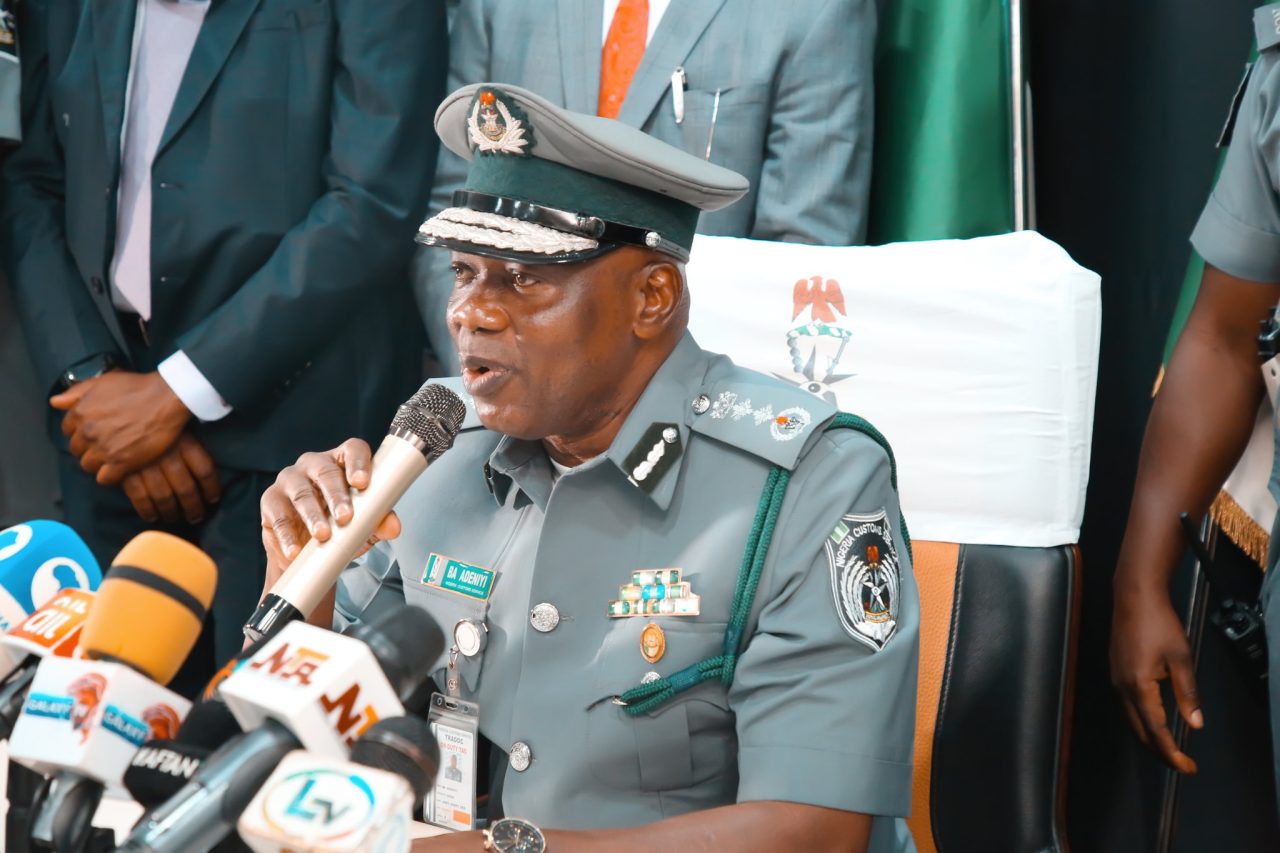
President Tinubu has extended Bashir Adewale Adeniyi’s tenure as Comptroller-General of the Nigeria Customs Service for the second time in under a year, keeping him in office until February 2027, a final extension, the presidency says.
The decision was announced on Friday, June 19, in a statement by the President’s Special Adviser on Information and Strategy, Bayo Onanuga, who said the additional six months would allow Adeniyi to consolidate the rollout of the National Single Window project and oversee a structured leadership transition within the service.
Adeniyi’s current term had been due to lapse on August 1, 2026, following a one-year extension Tinubu approved in July 2025.
That earlier extension had itself moved his exit date forward from an original expiry of August 31, 2025. With this latest approval, he will now remain at the helm of customs roughly three and a half years after first being appointed Comptroller-General in June 2023.
Unlike the earlier extensions, the presidency has explicitly framed this one as the last, signaling that succession planning is now a formal part of Adeniyi’s mandate rather than an afterthought.
According to the statement, he is expected to work hand-in-hand with the Nigeria Customs Service Board over the coming months to resolve outstanding personnel matters and shore up institutional continuity ahead of his departure.
Two specific tasks have been set for the transition window: pushing through the promotion of qualified officers to the rank of comptroller of customs and processing the retirement of officers who have either turned 60 or clocked 35 years in service, both routine but often delayed exercises in a paramilitary bureaucracy where leadership changes can stall personnel decisions for years.
The centerpiece of the extension, however, remains the National Single Window, a digital platform designed to fold the various government agencies involved in cross-border trade into one integrated system, cutting down the bureaucratic back-and-forth that has long slowed cargo clearance at Nigerian ports.
The project moved from blueprint to reality this year when its first phase went live on March 27, 2026, after being launched in March 2025. The presidency’s reasoning for the extension rests heavily on giving Adeniyi enough runway to bed the system in before a successor takes over.
Adeniyi is no outsider brought in to shake up Customs; his rise has been entirely internal. A graduate of Obafemi Awolowo University, he joined the service in the late 1980s and worked his way up to Deputy Comptroller in 2012, Comptroller in 2017, and Assistant Comptroller-General in 2020, a period during which he was also linked to a high-profile seizure of millions of dollars in cash being smuggled out through Lagos’s international airport.
He was named Acting Deputy Comptroller-General in January 2023 before Tinubu elevated him to the top job that June.
That institutional pedigree has likely shaped how the presidency frames his continued stay: less as a vote of no confidence in the bench of senior officers waiting behind him and more as a deliberate choice to let one administration finish what it started, particularly on trade facilitation reforms tied to Nigeria’s commitments under the African Continental Free Trade Area (AfCFTA).
Tenure extensions for heads of Nigerian security and revenue agencies are not unusual, but two in under twelve months for the same official invites scrutiny both of the pace of reform implementation and of succession bench strength within Customs.
Critics of repeated extensions typically argue they can blur lines of accountability and delay the promotion pipeline for officers next in line; the presidency’s own framing of this extension, built explicitly around clearing a promotion and retirement backlog, suggests an awareness of that critique.
For now, Adeniyi remains in charge of one of Nigeria’s most consequential revenue-generating agencies through the first quarter of 2027, with an explicit mandate to leave the National Single Window running and the leadership pipeline behind him in better shape than he found it.
WHAT YOU SHOULD KNOW
This is now officially Adeniyi’s last extension. President Tinubu has kept him as Customs Comptroller-General until February 2027, not to delay succession but to force it.
He has a fixed deadline to finish rolling out the National Single Window trade platform and to clear the promotion and retirement backlog so a successor inherits a settled house, not a stalled one.