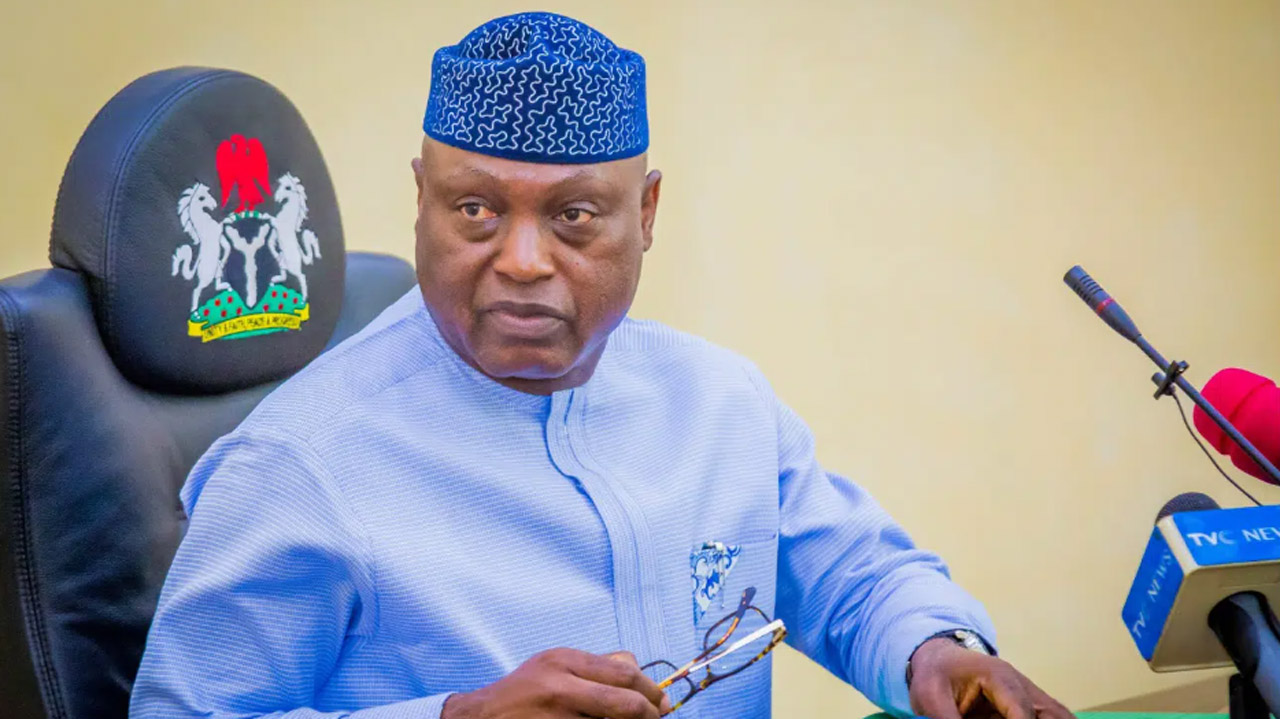
Governor Biodun Oyebanji has been returned for a second term as governor of Ekiti State after the Independent National Electoral Commission (INEC) declared him winner of Saturday’s keenly contested governorship election in the early hours of Sunday morning.
The declaration came from the Chief Returning Officer, Professor Adenike Oladiji, Vice-Chancellor of the Federal University of Technology, Akure, who announced the result at INEC’s collation centre in Ado-Ekiti at roughly 3 a.m. Oladiji declared that Oyebanji polled a total of 319,224 votes to defeat his closest rivals in the contest conducted across the state’s 16 local government areas.
His nearest challenger, Dr. Wole Oluyede of the Peoples Democratic Party, came a distant second with 40,543 votes, while Dare Bejide of the African Democratic Congress polled 12,872 votes to round out third place.
The APC’s dominance was comprehensive rather than narrow: Oyebanji won re-election by emerging victorious in all 16 local government areas of the state, with particularly strong showings recorded in Ado-Ekiti, Ekiti West, Irepodun/Ifelodun, Ikole and Ekiti East.
In his own backyard, Ekiti West, INEC’s local collation showed the governor scoring 28,258 votes against 3,644 for the PDP candidate and 674 for the ADC’s.
INEC’s broader figures painted a picture of moderate turnout in a high-stakes race. Of 988,251 registered voters in the state, only 384,940 were accredited to vote, and of the 382,109 ballots cast, 375,777 were ultimately ruled valid. Voting and collation took place across 2,445 polling units under heavy security deployment.
Beyond the numbers, the result carries unusual historical weight. Ekiti has a long-standing reputation for unseating incumbents, with governorship contests since 1999 frequently producing changes in leadership.
Oyebanji’s win, therefore, marks the first time an Ekiti governor has secured immediate, consecutive re-election while in office, a distinction even former governor Kayode Fayemi, who returned to the seat for a second spell in 2018, did not achieve, since his second term followed a gap out of power rather than a direct reelection.
Analysts had framed the contest as an early test of APC strength in the South-West ahead of the 2027 general elections, with Oyebanji campaigning chiefly on continuity and pointing to his first-term record on infrastructure, education, healthcare, agriculture, and investment.
Election observation group Yiaga Africa flagged concerns over the consistency of materials deployed by INEC, noting that court rulings affecting the PDP’s candidacy and late administrative changes after INEC’s initial January candidate list created the risk that presiding officers might record zero votes for parties that did not appear on ballots voters actually saw.
On the security front, however, the policing of the exercise drew a more reassuring assessment: the commissioner of police overseeing the election said no case of vote-buying had been reported to his agency.
Reaction from the ruling party was swift. APC collation agent Senator Cyril Fasuyi urged opposition candidates to put the state’s progress ahead of political rivalry following the announcement.
With the result now declared, attention is expected to turn to whether the PDP and ADC contest the outcome through tribunal challenges and to preparations for Oyebanji’s second-term inauguration in the months ahead.
WHAT YOU SHOULD KNOW
Governor Biodun Oyebanji’s re-election is significant less for the margin of victory than for what it represents: in a state where incumbents have historically struggled to hold power since 1999, he is the first Ekiti governor to win immediate, consecutive re-election.
With 319,224 votes and a clean sweep of all 16 local government areas, the result hands the APC a strong signal of South-West dominance heading into the 2027 general elections even as observer concerns over ballot consistency mean the outcome may still face scrutiny.