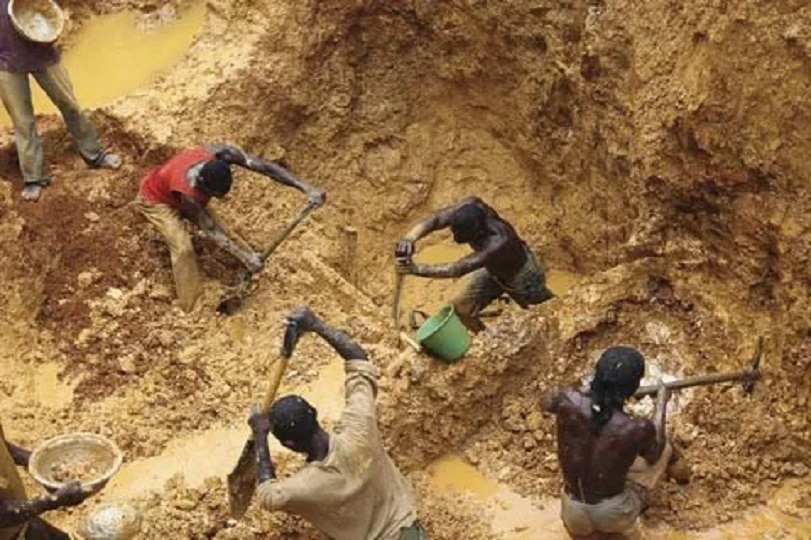
Nigeria’s mining and quarrying sector recorded its best-ever tax performance in 2025, contributing N723.33 billion in company income tax (CIT), a figure that has drawn wide attention across economic and policy circles.
Data released by the National Bureau of Statistics (NBS) shows the sector’s tax receipts climbed by more than 38 percent compared to the N520.34 billion recorded in 2024, cementing what many fiscal analysts are calling a meaningful, if fragile, inflection point for one of Nigeria’s most underutilised economic assets.
For decades, Nigeria’s mining sector has existed largely as an afterthought in the country’s economic conversation, overshadowed by oil revenues, underfunded by successive administrations, and plagued by illegal operations that have drained resources without contributing a single naira to the public purse.
The sector currently contributes less than five percent to Nigeria’s Gross Domestic Product, a figure that speaks volumes about the scale of underinvestment and policy neglect that has stunted its growth. The country sits atop vast deposits of solid minerals—gold, lithium, coal, tin, and limestone among them—yet has historically failed to translate that geological wealth into fiscal revenue.
The 2025 CIT figures suggest that this long-standing gap between potential and performance may finally be beginning to close.
The NBS data paints a picture of a sector that gathered momentum through the year before hitting an abrupt wall in the final quarter.
Collections opened at N142.87 billion in the first quarter, before rising sharply to N212.27 billion in Q2. The sector then peaked at N244.86 billion in Q3—its strongest single-quarter performance of the year—only to fall back steeply to N123.34 billion in Q4.
The contrast with 2024 is instructive. Last year’s quarterly collections stood at N80.92 billion, N170.73 billion, N169.14 billion, and N99.54 billion, respectively—showing growth across each corresponding quarter in 2025, but also revealing that the pattern of a weak final quarter is not entirely new.
Fiscal analysts say the Q4 decline warrants close attention. “You cannot read this data without asking what happened in the last three months,” one tax policy consultant familiar with the NBS figures told this reporter. “A drop of that magnitude, from the sector’s highest quarter to nearly half of it, raises questions about seasonality, compliance cycles, or whether there are structural constraints that kick in toward year-end.”
The surge in mining tax revenues does not exist in a policy vacuum. The numbers track closely with a sweeping legislative intervention by the administration of President Bola Ahmed Tinubu, who in June 2025 signed four landmark tax reform bills into law.
The legislation—comprising the Nigeria Tax Bill, the Nigeria Tax Administration Bill, the Nigeria Revenue Service (Establishment) Bill, and the Joint Revenue Board (Establishment) Bill—represents the most comprehensive overhaul of Nigeria’s tax architecture in a generation.
Central to the reforms, and particularly relevant to the mining sector, is the transfer of mineral royalty collection to the newly constituted Nigeria Revenue Service (NRS). The move is designed to close longstanding leakage points in the royalty collection chain and impose greater accountability on operators who have historically underreported output.
Analysts say the reform signals that the federal government is no longer content to leave money on the table. “What you are seeing in these CIT numbers is partly the effect of sharper regulatory attention,” noted a Lagos-based economist who tracks Nigeria’s extractive industries. “When operators know that royalty administration is being tightened, broader compliance tends to improve.”
The CIT figure tells only part of the story. Separate data shows that the Federal Government also generated N6.96 billion in mining fees in the first quarter of 2025 alone—a figure that, when annualized, suggests the sector’s total fiscal contribution is considerably larger than CIT receipts alone indicate.
Royalties, licensing fees, and other levies have historically been underutilized revenue streams within the mining sector. Their potential, if properly harnessed under the new NRS framework, could significantly expand the government’s non-oil revenue base—a goal that has taken on fresh urgency as Nigeria continues to navigate a challenging fiscal environment marked by subsidy removal pressures and foreign exchange volatility.
Despite the encouraging headline numbers, sector watchers are careful not to overstate the milestone. Illegal mining continues to deprive the government of substantial revenue, particularly in artisanal gold and gemstone operations across Zamfara, Osun, and other mineral-rich states.
Infrastructure deficits—from poor road access to mining sites to unreliable power supply—continue to raise operating costs and deter the scale of foreign investment the sector needs.
Weak incentive structures have also historically made it difficult to attract the kind of long-term capital commitment that would transform the sector from a marginal player into a genuine economic pillar.
“The N723 billion is good news, but it should be read as a floor, not a ceiling,” said one mineral resources consultant with experience across West Africa. “The real test is whether the regulatory and legislative reforms of 2025 translate into sustained compliance and new investment in 2026 and beyond.”
What the NBS data ultimately confirms is that Nigeria’s mining and quarrying sector is no longer simply a statistical footnote. Its growing contribution to the country’s revenue mix—in a year when oil receipts remained volatile and government finances came under sustained pressure—underscores the urgency of the ongoing push for economic diversification.
Whether the record 2025 performance represents a durable trend or a high-water mark shaped by one-off compliance improvements will become clearer in the quarters ahead.
For now, however, the numbers offer Nigeria’s policymakers something they have long sought in the solid minerals space: concrete evidence that reform, when pursued with consistency, can move the needle.
WHAT YOU SHOULD KNOW
Nigeria’s mining sector posted a record N723.33 billion in company income tax in 2025—a 38% jump from 2024—signaling that a long-overlooked sector is finally beginning to pull its fiscal weight.
The surge is largely driven by President Tinubu’s 2025 tax reform legislation, particularly the transfer of mineral royalty collection to the Nigeria Revenue Service, which has tightened compliance and reduced revenue leakages.
However, one number demands caution: Q4 collections collapsed to N123.34 billion from a Q3 peak of N244.86 billion—a sharp drop that exposes the sector’s underlying structural fragility.
Illegal mining, poor infrastructure, and weak investment incentives have not disappeared; they have simply been temporarily outpaced by improved tax administration.