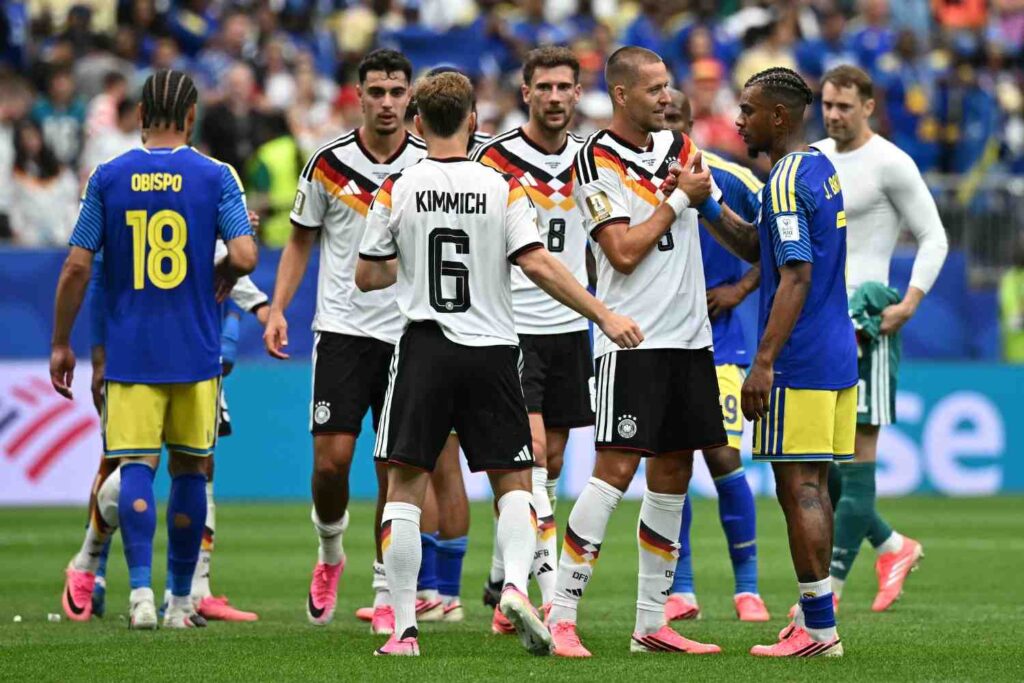
A decade after their last World Cup title, Germany made a thunderous comeback, crushing Curacao 7-1 in Houston, a scoreline hauntingly reminiscent of their famous 2014 semi-final rout of Brazil.
It was a performance that will send a warning shot across the tournament: the four-time world champions, long absent from the knockout rounds of a World Cup, are back, and they mean business.
From the first whistle, Julian Nagelsmann’s side looked sharp, purposeful, and hungry. Felix Nmecha, one of several players in this Germany squad who once wore the colors of England at the youth level, drew first blood in just the sixth minute, a moment of genuine quality that had even the coaching staff on their feet.
Receiving a delicate pass from the gifted Florian Wirtz, Nmecha shaped his body and curled an exquisite effort around a retreating Curacao defender and beyond goalkeeper Eloy Room. Nagelsmann, not typically one to show raw emotion, let out a roar that could be heard across the bench.
But just as Germany looked set to steamroll their opponents into submission, Curacao, making their very first appearance on the grandest stage of world football, found a moment of magic to silence the German faithful in Houston.
A speculative effort from Livano Comenencia took a wicked deflection and looped past the helpless Manuel Neuer, sending Blue Wave Curacao’s famously passionate supporter base into delirium.
For a brief, tantalizing moment, the script appeared to be writing itself: could the smallest nation at this World Cup be engineering one of its greatest ever upsets?
Dick Advocaat, the 78-year-old Curacao head coach and the oldest manager in World Cup finals history, leapt from his seat, arms raised, the image of a man who had dared to believe.
The drinks break could not have come at a better time for the Germans. In the huddle, heads were cleared, messages were delivered, and resolve was reinforced. Nathaniel Brown, the young fullback who would later etch his name into the history books, was among those who refused to allow the conceded goal to fester.
“The goal we conceded was unnecessary, but that’s part of it,” Brown said afterwards. “I’m proud that we didn’t let our heads drop.”
That resilience soon bore fruit. Nico Schlotterbeck, all power and presence, had a towering header brilliantly tipped over the crossbar by the impressive Room, a moment that underlined that Curacao’s goalkeeper, at least, was determined to fight to the last.
Yet the Curacao rearguard, so gallant and so spirited, finally cracked in the 38th minute. Schlotterbeck, unmarked at the back post from a corner, powered a header past Room for his maiden international goal, a moment of heartfelt celebration from the big Borussia Dortmund defender.
Germany went into half-time with a commanding two-goal cushion, Kai Havertz coolly converting from the penalty spot after Nmecha was cynically hauled down by Riechedly Bazoer. At 3-1, Curaçao’s fairytale was fading fast.
If the first half had been a contest, the second half was a coronation. Germany needed just 69 seconds after the restart to make it four, the mercurial Jamal Musiala, another product of England’s youth system, ghosting onto a perfectly weighted pass from Joshua Kimmich and finishing coolly from a tight angle. The stadium lights caught the net rippling, and Germany were in full flow.
Leroy Sané squandered a gilt-edged opportunity to make it five, somehow sending his effort wide with only Room to beat, a rare moment of profligacy that will have irritated the meticulous Nagelsmann.
Where Sané faltered, Brown emphatically did not. The fullback, still only in the early chapters of his international career, rifled home to make it 6-1, and in the moment that followed, the raw, unbridled joy of a young man scoring his first-ever goal for his country was there for the entire world to see.
“It is indescribable,” said Brown, 22, barely able to contain his emotions in the post-match interview. “To score in the first World Cup match, my family is there, and then to celebrate with the guys, simply incredible.”
Substitute Deniz Undav, a man in the form of his life, added gloss to the scoreline with his seventh goal in his last seven international appearances, a statistic that underlines Germany’s remarkable attacking depth.
And fittingly, it was Havertz who rounded off proceedings with his 24th goal in the German shirt, completing a 7-1 rout, the very same scoreline Germany recorded against a shell-shocked Brazil in the 2014 semi-finals in Belo Horizonte.
Manuel Neuer, playing in his fifth World Cup at the age of 40, became the oldest German player ever to appear at the tournament, a remarkable achievement for a goalkeeper who, not so long ago, many had written off.
Though he had little to do for much of the afternoon, that deflected Comenencia strike will have reminded him that even on easy days, goalkeepers must remain vigilant.
For Curacao, defeat was heavy, but the occasion itself was historic. Advocaat, a veteran coach who has graced the world stage with multiple nations over a long and distinguished career, can hold his head high.
His side dared to dream; they scored on the biggest stage of all, and their supporters, the irrepressible Blue Wave, gave them a roar that belied their numbers.
For Germany, the real tests lie ahead. Ecuador and the Ivory Coast await in what promises to be a competitive and unpredictable Group E. Neither side will be as accommodating as Curacao, and Nagelsmann knows that a performance of this nature, while deeply encouraging, must now be treated as a foundation rather than a destination.
But on this evidence, after years of early exits and tournament disappointment, Germany looks refreshed, reinvigorated, and genuinely dangerous. The ghosts of 2018 and 2022 have not yet been fully exorcised, but on a warm Sunday evening in Houston, they took a significant step in the right direction.
WHAT YOU SHOULD KNOW
Germany’s long-awaited return to World Cup relevance began with a thunderous statement in Houston as they dismantled debutants Curacao 7-1, eerily mirroring their iconic 2014 semi-final demolition of Brazil.
Despite a brief scare when Curacao equalized, Germany’s clinical depth, youthful energy, and ruthless finishing proved far too much for the Caribbean nation.
With Musiala, Havertz, and a historic Neuer anchoring both ends of the pitch, this is not merely a team celebrating a comfortable opening win; it is a squad serving notice to every World Cup contender that the four-time world champions have rediscovered their identity.