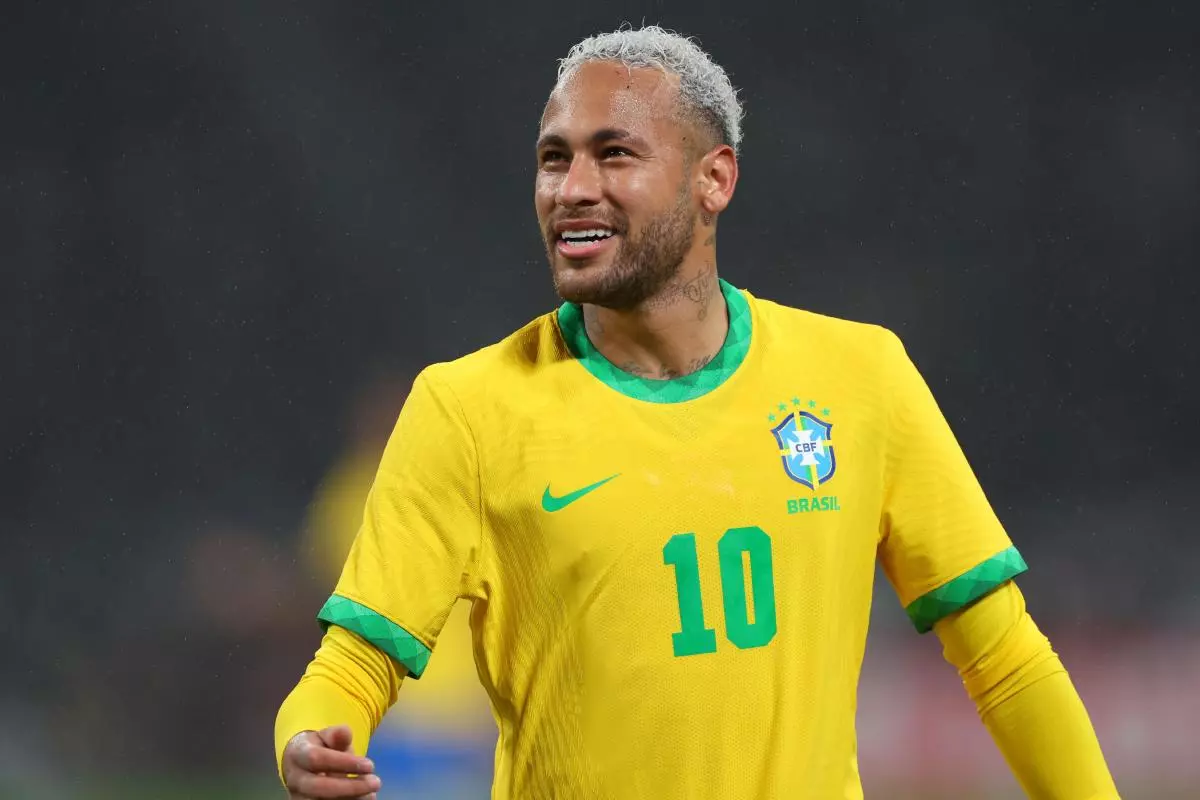
Santos forward Neymar Jr. has confirmed his retirement from international football, ending a Seleção career that began as a wide-eyed teenage prodigy in 2010 and concludes with him as Brazil’s record goalscorer.
The confirmation came in the aftermath of Santos’s 4-2 aggregate win over Universidad Central in the Copa Sudamericana knockout playoffs, a routine club fixture that nonetheless became the stage for a deeply personal announcement.
Facing reporters, a measured but emotional Neymar put to rest months of speculation over whether he might yet be tempted back into the national fold.
“My time with the national team is over,” he said. “I made history; I was very happy, I gave my blood, my life. I always fought for the yellow jersey, but now I don’t want to anymore.”
It is a quieter, more deliberate goodbye than the one many had already assumed was final. Neymar’s last act in a Brazil shirt had, in fact, come weeks earlier as a substitute in the Round of 16 of the 2026 FIFA World Cup, when he stepped off the bench to convert a stoppage-time penalty against Norway.
The goal, struck with typical composure under pressure, proved to be nothing more than a consolation: Brazil fell 2-1 and were eliminated, their pursuit of a sixth World Cup title extinguished in New Jersey.
Neymar announced his international retirement moments after his team crashed out of the 2026 World Cup in that Round-of-16 loss to Norway, played in East Rutherford.
Speaking immediately after that defeat, Neymar had told reporters, “I tried. It started here, at MetLife Stadium, and I finished here. It is now over,” before collapsing in tears at the final whistle and having to be consoled by his teammates.
That raw, pitch-side declaration was followed by weeks of uncertainty, with fans and pundits divided over whether the emotion of the moment might soften into a reconsideration, a debate stoked further when Neymar reacted warmly to a nostalgic social media post in which his younger self urged him to “try and win the World Cup for Brazil again.” Wednesday’s comments after the Universidad Central tie appear designed to close that door for good.
Neymar’s final World Cup was, in many ways, a microcosm of the second half of his international career: talent undimmed, fitness unreliable.
His place in the squad for the tournament had been far from guaranteed he was carrying a right hamstring problem and was not initially favored for selection by manager Carlo Ancelotti, only forcing his way into contention after a rehabilitation program that went better than expected.
A grade-two calf injury sustained while turning out for Santos ultimately ruled him out of Brazil’s opening two group matches at the tournament.
He returned for a brief cameo off the bench in the final group game against Scotland, managing only around fifteen minutes on the pitch, before his solitary moment of real impact arrived against Norway, a match that would double as both a swansong and a heartbreak.
Whatever the frustrations of his injury-hit farewell campaign, Neymar leaves the national team with the record books rewritten.
His penalty against Norway pushed his tally to 80 international goals, moving him clear of Pelé’s long-standing haul of 77 and cementing his status as Brazil’s greatest-ever marksman in the yellow shirt, a milestone made all the more striking given that, as one obituary of his career noted, he had even scored his first goal for Brazil before Pelé’s record was in his sights, on debut back on August 10, 2010, in a friendly against the United States.
Coincidentally, that 2010 debut also came at MetLife Stadium’s East Rutherford home, the same ground where, sixteen years and 128 caps later, his Brazil story would end.
Neymar was the talisman of Brazil’s triumphant 2013 FIFA Confederations Cup campaign and later captained his country to a first-ever Olympic men’s football gold medal on home soil at Rio 2016, a moment widely seen as exorcising the ghost of the 2014 World Cup semi-final humiliation, a 7-1 defeat to Germany that Neymar was forced to watch from the stands after being injured in the quarter-final.
He featured across four World Cups, multiple Copa América tournaments, a Confederations Cup and two Olympic Games, establishing himself as the face of Brazilian football through the post-Pelé, post-Ronaldinho generation.
If there is a single thread running through Neymar’s international career, it is one of what-ifs. Persistent injury problems repeatedly denied him and Brazil the chance to see his talent fully translate into World Cup glory.
The 2014 back injury against Colombia, long-term knee and ankle issues throughout his thirties, an ACL and meniscus tear suffered during 2026 World Cup qualifying in October 2023 that kept him out of the shirt for well over a year, and finally, the calf and hamstring troubles that punctuated his farewell tournament, each chapter chipped away at a career that many still regard as one of the most gifted of his generation.
He had even mused openly, in the buildup to the tournament, that retirement was on his mind regardless of the outcome, telling Brazilian broadcaster Caze earlier this year that he was “living year to year” and that his heart would ultimately decide his future. The 2-1 exit to Norway appears to have supplied that answer.
Neymar’s departure closes the book on one of the most decorated and most scrutinized individual careers in Brazilian football history, and it leaves a five-time world champion nation to plot its next chapter without the player who had been its talisman for the better part of two decades.
Attention now turns to the likes of Vinícius Júnior and Raphinha, both of whom were pictured consoling their former captain in the immediate aftermath of the Norway defeat, to carry the weight of the yellow shirt into the next World Cup cycle.
For a player whose club career took him from Santos to Barcelona, Paris Saint-Germain, Al-Hilal, and back home again to Santos, the international story ends not with a trophy lift in the Maracanã, but with a stoppage-time penalty, a collapse to his knees, and finally, definitively, a farewell delivered in his own words: fought for, cherished, and now, over.
WHAT YOU SHOULD KNOW
Neymar’s international career is over. After 16 years, four World Cups, and 80 goals that made him Brazil’s all-time top scorer, injuries, not a lack of talent, wrote the final chapter, denying him and Brazil the World Cup he chased his whole career.
He leaves as a legend whose body couldn’t quite keep pace with his gift, handing the yellow shirt to the next generation.