The Federal Reserve concluded its two-day policy meeting Wednesday by voting to leave its benchmark interest rate unchanged, but the decision was anything but unanimous, exposing a widening split within the central bank over how aggressively to confront inflation that has now lingered above target for years.
The Federal Open Market Committee voted 9 to 3 to leave its short-term borrowing rate in a range between 3.5 and 3.75%, marking the fifth consecutive meeting at that level.
Three regional Fed presidents broke ranks: Beth Hammack of Cleveland, Neel Kashkari of Minneapolis and Lorie Logan of Dallas dissented, each preferring to raise rates rather than hold steady, a notable reversal, since the previous month’s vote to keep rates in their current range had been unanimous.
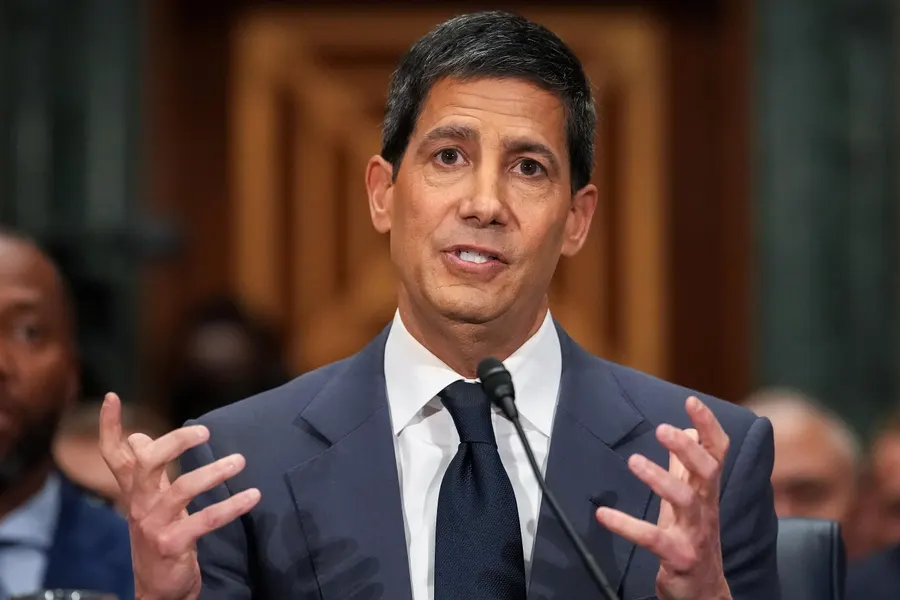
The decision marked the second policy meeting under Fed Chair Kevin Warsh, who has broken from his predecessors’ habit of offering markets detailed guidance on the Fed’s next steps.
Rather than treating the dissent as a sign of dysfunction, Warsh appeared to embrace it. “I asked for a good family fight, and I got one,” he told reporters, adding that open disagreement is “the better way to get policy right.” He described the two days of internal deliberation as collegial and constructive.
Warsh has previously called inflation “a choice” and signaled to lawmakers that bringing prices down remains his top priority, even as he resists giving markets a forward roadmap the way past chairs did.
In its statement, the Committee acknowledged that inflation remains elevated relative to its 2% goal, attributing the pressure in part to supply shocks that have driven up prices in certain sectors, including energy.
Officials pointed specifically to the conflict in the Middle East as a source of elevated uncertainty, even as they characterized the broader economy as expanding at a solid pace.
According to the post-meeting statement, they “preferred to raise the target range for the federal funds rate by ¼ percentage point at this meeting.” Their concern reflects a broader frustration: inflation has now remained above the Fed’s 2% target for more than five years.
Wall Street took note of the tension. Kay Haigh, global head and chief investment officer of fixed income and liquidity solutions at Goldman Sachs Asset Management, said the Fed “appears to be running out of patience with above-target inflation, despite recent data coming in cold.”
Despite the hold, investors are increasingly betting the Fed’s patience won’t last. Markets broadly expect the central bank to move toward a rate hike at its September meeting, a sharp reversal from expectations as recently as June, when officials had projected no rate changes until a cut sometime in the second quarter of 2027.
Some Wall Street forecasters are positioning for an even more aggressive shift. Bank of America analysts said this week they expect three separate quarter-point hikes this year, which would push rates as high as 4.25%-4.50%, citing rising oil prices that have driven inflation to multiyear highs.
Wednesday’s decision is the latest chapter in a rate cycle that has swung dramatically over the past several years. The Fed raised rates aggressively from March 2022 through August 2023 in response to the worst inflation in four decades, pushing the benchmark to a peak of 5.25%-5.50%, the highest level since early 2001.
The central bank then reversed course beginning in September 2024, cutting rates three times to bring the federal funds rate down to 4.25%-4.50%, and followed a similar pattern in 2025, holding steady before issuing three more consecutive cuts starting in September to arrive at the current 3.50%-3.75% range.
For now, the Fed has offered little in the way of forward signals. Wednesday’s statement left investors with comparatively little to work with, consistent with Warsh’s preference for a data-dependent approach over explicit guidance.
But with three sitting regional presidents now on record favoring a hike, and market pricing shifting toward tightening as soon as September, the central bank’s next meeting is shaping up as a genuine inflection point one that will test whether Wednesday’s dissent was an isolated event or the start of a broader shift in the Committee’s thinking.
WHAT YOU SHOULD KNOW
The Fed held rates steady at 3.5%–3.75%, but a rare 9-3 vote with three regional presidents openly dissenting in favor of a hike signals that patience with above-target inflation is wearing thin inside the central bank.
With markets now pricing in a possible rate hike as early as September, the real story isn’t this month’s decision to hold, but the growing likelihood that the next move is up, not down.