Nigeria’s Federal Government on Wednesday firmly denied plans to introduce new taxes on fuel and telecommunications services, pushing back against reports linked to a recently published International Monetary Fund report.
The controversy erupted after the IMF released its Article IV Consultation Report on Nigeria, a routine annual economic health check, in which the Fund suggested that extending VAT to petroleum products and introducing excise duties on telecoms services could help the government raise badly needed revenue to fund development and social spending.
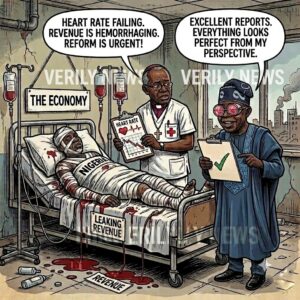
The recommendations, though standard IMF fare for economies grappling with fiscal deficits, landed in a public climate already tense from the aftershocks of fuel subsidy removal and a sharp depreciation of the naira.
In a statement attributed to Efe Ovuakporie, Head of the Information and Public Relations Unit at the Ministry of Finance, the government was unequivocal: media reports had misrepresented the IMF document and did not, in any way, reflect its policy direction.
“The IMF Article IV Consultation Report contains the Fund’s assessment of Nigeria’s economy as well as recommendations for consideration by the authorities. Those recommendations do not amount to government policy and are not binding on Nigeria. Decisions on tax matters are taken through established constitutional and legislative processes and are guided by national priorities and prevailing economic realities.”
The statement went further, providing specific clarifications on each of the two measures that had generated the most alarm. On petroleum, the government confirmed that the existing VAT waiver on fuel products remains fully intact and has not been withdrawn.
It acknowledged that legislation technically provides for a fuel surcharge mechanism but stressed that any such surcharge can only be activated through a formal ministerial order followed by publication in the Official Gazette, a process it said is not currently under consideration.
“The continued suspension of these charges has helped cushion the effect of global energy price fluctuations on households and businesses while keeping domestic fuel prices relatively stable,” the ministry said, signaling that the status quo will be maintained for now.
The government noted that a telecommunications excise duty in force before 2023, which had itself proved deeply unpopular with consumers and operators alike, was formally repealed under Nigeria’s revised tax legislation and is therefore no longer applicable.
The interventions come at a politically sensitive moment. Nigeria is midstream in a sweeping economic reform program that has already seen the removal of decades-old fuel subsidies and a unification of exchange rates.
Both measures, while applauded by multilateral lenders, have contributed to a cost-of-living crisis straining household budgets across the country. Any hint of additional consumer taxes risks further eroding public confidence at a time when the administration is seeking to rebuild it.
By emphasizing that IMF recommendations “are not binding,” Abuja was also effectively reminding Nigerians that it is not Washington that sets fiscal policy, a pointed signal to a public grown wary of external influence over domestic economic decisions.
The Ministry of Finance rounded off its statement with a broader articulation of its economic philosophy, framing its reform agenda around growth and efficiency rather than revenue extraction.
“The emphasis remains on expanding economic activity, plugging leakages, and improving efficiency rather than placing additional tax burdens on citizens. Any future tax measures will be announced through official channels and implemented in line with the law.”
Whether that reassurance will be sufficient to calm public nerves remains to be seen. For now, however, Abuja’s message is clear: the fuel tax waiver stays, the telecoms levy is dead, and the IMF’s notebook does not write Nigerian law.
WHAT YOU SHOULD KNOW
Nigeria’s Federal Government has firmly rejected claims that it plans to introduce new taxes on fuel or telecom services, stressing that the IMF’s recommendations in its Article IV report are neither government policy nor binding.
The VAT waiver on petroleum products remains in place, and the telecom excise duty was already repealed under new tax laws. No new taxes are coming, and any that do will be announced through proper legal channels, not leaked through IMF consultation documents.