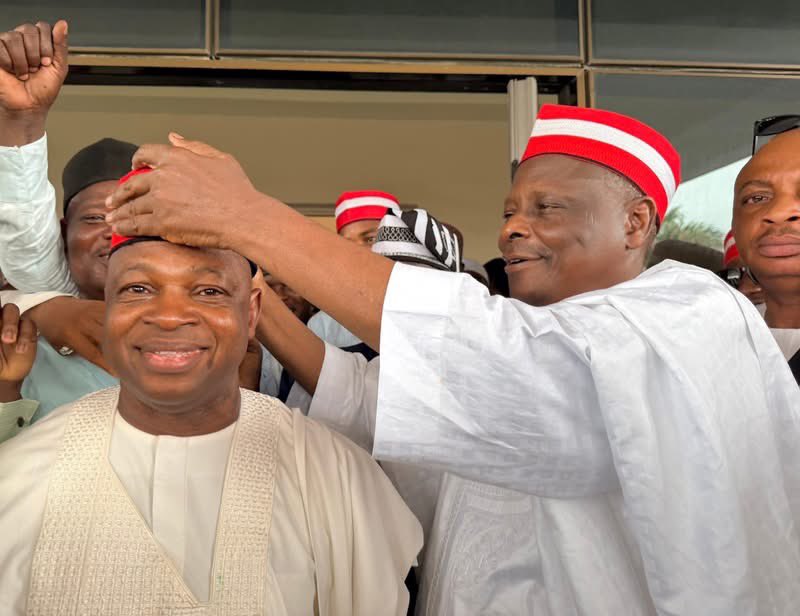
Mustapha Bala Dawaki, former Chief of Staff to All Progressives Congress (APC) national Chairman Prof. Nentawe Yilwatda, has formally defected to the Nigerian Democratic Congress (NDC), throwing his lot in with former Kano Governor and Kwankwasiyya movement leader Rabiu Musa Kwankwaso.
The defection, confirmed on Monday by Saifullahi Hassan, Media Aide to Kwankwaso, was formalized at the Kano Miller Rose residence of the Kwankwasiyya leader, a venue that has become increasingly synonymous with high-profile political realignments in the state.
“Leader Kwankwaso has today accepted the former Chief of Staff to the APC national Chairman, Mustapha Bala Dawaki (Mai Gidan Ruwa), to the NDC Kwankwasiyya,” Hassan announced on his verified Facebook page, lending official weight to what many had suspected was coming.
For Dawaki, a former member of the House of Representatives who represented the Dawakin Kudu/Warawa federal constituency in Kano State, the exit from the APC is less a philosophical shift and more a wound still raw from political rejection.
Sources close to the matter reveal that the defection came barely a week after Dawaki lost his bid for a return ticket within the APC, denied not by the ballot, but by the party’s controversial consensus mechanism, a process critics argue sidelines grassroots democracy in favour of backroom horse-trading.
Having served at the very apex of APC’s national structure as Chief of Staff to its chairman, Dawaki’s departure strikes at something deeper than mere personal ambition.
It lays bare the tensions simmering within the ruling party, where even those closest to its leadership are not insulated from the brutal calculus of internal politics.
Dawaki’s arrival at the NDC comes at a particularly delicate moment. The opposition party is currently in the throes of its own candidate selection process across Kano State, relying heavily on the same consensus model that ironically shut Dawaki out of the APC.
Senior NDC sources, indicated that no guarantees had been extended to Dawaki ahead of his formal reception by Kwankwaso. “The Leader welcomed him. That does not automatically translate to a ticket,” one source told this correspondent. “The process is ongoing, and every aspirant, new or old, must work within the framework.”
This ambiguity raises pointed questions about Dawaki’s strategic calculus. Did he leap from one house only to find the doors of opportunity not yet fully open in the other?
For Kwankwaso, however, the optics are unambiguously positive. Receiving a man of Dawaki’s profile, a sitting APC chairman’s former chief of staff and a former federal lawmaker, sends a clear message about the momentum the Kwankwasiyya movement believes it is building ahead of future contests.
Kwankwaso, who has long positioned himself as the dominant force in Kano’s political landscape, has been steadily expanding his coalition, drawing figures from across party lines who either share his vision or, as appears to be the case with Dawaki, find themselves without a home in their former political abodes.
Dawaki’s defection, while perhaps not seismic in isolation, is a telling indicator of the fractures within the APC’s northern flank as the political temperature gradually rises.
When a man who served within the inner sanctum of the party’s national leadership chooses to walk away and walk into the arms of an opposition movement, it is the kind of signal that strategists on all sides will be carefully parsing in the weeks ahead.
For now, Mustapha Bala Dawaki sits in Kwankwaso’s tent, his political future uncertain but his message to his former party unmistakable.
WHAT YOU SHOULD KNOW
Mustapha Bala Dawaki’s defection from the APC to the NDC is ultimately a story of political betrayal and opportunism. Having loyally served at the heart of the APC’s national leadership as Chief of Staff to the party chairman, Dawaki was unceremoniously denied his return ticket through the party’s own consensus process and wasted no time finding a new political home.
His swift move to Kwankwaso’s NDC underscores an uncomfortable truth about Nigerian politics: loyalty is rarely rewarded, and self-preservation almost always trumps party allegiance.
However, with the NDC itself yet to guarantee him a ticket, Dawaki may have jumped out of the frying pan and into the fire.