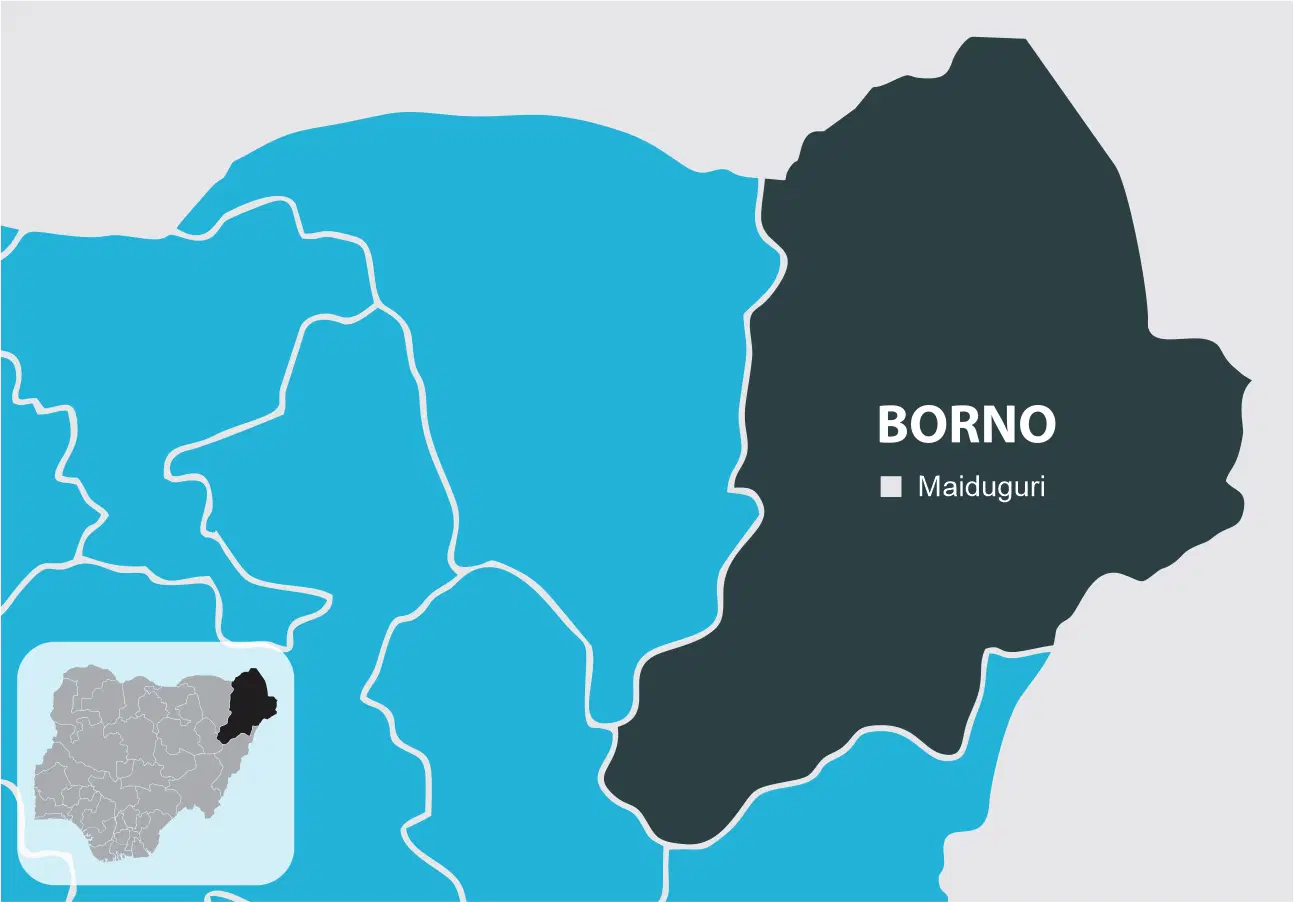
A deadly cholera outbreak is tearing through Borno State with alarming speed, leaving at least 27 people dead and pushing the healthcare system in one of Nigeria’s most conflict-battered regions to the brink.
Within just the first 24 days of May 2026, health authorities recorded approximately 2,715 suspected infections, a figure that health officials themselves describe as conservative, given that data from several Cholera Treatment Centers and Oral Rehydration Points have yet to be fully documented and integrated into the official record.
What makes this crisis especially alarming is not just its scale but also its velocity. The data reveal a rapidly escalating public health situation, with hundreds of new suspected cases reported in a single 24-hour period.
For a state already worn thin by years of Boko Haram insurgency, mass displacement, and threadbare infrastructure, the pace of the outbreak reads less like a medical statistic and more like a distress signal.
The outbreak has fanned out across six local government areas: Jere, Mafa, Konduga, Monguno, Ngala, and Magumeri, but the storm’s eye sits firmly in the state capital. The Maiduguri Metropolitan Council emerged as the worst-hit area, with 1,568 suspected cases, representing more than half of the infections documented so far.
Jere follows with 834 cases, while Mafa recorded 159, Konduga 95, and Monguno 56. Ngala and Magumeri have each recorded a handful of cases, but in an environment where contagion travels faster than containment, even isolated figures carry ominous implications.
The outbreak has spread across 29 wards and 124 communities, painting a picture of a disease that has not merely entered Borno State but embedded itself within it.
Of the 27 confirmed fatalities, the breakdown is as revealing as it is disturbing. Sixteen deaths occurred within health facilities, a sobering reminder of how severely ill patients are arriving at treatment centers.
But it is the remaining eleven deaths that have drawn the sharpest concern from public health experts: these occurred within communities, before patients could reach any form of medical care.
This points to a familiar and deadly combination: poor access to healthcare, inadequate awareness, and a delayed emergency response that costs lives before it can save them.
The case fatality rate currently stands at one percent, a threshold that may sound modest in isolation but carries enormous weight in the language of global health. It meets the World Health Organization’s emergency benchmark for urgent intervention, effectively placing this outbreak in a category that demands immediate, coordinated action.
Borno State is no stranger to compounding disasters. Populations displaced by armed conflict are among the most exposed, due to overcrowded camps, limited access to safe drinking water, and deteriorating sanitation infrastructure.
Cholera thrives precisely in these conditions in the gap between what a functioning state provides and what a broken one cannot.
The epidemiological report explicitly acknowledged that the published figures likely represent an undercount of the actual crisis, noting that verification logs and patient intake registries from several remote Cholera Treatment Centers and community-level Oral Rehydration Points have yet to be fully captured and integrated into the central database.
Communication and logistical bottlenecks, particularly in areas with limited digital connectivity, mean the true scale of the outbreak is projected to be substantially higher than the current baseline.
On the ground, frustration is mounting. Health workers, particularly those operating in the non-governmental sector, who often serve as the last line of medical defense in underserved communities, have raised pointed concerns about the pace of the official response.
Their central grievance: the state government has yet to declare a public health emergency or launch a large-scale public awareness campaign, even as the outbreak sprawls across dozens of wards and communities.
Residents have also expressed concern that the disease could spread more rapidly during the forthcoming festive season, especially amid the absence of an official public health advisory from the state Ministry of Health.
When journalists sought a response from state authorities, the reaction was telling. The Director of Public Health at the Borno State Ministry of Health, Dr. Goni Imam Ali, distanced the ministry from the epidemiological report, saying it did not originate from his office and declined to say anything further.
Nigerian authorities, supported by humanitarian organizations, are reported to be scaling up cholera treatment centers, community awareness campaigns, and the distribution of water purification products.
But whether these efforts will match the speed of a disease that has already claimed 27 lives and infected nearly 3,000 people in less than a month remains the urgent, unanswered question.
In Borno State, where the intersection of conflict, displacement, and poverty creates near-perfect conditions for waterborne disease, the window for decisive action is not merely closing. For some, it has already closed.
WHAT YOU SHOULD KNOW
Borno State is in the grip of a rapidly worsening cholera outbreak that has killed at least 27 people and infected nearly 3,000 others in under a month, and the true numbers are almost certainly higher.
What makes this crisis particularly urgent is not just the disease itself but the dangerous combination of factors fueling it: a population already displaced and weakened by years of conflict, collapsing water and sanitation infrastructure, and a state government that has yet to declare a public health emergency or mount a meaningful public response.
With the rainy season underway and critical data still missing from treatment centers, every day of official inaction is a day the outbreak gains ground. Cholera is spreading, but it is the silence from Abuja that should alarm us most.