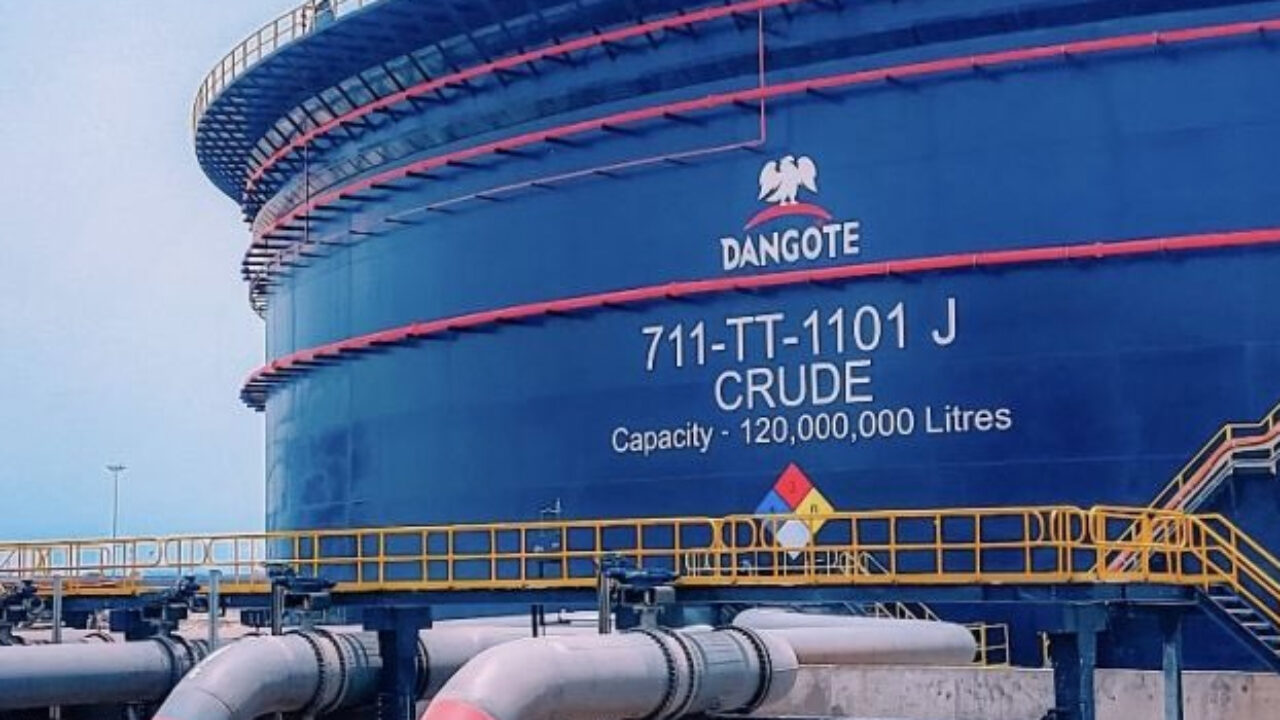
Dangote Petroleum Refinery’s offshore marine terminal has now logged approximately 1,100 tanker calls since operations began, with traffic currently running at around 75 vessels per month, a figure the company expects to climb to between 900 and 1,000 calls annually once the refinery reaches full operational capacity.
The disclosure came not through a press release, but during a hands-on tour of the refinery’s marine facilities, when Captain Satendra Singh Rana, Head of Port Infrastructure and Marine Operations at Dangote Petroleum Refinery and Petrochemicals, walked a delegation of executives through the arteries that keep the sprawling complex fed with crude and stocked for export.
The tour, organized for participants of the Global CEO Africa Programme run by Lagos Business School, took visitors through the refinery’s gantry, its processing units, the laboratory, the main control room, the crude oil storage farm, and finally the Landfall Point, known informally as the Trestle, where offshore infrastructure meets onshore refining.
It was here, standing at the literal seam between sea and industry, that Rana laid out the scale of what has been built. “We are now clocking about 75 tanker calls a month,” he told the group. “We are looking to scale to 900 to 1,000 tanker calls per year as the refinery is ramped up to full capacity already.”
He added, with evident pride, that the terminal’s cumulative tally of roughly 1,100 calls to date reflects something larger than logistics: a shift in Nigeria’s standing in both energy and maritime trade. “Today we have clocked approximately 1,100 tanker calls already, changing the energy landscape and maritime economy, bringing Nigeria to the forefront, not only by the refinery but in the maritime trade as well,” he said.
The Landfall Point itself functions as a kind of relay station. Pipelines running from the refinery’s offshore Single Point Mooring (SPM) terminals surface here before threading into the refinery’s processing units.
Crude oil, once discharged from tankers at the offshore SPMs, travels through subsea pipelines into storage tanks, where it undergoes crude distillation and further secondary and tertiary refining.
Finished products then reverse the journey, pumped back out through separate pipelines to the offshore terminals for loading onto export vessels or redistribution domestically.
Central to this operation are five offshore Single Point Mooring terminals, two dedicated exclusively to crude oil imports, and three configured for loading refined products outbound. The arrangement, Rana explained, allows imports and exports to run in parallel without bottlenecking a single point of entry.
The decision to build offshore rather than dredge a conventional deepwater port was, according to Rana, deliberate and economically pragmatic. Very Large Crude Carriers require natural water depths of 21 to 22 meters to berth safely depths the refinery’s chosen offshore location provides naturally, sparing the company the considerable capital and ongoing maintenance costs of dredging a channel to those specifications.
The scale of vessels the terminal has already handled is striking. Rana noted that the largest ship to berth there delivered three million barrels of crude in a single call, while VLCCs carrying around two million barrels arrive routinely. Suezmax tankers, ferrying roughly a million barrels apiece from both domestic and international suppliers, are also regular visitors.
Compounding the location’s appeal, Rana pointed out, is its freedom from cyclones and typhoons, allowing marine operations to run uninterrupted across the calendar year rather than pausing for seasonal weather risk as many tropical ports must.
The moorings themselves eliminate a step common elsewhere in the industry: ship-to-ship transfers. Instead, vessels berth directly at the SPMs, connecting to seabed-anchored pipelines via floating hoses, a deepwater model Rana described as proven, efficient, and central to the refinery’s integrated logistics chain.
For the Lagos Business School delegation, the visit was as much about strategic lessons as engineering. Enase Akinwuntan, Academic Director of the Global CEO Africa Programme at Pan Atlantic University, framed the refinery as evidence of what large-scale African-led investment can achieve. “Led by Alhaji Aliko Dangote and funded with local resources, the refinery symbolizes a bold commitment to advancing Africa’s industrial capabilities,” he said.
Akinwuntan argued the refinery’s relevance stretches well beyond Nigeria’s downstream fuel market, positioning it as a template for how private capital can accelerate regional trade integration under the African Continental Free Trade Area.
Domestic refining paired with export capacity, he noted, demonstrates how value addition can shift a country’s trade balance, cut import dependence, and open new channels of foreign exchange earnings.
The broader intent behind exposing executives to sites like Dangote’s refinery, he added, is practical: giving current and future business leaders a close look at how projects of this magnitude get built and run, knowledge the program hopes will translate into globally competitive ventures across the continent.
WHAT YOU SHOULD KNOW
Dangote Refinery built a deepwater solution to a depth problem, and it’s working at scale. By using offshore Single Point Mooring terminals instead of a conventional dredged port, the refinery can host the world’s largest crude carriers (VLCCs delivering up to 3 million barrels) without the massive capital and maintenance costs dredging would demand.
That engineering choice is what has enabled roughly 1,100 tanker calls to date, a current pace of 75 per month, and a clear path to 900–1,000 annually as the refinery hits full capacity.
The offshore terminal isn’t a side detail it’s the infrastructure decision making Nigeria’s biggest industrial project commercially and logistically viable.