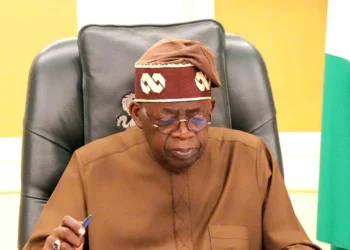
Nollywood actress Yvonne Jegede has added her voice to rising public outrage over the Tinubu administration‘s handling of Nigeria’s worsening security crisis, with a hard-hitting social media post that has sparked widespread debate online.
In an emotionally charged message shared on her verified Instagram account, the veteran actress did not mince words as she accused the administration of treating Nigerian lives with alarming indifference, a sentiment that resonated deeply with thousands of followers who quickly amplified her message across multiple platforms.
“The Nigerian government lacks a sense of humanity,” Jegede wrote, directly tagging President Tinubu’s official handle as well as that of First Lady Oluremi Tinubu in a bold move that underscored the urgency and personal nature of her appeal.
What makes Jegede’s statement particularly striking is her deliberate effort to reframe the national conversation around insecurity. Rather than simply cataloging the violence, the bandit attacks, kidnappings, communal clashes, and terrorist incursions that have become a grim feature of daily Nigerian life, the actress zeroed in on what she described as the government’s lackadaisical approach to addressing the crisis, arguing that official inaction is as dangerous as the crimes themselves.
“Crimes happen everywhere in the world,” she acknowledged, in what reads as a measured and informed observation. “It is the fact that Nigerians know that no one will ever come looking for them that is the issue.”
It is a damning indictment, one that speaks directly to a pervasive sense among ordinary citizens that the state has effectively abdicated its most fundamental responsibility: the protection of its people.
When victims of violent crime and kidnappings disappear with little or no government response, Jegede argues, it does not merely reflect institutional failure. It actively emboldens perpetrators.
Jegede’s choice of language was pointed and deliberate. Describing Nigerians as neither “doormats” nor people to be “preyed on,” the actress evoked the dignity of a citizenry that has grown increasingly frustrated with a leadership perceived to be detached from the realities of life on the ground.
Perhaps most notably, she was careful to strip the crisis of any ethnic or sectarian coloring, stating plainly that “these atrocities have not been tribal, religious, nor class-based.”
In a country where political actors have long exploited divisions along ethnic, regional, and religious lines, this framing is both refreshing and a pointed call to see insecurity as a Nigerian problem demanding a Nigerian solution, not a convenient wedge issue.
Jegede is not the first public figure to aim for the Tinubu administration’s security record, and she is unlikely to be the last. Nigeria has witnessed a sustained spike in violent crime across multiple geopolitical zones, with communities in the North-West, North-Central, and South-East regions bearing a disproportionate burden of attacks.
Yet there is a particular potency when figures from the entertainment industry, with massive, cross-generational followings, choose to step beyond the footlights and engage directly with political leadership.
Jegede’s post, reaching hundreds of thousands of followers within hours, reflects a broader trend of Nigerian celebrities leveraging their platforms to hold power to account in ways that traditional civic channels have often failed to do.
As of the time of filing this report, neither the presidency nor the Office of the First Lady had issued any official response to Jegede’s post. The silence, critics would argue, is itself telling.
For millions of Nigerians scrolling through their feeds, many of whom have personally experienced or know someone affected by violent crime, the actress’s words land less as celebrity commentary and more as a mirror held up to a nation waiting, still, for its government to act.
WHAT YOU SHOULD KNOW
Nollywood actress Yvonne Jegede’s viral Instagram post cuts to the heart of Nigeria’s security crisis with a truth many citizens feel but rarely hear stated so plainly: the problem is not just the violence itself but a government that responds to it with dangerous indifference.
When Nigerians believe no one in authority will come looking for them, criminals are effectively handed a blank check. Until the Tinubu administration replaces its silence with decisive, visible action, every Nigerian, regardless of tribe, religion, or class, remains vulnerable.