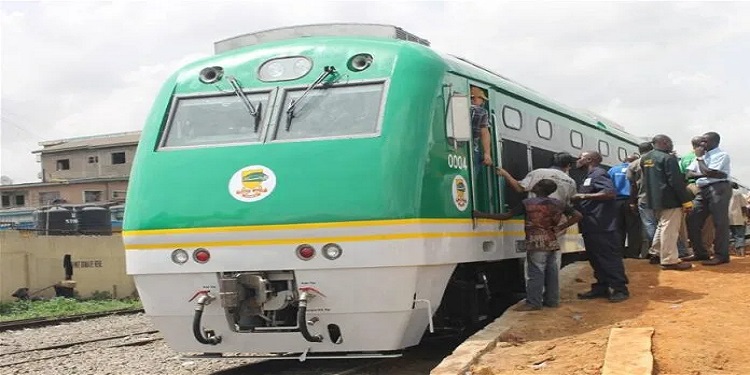
The Nigerian Railway Corporation (NRC) has thrown the travel plans of thousands of commuters into uncertainty after announcing a temporary suspension of the Warri Itakpe Train Service (WITS), one of the country’s most strategically important rail corridors.
In an official statement released on Tuesday, the NRC said the decision to halt services on the corridor was driven by “operational exigencies” and technical advice received from its team of engineers, language that, while deliberately measured, signals that conditions on the route had deteriorated to a point where continued operations posed risks the corporation was unwilling to take.
“The temporary suspension has become necessary to enable the corporation to carry out critical operational assessments aimed at ensuring continued safety, reliability, and improved service delivery on the corridor,” the statement read.
The NRC did not specify the precise nature of the technical faults identified, nor did it indicate how many trains, crew members, or daily passenger trips would be affected by the suspension.
Sources familiar with rail operations in Nigeria, however, note that the Warri–Itakpe corridor, spanning roughly 276 kilometers through the oil-rich Niger Delta and into Kogi State in Nigeria’s north-central heartland, is a vital artery for both passenger movement and economic activity in the region.
Any prolonged disruption risks compounding hardship for commuters who depend on it as a more affordable alternative to road transport, particularly along routes plagued by highway insecurity and deteriorating road infrastructure.
The NRC was careful to temper the blow with an assurance that the shutdown would be short-lived. The corporation pledged that passengers and intending travelers would be formally informed of a resumption date before the end of the week, while also expressing regret over the disruptions the suspension may cause commuters and other stakeholders who had made travel arrangements in good faith.
“The NRC regrets the inconvenience this development may cause passengers and other stakeholders and assures the public that efforts are currently ongoing to resolve the issues within the shortest possible time,” the statement said.
It is a familiar refrain from Nigeria’s rail management and one that has, in the past, been met with a mixture of cautious optimism and weary skepticism from a traveling public that has seen numerous service interruptions on various corridors in recent years.
How quickly the corporation can deliver on that promise will go some way to determining whether public confidence in the nation’s rail infrastructure is further eroded or reinforced.
The timing of the suspension has not been lost on observers. In what can only be described as a jarring juxtaposition, the same week that saw the WITS service ground to a halt also saw the federal government announce a 50% fare reduction on NRC train services, a gesture timed to coincide with the Sallah celebrations and intended to ease the financial burden on Nigerians traveling during the festive period.
The announcement was contained in a statement issued by the permanent secretary of the Federal Ministry of Transportation, Funsho Adebiyi, who framed the fare reduction as part of the Federal Government’s broader commitment to making transportation more accessible and affordable for ordinary Nigerians.
“The fare reduction is part of efforts by the federal government to ease transportation costs for Nigerians traveling during the festive period,” the ministry stated.
It is a well-intentioned policy that now rings somewhat hollow for commuters along the Warri–Itakpe axis, who find themselves unable to benefit from the discount because the service they would have boarded is no longer running.
For passengers who had budgeted for Sallah travel based on the promised concession, the suspension adds a layer of frustration to what should have been a moment of relief.
The Warri–Itakpe rail line has long been a symbol of both Nigeria’s infrastructural ambitions and its struggle to sustain them. Conceived and partly constructed decades ago, the line languished incomplete for years before finally being inaugurated for commercial service, a milestone that was celebrated as a sign of renewed commitment to reviving Nigeria’s once-thriving rail network.
Its suspension, even if genuinely temporary, inevitably stirs anxieties about whether the gains of recent years can be adequately maintained.
As the NRC works to resolve the technical issues flagged by its engineers, the corporation faces a dual imperative: restore the service swiftly enough for passengers to still benefit from the Sallah fare reductions and do so in a manner rigorous enough to guarantee the safety and reliability it has publicly committed to.
Both goals are achievable, but only if the corporation delivers on its promise to communicate clearly and act decisively before the week is out.
WHAT YOU SHOULD KNOW
The Nigerian Railway Corporation’s suspension of the Warri–Itakpe Train Service, coming at the same time as a government-announced 50% Sallah fare reduction, captures in one moment the central tension plaguing Nigeria’s rail sector: the gap between policy ambition and operational reality.
While the government moves to make rail travel more affordable, the very trains meant to deliver that promise are off the tracks.
Until the NRC can guarantee not just good intentions but consistent, safe, and reliable service, fare concessions, and public assurances will continue to ring hollow for the Nigerians who need functional rail transportation the most.