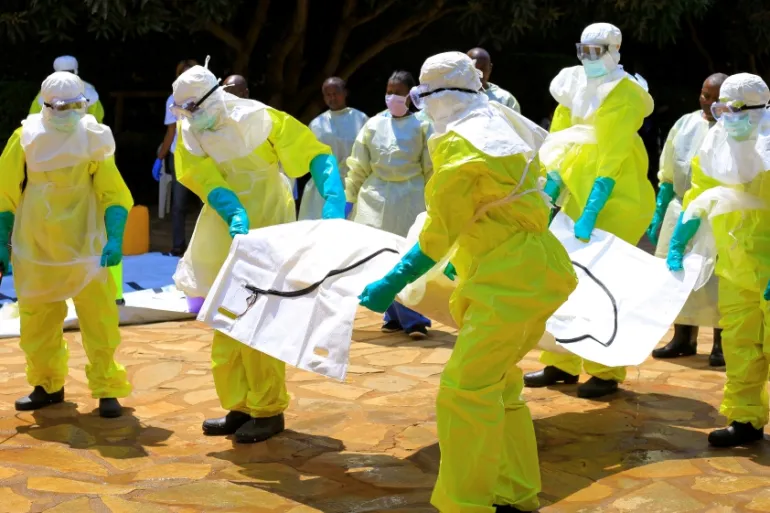
The Ebola outbreak tearing through the eastern Democratic Republic of the Congo is showing no signs of slowing, with the World Health Organization (WHO) warning on Friday that the virus is reaching new territory faster than health authorities can build the capacity to contain it.
The WHO’s latest figures put confirmed cases at 676, with 136 deaths recorded so far, alongside 119 suspected cases still awaiting confirmation and just 32 patients who have recovered.
As of 11 June, DRC’s Ministry of Health had reported 635 confirmed cases, including 127 deaths, with Ituri remaining the epicenter at 600 confirmed cases spread across 18 health zones, while North Kivu has recorded 32 cases from seven health zones, and South Kivu has three cases from one health zone.
The outbreak is caused by the Bundibugyo species of Ebola virus, a rarer strain for which no licensed vaccines or treatments currently exist, leaving responders reliant on supportive care and containment measures that have proven repeatedly to be a step behind the virus’s spread.
Speaking from Beni in North Kivu, Olivier le Polain, the WHO’s head of epidemiology and analytics for response, painted a picture of an outbreak that is both growing and morphing in character. New health zones across the three affected provinces are reporting cases almost daily, he said, a pattern that points to something more troubling than simple geographic creep.
Where earlier flare-ups in new areas could largely be traced back to people traveling from established hotspots, Le Polain said responders are now seeing a different and more worrying pattern: local transmission taking root independently in communities with no direct link to the outbreak’s original epicenter.
That shift suggests the virus has already seeded itself more widely than surveillance teams have been able to detect and that the official case count likely understates the true scale of the crisis.
Compounding the problem is the sheer mobility of the population in the affected region, much of which has been shaped by years of conflict, displacement, and cross-border trade.
Le Polain acknowledged that “blind spots” remain in several high-risk areas and that a clearer picture of the outbreak’s true reach will only emerge as surveillance capacity improves.
On contact tracing, one of the most critical tools for breaking chains of transmission, Le Polain reported cautious progress. Roughly 70 percent of contacts are now being appropriately traced, he said, a marked improvement from just one or two weeks earlier. But he was blunt that this figure remains too low to bring the outbreak under proper control, particularly given how quickly the virus appears to be moving through communities.
The most pressing structural problem, according to Le Polain, is a severe shortfall in isolation bed capacity. The affected provinces currently have around 250 isolation beds combined, a figure he said falls well short of what the outbreak’s trajectory demands and one that needs to be scaled up “quite rapidly.”
Without that capacity, he warned, even improved surveillance becomes a hollow victory: identifying more cases means little if there is nowhere safe to isolate and treat them, increasing the risk that infected individuals remain in their communities and continue spreading the virus.
The crisis has not stayed within DRC’s borders. Uganda has now confirmed 19 cases linked to the outbreak, including two deaths, after the virus crossed from Ituri earlier in the response.
Despite this, the African Union’s health agency said Thursday that the situation in Uganda remains “under control,” a relatively reassuring assessment that stands in contrast to the more urgent tone coming from WHO officials regarding the situation inside DRC itself.
Underlying all of this is the broader context of the outbreak’s severity. On 6 June, the WHO assessed the overall national risk in DRC to be very high, with the risk rated high in Uganda and in countries sharing land borders with areas where the virus has been detected.
The outbreak was significant enough that the WHO Director-General determined in mid-May that the Bundibugyo Ebola epidemic in the DRC and Uganda constitutes a public health emergency of international concern, though it does not meet the threshold of a pandemic emergency under international health regulations.
For a region already grappling with conflict, mass displacement, and fragile health infrastructure, the warning from Geneva amounts to a call for urgent, large-scale investment in beds, in surveillance teams, and in the logistical networks needed to reach communities on the move before the outbreak’s geographic spread outpaces the world’s ability to respond to it.
WHAT YOU SHOULD KNOW
This Ebola outbreak is outpacing the response. Cases are climbing toward 700, deaths past 130, and the virus is now spreading locally in new areas, not just through travelers from known hotspots, meaning the true scale is likely larger than reported.
With no approved vaccine for this Bundibugyo strain, isolation capacity (just 250 beds) and contact tracing (70%) remain critically insufficient for what’s needed. Without rapid scale-up of beds and surveillance, containment will keep losing ground to the virus’s spread across DRC and into Uganda.