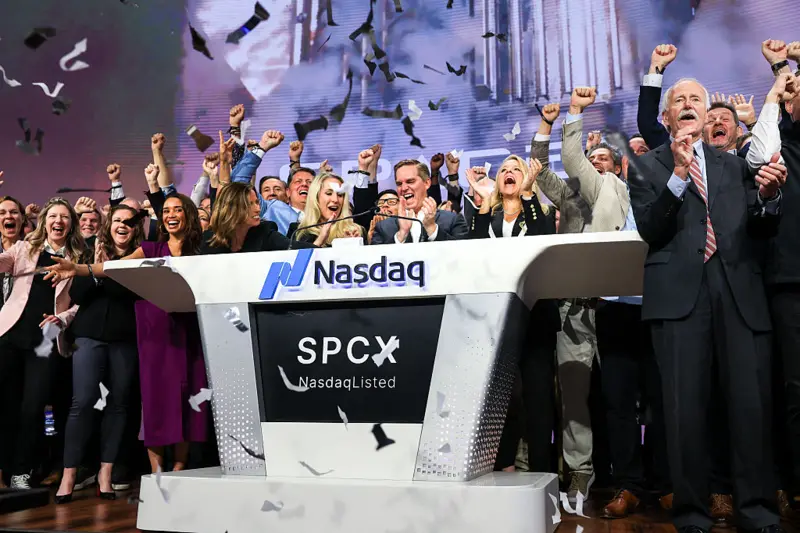
SpaceX began trading as a public company on the Nasdaq on Friday, completing what stands as the largest initial public offering in market history.
The rocket and satellite company raised over $75 billion in the offering, and the listing is positioned to make founder Elon Musk the world’s first trillionaire.
Trading opened under the ticker “SPCX” following a pricing of more than 555 million shares at $135 apiece, a deal that valued the combined company at just under $1.8 trillion. That figure places SpaceX among Wall Street’s ten most valuable companies, surpassing Tesla, Meta, and Walmart.
An additional allotment of nearly 83 million shares could push the total raised above $86 billion. Reports indicated the offering was oversubscribed more than four times over, with retail investors, who were allocated 20 percent of the shares, showing particularly strong demand.
The company that began trading on Friday is considerably broader than the rocket-launch business SpaceX was known for at its 2002 founding.
Over the past two decades, it has grown into a major satellite operator through its Starlink internet service, and it has since absorbed Musk’s artificial intelligence venture, xAI, along with the social platform X.
The newly combined entity’s prospects rest heavily on continued expansion of Starlink and on xAI’s Grok chatbot gaining ground against rivals OpenAI and Anthropic, an effort that has so far struggled for traction.
Musk marked the occasion at a launch event in Starbase, Texas, telling staff that the company intends to take people “to the moon, to Mars, and ultimately beyond,” and expressing confidence in the team’s ability to deliver.
In New York, roughly 100 people gathered outside the Nasdaq exchange, where a Times Square sign declared the company was “building the infrastructure to the future.” One attendee from financial firm Dovetail noted that Musk’s tendency to set unusually ambitious, long-term goals appeared to be a draw for investors.
The listing arrives amid a notable shift in Musk’s public standing. The IPO comes roughly a year after Musk departed from the Trump administration, where he had led the “DOGE” government-spending-cuts initiative while simultaneously serving as CEO of both Tesla and SpaceX.
His political alignment with Trump and European right-wing populist figures, paired with frequent controversial posts on X, has transformed his public image from a widely admired innovator into a more divisive figure, a shift that makes Wall Street’s enthusiastic reception notable.
That enthusiasm comes despite financial figures that have given some investors pause. SpaceX reported $18.7 billion in revenue for 2025 alongside a $4.9 billion net loss, driven largely by AI infrastructure spending.
The company’s valuation rests substantially on Musk delivering on still-unproven, long-horizon goals, including space-based data centers and crewed Mars missions, with the filing itself projecting the company could eventually generate more than $28.5 trillion in revenue across its markets.
SpaceX’s debut also positions it as the first major AI-linked company to go public, with both OpenAI and Anthropic having recently filed preliminary IPO paperwork suggesting Friday’s listing may be the opening act in a broader wave of AI-sector market debuts.
WHAT YOU SHOULD KNOW
SpaceX’s record-breaking $75 billion IPO marks a pivotal moment for Wall Street, but the eye-popping $1.8 trillion valuation rests almost entirely on unproven future bets, such as Mars colonization, space data centers, and xAI’s struggling Grok chatbot, rather than current fundamentals, given the company posted a $4.9 billion net loss in 2025.
Investors are essentially betting on Musk’s vision delivering at a scale ($28.5 trillion in projected revenue) that has no precedent, making this listing a high-stakes gamble as much as a milestone.