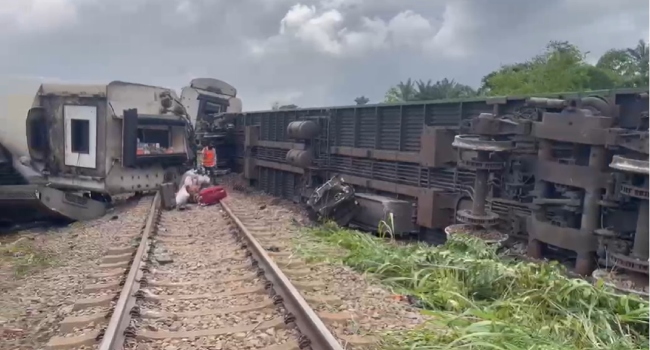
At least three passengers have lost their lives following yet another derailment on the Warri–Itakpe Train Service (WITS), in what is fast becoming an alarming pattern of rail disasters that has cast a long, dark shadow over Nigeria’s ambitious railway expansion program.
The incident, which occurred on Monday, has once again thrust the Nigerian Railway Corporation (NRC) into the spotlight and not for reasons its leadership would welcome.
Emergency response teams and relevant authorities were swiftly deployed to the scene, according to a terse statement issued by the corporation, but for three passengers who boarded that train, help came too late.
In a statement signed by its Managing Director and Chief Executive Officer, Kayode Opeifa, the NRC confirmed the incident in measured, carefully worded language that offered scant detail but promised more to come.
“The Nigerian Railway Corporation confirms that an incident involving the Warri–Itakpe Train Service occurred today,” the statement read. Emergency response teams and relevant authorities are currently at the scene attending to the situation and providing necessary assistance. The corporation is closely monitoring developments, and a detailed statement will be issued as soon as more information becomes available.”
It is the kind of statement that crisis communications professionals are trained to draft cautiously, noncommittally, and thin on specifics. But for grieving families awaiting word on their loved ones, it will offer little comfort.
What makes Monday’s tragedy particularly difficult to stomach is the timing. The Warri–Itakpe Train Service had only recently returned to operation after the NRC placed it on a temporary suspension less than a month ago, citing what it described as “operational exigencies and technical advice from its engineers.”
At the time, the corporation had framed the suspension as a proactive safety measure, stating that the pause was “necessary to enable it to carry out critical operational assessments aimed at ensuring continued safety, reliability, and improved service delivery on the corridor.”
The public was reassured. Passengers were told they would be informed before the end of the week on the date for the resumption of normal operations.
They were. The trains ran again. And now three people are dead.
The uncomfortable question now hanging in the air is this: Were those assessments thorough enough? And if they were, how did this happen?
Monday’s derailment does not occur in a vacuum. It is the latest chapter in what has become a deeply troubling story about the state of Nigeria’s rail infrastructure.
In November 2025, the same Warri–Itakpe corridor was the scene of another derailment, one that the NRC blamed squarely on the activities of vandals. Two suspects were arrested in connection with that incident, which took place in Agbor, Delta State.
Whether those arrests led to any prosecutions, or whether the underlying vulnerability that enabled that attack was ever truly addressed, remains unclear.
Just months earlier, in August 2025, a passenger train traveling from Abuja to Kaduna derailed along the Kaduna corridor, triggering widespread panic among passengers and their families. The train had departed Abuja around 11 a.m., and eyewitness accounts painted a harrowing picture.
One passenger described the scene as “chaotic, with people scrambling to safety in fear and confusion.” No fatalities were officially reported in that incident, but the psychological toll on those on board was immeasurable.
Three derailments in less than a year. Three separate corridors. A mounting body count. The data points are damning.
In November 2025, the Senate resolved to establish an ad hoc committee tasked with conducting a comprehensive investigation into the root causes of the recurring incidents.
The probe was intended to assess the condition of rail infrastructure across the country, as well as scrutinize the quality of imported materials used in the sector, a pointed reference to long-standing concerns about substandard procurement.
Whether that committee has concluded its work, published its findings, or made any enforceable recommendations is a question the Nigerian public deserves a clear answer to, particularly in the aftermath of Monday’s deaths.
The Warri–Itakpe railway line, completed after decades of delays and inaugurated to considerable fanfare, was meant to be a symbol of Nigeria’s determination to modernize its transportation infrastructure and ease the burden on its congested road networks.
For communities along the Niger Delta corridor, it represented something more personal: a safer, more affordable way to travel.
Three families are tonight without a mother, a father, a son, or a daughter, people who did nothing more dangerous than board a train. The NRC has pledged a detailed statement.
But as Nigeria buries its dead once more, the questions that matter most cannot be answered in a press release: Why does this keep happening? Who is accountable? And what, concretely, will be done to ensure that the next passenger who boards the Warri–Itakpe Train Service arrives at their destination alive?
WHAT YOU SHOULD KNOW
Three passengers are dead following yet another derailment on Nigeria’s Warri–Itakpe train service, a line that had only just resumed operations after a safety-motivated suspension.
This tragedy is not an isolated incident; it is the third derailment on Nigeria’s rail network in less than a year, occurring on a corridor that suffered the same fate just months ago.