Vice President Kashim Shettima has revealed that shortly after President Bola Tinubu assumed office in 2023, some individuals from Borno State allegedly approached the President and warned him against wearing traditional outfits earlier gifted to him during the presidential campaign.
According to Shettima, the visitors claimed the garments had been spiritually manipulated and could allegedly endanger Tinubu’s life. He, however, disclosed that the President rejected the claims and intentionally continued wearing the attire for an entire week to dismiss what he considered baseless allegations.
The Vice President made the disclosure on Tuesday in Abuja during the public presentation of the autobiography of former Head of State, Yakubu Gowon, titled “My Life of Duty and Allegiance.”
Representing President Bola Ahmed Tinubu at the event, Shettima used the story to highlight what he described as the growing culture of suspicion and mistrust in Nigerian political and social life.
He contrasted the current atmosphere with an earlier era recalled by the Sultan of Sokoto, who narrated how the family of the Sultan regularly sent gallons of fura to Gowon at Dodan Barracks in Lagos without fear or suspicion.
According to Shettima, Gowon accepted the gifts freely because there was trust among Nigerians at the time, unlike the current climate where suspicion now dominates relationships.
The Vice President said, “His Eminence the Sultan of Sokoto had been narrating the story of the family of the Sultan sending gallons of fura every week to Gen Yakubu Gowon in Dodan Barracks, because of the trust and confidence Gen Gowon was willingly receiving it without any suspicion.
“But now the game is different. Suspicion smears our relationships, and it ought not to be. We are essentially one people tied to a common destiny.”
Narrating how the incident involving Tinubu began, Shettima explained that during the build-up to the 2023 presidential election, he personally sourced traditional Borno attire and caps for Tinubu to wear while campaigning across northern Nigeria.
According to him, the outfits helped the then-presidential aspirant blend more naturally with northern supporters during campaign outings, and Tinubu repeatedly wore the clothes throughout the election season.
The Vice President said the controversy resurfaced months later after he returned from Beijing, China, where he had represented Tinubu at the Belt and Road Initiative Conference in October 2023.
Shettima recalled that after his return, Tinubu summoned him and informed him that some individuals had warned him against wearing the outfits gifted to him.
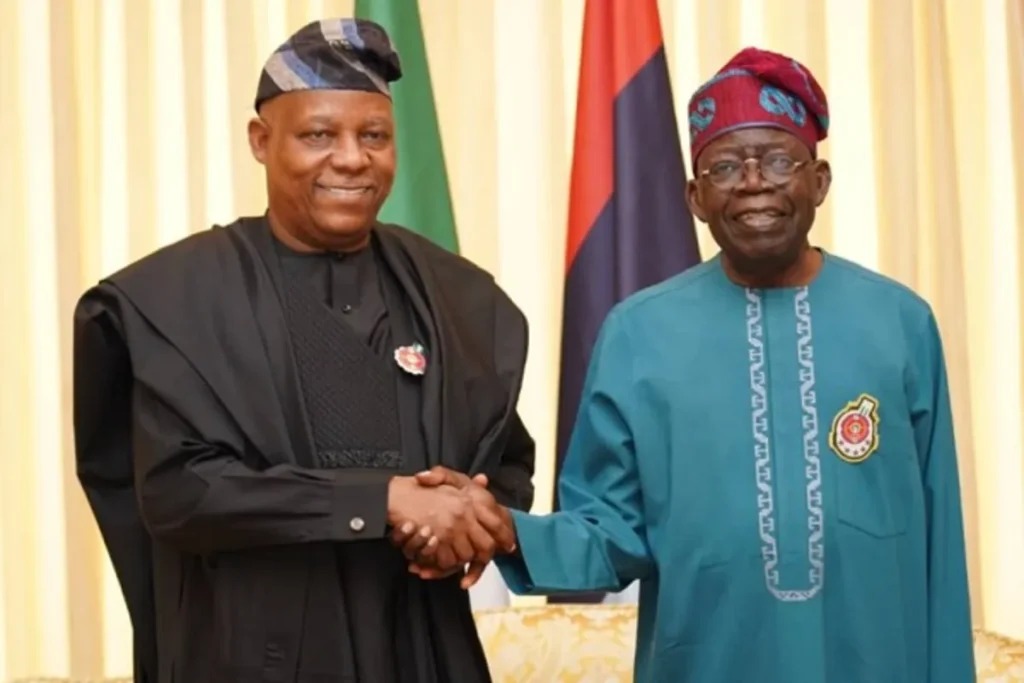
“When I came back from China, where I had represented him at the Belt and Road Initiative Conference, he said: ‘Sit down. Your people came to me and said I should stop wearing those dresses you gave me. They said I must have been charmed, and that I am going to die and you will become the president,’” Shettima recounted.
The Vice President stated that Tinubu immediately dismissed the allegation because it lacked logic, especially considering that at the time the clothes were gifted, neither of them had secured their eventual positions on the APC ticket.
According to Shettima, Tinubu responded by saying: “Their story did not add up, because when you gave me those dresses, I was an aspirant. I wasn’t even the candidate. Neither were you the vice presidential candidate.”
He further disclosed that Tinubu deliberately continued wearing the attire publicly for an entire week to demonstrate that he was not influenced by superstitious claims or political fear.
“For one week, to prove to them that he is not a fetish, he wore those dresses.
“These are some of the gimmicks taking place in power circles in Nigeria nowadays,” Shettima added.
The Vice President also praised Gowon for promoting national unity during and after his time in office, describing him as a symbol of patriotism and reconciliation.
He highlighted Gowon’s role in establishing the National Youth Service Corps, NYSC, and his contributions to the formation of the Economic Community of West African States, ECOWAS.
Shettima further urged Nigerians to resist division and embrace unity despite ethnic and religious differences, stressing that the country’s future depends on collective trust and cooperation.
Referencing the lingering violence in Plateau State, he appealed for greater understanding among communities, noting that many groups currently in conflict share historical, linguistic and cultural ties.
Describing Gowon as “the last man standing” among Nigeria’s early military leaders, Shettima said the former Head of State’s autobiography arrives at a time when the country needs reflection, memory and national healing.
“There are people who are remembered before they leave office.
“There are others whose memory endures because the office became, in their hands, an instrument of national meaning. General Gowon belongs to the second company,” he said.
The Vice President concluded by quoting American civil rights leader Martin Luther King Jr., urging Nigerians to choose unity over division.
“Let us learn to live together as brothers or perish together as fools,” he stated.
What you should know
Vice President Kashim Shettima’s remarks have sparked conversations around political mistrust, ethnic suspicion and power dynamics within Nigeria’s political space.
By recounting President Tinubu’s reaction to claims surrounding traditional Borno attire, Shettima attempted to project the President as someone unwilling to succumb to political fear or superstition. The speech also served as a broader call for national unity, tolerance and trust among Nigerians.
His comments came during the unveiling of Yakubu Gowon’s autobiography, where issues of national cohesion, historical reconciliation and the need to reduce suspicion in public life dominated discussions among political leaders and dignitaries present at the event.