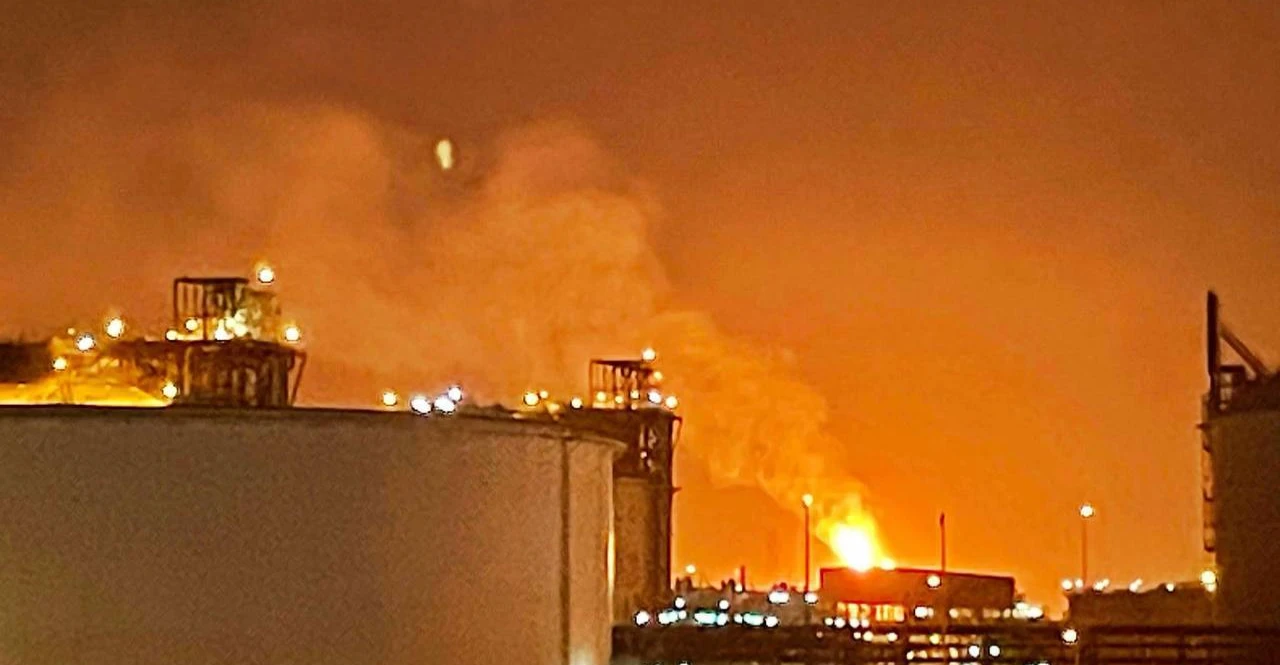
An explosion tore through Qatar’s Ras Laffan Industrial City on Sunday night, injuring 54 people and leaving 18 missing, a disaster that unfolded as workers attempted to revive the war-battered facility.
The blast struck the Barzan gas supply facility during a restart of operations, a cruel irony for a site that had only recently been ravaged by Iranian missile strikes during the US-Iran war.
The explosion rattled windows and panicked residents more than 70 kilometers away in central Doha. An AFP journalist stationed just 20 kilometers from the site reported towering orange flames and a thick column of smoke punching into the night sky, a vision visible across much of the northern Gulf Coast.
Qatar’s Interior Ministry was initially guarded in its language, describing the event as a “technical incident” before later settling on “technical malfunction” as the official explanation.
QatarEnergy confirmed the explosion occurred “during the start-up of operations” at the facility, adding that emergency response teams were immediately mobilized and that the resulting fire had since been brought under control.
Authorities were careful to add that there was no leakage from the facility posing a danger to public safety, while the Qatari International Search and Rescue Group was deployed alongside civil defense teams to locate the 18 missing individuals. The ministry did not disclose the nationalities or conditions of those injured.
To appreciate the full gravity of Sunday’s explosion, one must understand what Ras Laffan represents on the world stage. The industrial city is home to the world’s largest LNG export facility, responsible for producing roughly one-fifth of global supply.
Within that complex, the Barzan plant occupies a uniquely vital role not as an export hub but as the beating heart of Qatar’s domestic energy system, feeding the power plants and water desalination facilities upon which every household in this desert nation depends.
Iranian missile strikes in March had already inflicted severe damage on the complex, slashing approximately 17% of Qatar’s LNG export capacity and forcing the evacuation of some 10,000 workers from offshore rigs and onshore processing plants.
Qatar’s Energy Minister Saad Al-Kaabi grimly assessed at the time that the repairs could take three to five years. With Iran gradually loosening its grip on the Strait of Hormuz as ceasefire negotiations progressed, Qatar had only recently begun the painstaking work of restarting its export terminal. Sunday night, that effort ended in fire and chaos.
The ripple effects of this latest disaster will be felt well beyond Qatar’s borders. The emirate sits alongside the United States, Australia, and Russia as one of the world’s foremost LNG producers, and its customers span the breadth of Asia and Europe.
Qatar’s Energy Minister had already cautioned in March that major importers, including China, South Korea, Italy, and Belgium, faced significant exposure to supply disruptions. Sunday’s explosion threatens to deepen that uncertainty at a moment when global energy markets can least afford it.
Qatar had previously scaled back production after heightened tensions in the Strait of Hormuz disrupted shipping routes. As diplomatic efforts progressed and pressure on the strategic waterway eased, authorities had begun restoring operations to normal levels.
Whether that recovery can survive yet another catastrophic setback at its most important facility is the question now confronting Doha and the energy desks of every major importing nation watching closely from afar.
For now, the most urgent priority is human. Rescue teams pressed on through Monday, searching for the 18 workers still unaccounted for in the wreckage of Barzan. Their fate, like that of Qatar’s energy recovery, remains deeply uncertain.
WHAT YOU SHOULD KNOW
The explosion at Qatar’s Ras Laffan Industrial City is more than an industrial accident, it is a crisis layered upon a crisis.
A facility already crippled by Iranian missile strikes was struck again, this time from within, as a routine restart turned catastrophic.
With 54 injured, 18 missing, and the world’s largest LNG hub once more in chaos, the human cost is immediate, and the global energy implications are severe.
Qatar’s road to recovery, already measured in years, just got longer, and the nations dependent on its gas exports may be the next to feel the consequences.