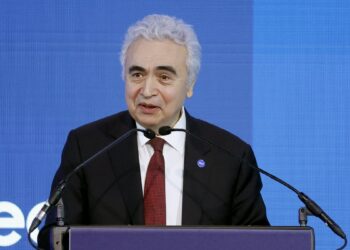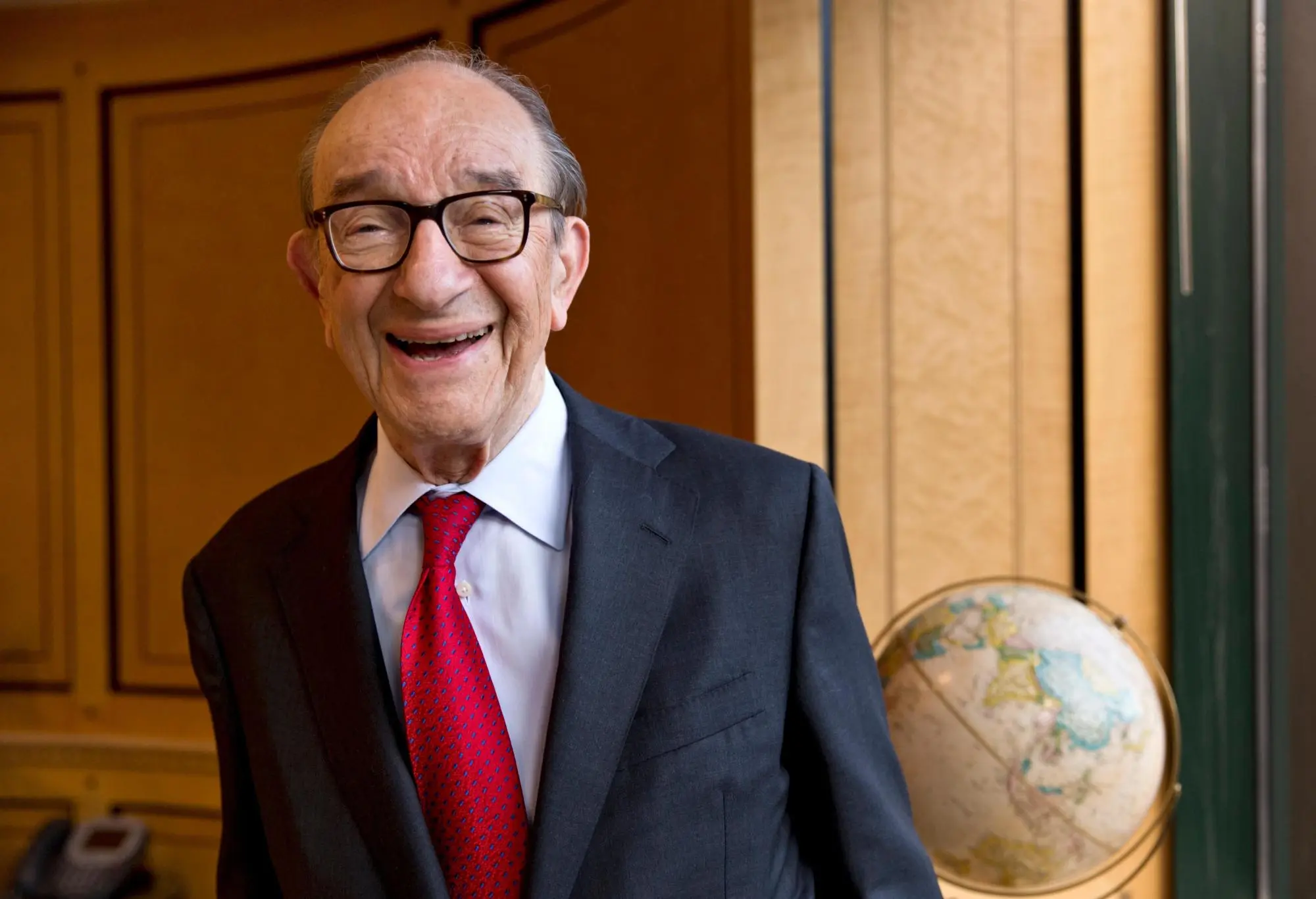
Alan Greenspan, the longtime Federal Reserve chairman known as “the Maestro,” who became one of the most influential economic policymakers of his era and famously warned of “irrational exuberance,” has died at the age of 100.
The influential economist died on Monday at his home from complications of Parkinson’s disease, according to his wife of 29 years, Andrea Mitchell, chief Washington and foreign affairs correspondent for NBC News.
In a statement that laid bare the grief of a life shared with one of the most consequential figures of the modern economic age, Mitchell described him as “a giant of a man who helped shape the U.S. economy for decades under presidents of both parties but was always honest in acknowledging his mistakes.”
On a more personal note, Mitchell added, “To me, he was my husband, who shaped my life from our very first date in 1984. He had ‘irrational exuberance’ for baseball, the Washington Commanders, tennis, golf, and music, especially jazz. He will be remembered for his brilliance and his kindness. Being his life partner was the joy of my life.”
Greenspan served as the 13th chairman of the Federal Reserve from 1987 to 2006, first nominated by President Ronald Reagan and reappointed at successive four-year intervals until retiring on January 31, 2006, after the second-longest tenure in the position in history.
He saw the Federal Reserve through the rise of the internet, the dot-com bubble and its subsequent burst, and the September 11 attacks before retiring after five consecutive four-year terms.
During his long tenure, Greenspan became something close to a mythic figure in the corridors of global finance. A Washington Post column from 1997 captured his stature succinctly: “With a couple of choice words, he can momentarily send the stock market to heaven or hell… second to the president, Alan Greenspan is arguably the nation’s most powerful person.”
His reign at the central bank coincided with the so-called Great Moderation, a period of stability from the mid-1980s until 2007 marked by low inflation, stock market gains, and strong economic growth.
Among his most celebrated decisions was a willingness to buck conventional central banking wisdom. Traditionally, central bankers respond to low unemployment by raising interest rates to ward off inflation. But Greenspan broke with that tradition and kept borrowing costs low.
Princeton economist Alan Blinder, who served under Greenspan on the Fed’s governing board, recalled: “He was willing to watch and wait as the unemployment rate drifted lower and lower and lower and lower, and we still had no inflation.”
In 1996, Greenspan famously coined the phrase “irrational exuberance” to describe bubbles fueled by unbridled investor optimism, alluding to that era’s craze for internet company stocks.
No obituary of Alan Greenspan would be complete without confronting the long shadow of the 2008 global financial crisis. His legacy is linked to the collapse and the ensuing Great Recession, though it occurred after he ended his final term as Fed chair in early 2006.
Greenspan was born to Jewish parents on March 6, 1926, in New York’s Washington Heights, the son of a stockbroker and financial analyst. As a boy growing up during the Great Depression, he received an allowance of a quarter a week.
He was a talented jazz musician who studied clarinet and saxophone at Juilliard, but it was economics that ultimately made him a rock star.
He served as President Gerald Ford’s chairman of the Council of Economic Advisers from 1974 to 1977, helping to reduce inflation from 11% to 6.5%. He later returned to private consulting before President Reagan tapped him to lead the Fed.
In his 2007 memoir, he praised Presidents Ford and Clinton but harshly criticized President George W. Bush for not reining in spending.
And as recently as January 2026, he signed a joint statement with other former Fed and Treasury officials denouncing a criminal probe of Fed Chair Jerome Powell, calling it “an unprecedented attempt to use prosecutorial attacks to undermine” the Federal Reserve’s independence.
WHAT YOU SHOULD KNOW
Alan Greenspan, the man who steered the American economy for nearly two decades as Federal Reserve Chairman, died today at 100 from complications of Parkinson’s disease.
A towering and often polarizing figure, his legacy is one of brilliant contradiction, celebrated for engineering an era of unprecedented prosperity and low inflation, yet blamed for the deregulatory blind spots that helped trigger the devastating 2008 financial crisis.
He was, in the truest sense, the architect of both America’s greatest modern boom and its most catastrophic bust.