Opposition parties across Nigeria have declared a renewed determination to challenge the dominance of the ruling All Progressives Congress (APC), warning of growing threats to democratic governance as the 2027 general elections approach.
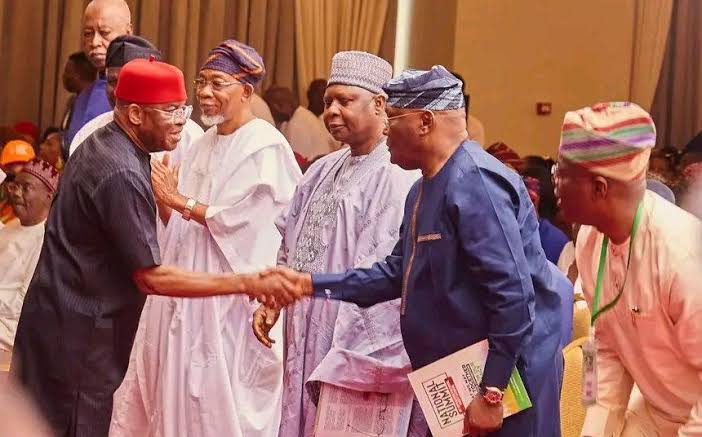
The declaration followed a national summit held in Ibadan, where prominent political figures including Atiku Abubakar, Rabiu Musa Kwankwaso, Rotimi Amaechi, Peter Obi, and Rauf Aregbesola convened to outline a unified political strategy.
Reading the communiqué, factional chairman of the Peoples Democratic Party (PDP), Taminu Turaki, stated: “We shall resist all machinations by the APC to foist a one-party State on Nigeria and fight for the survival of multi-party democracy in our country.”
On the 2027 elections, the opposition dismissed claims of a predetermined outcome, declaring: “Despite the onslaughts and manoeuvrings of the ruling party… we shall field candidates and contest the 2027 Presidential and other elections.”
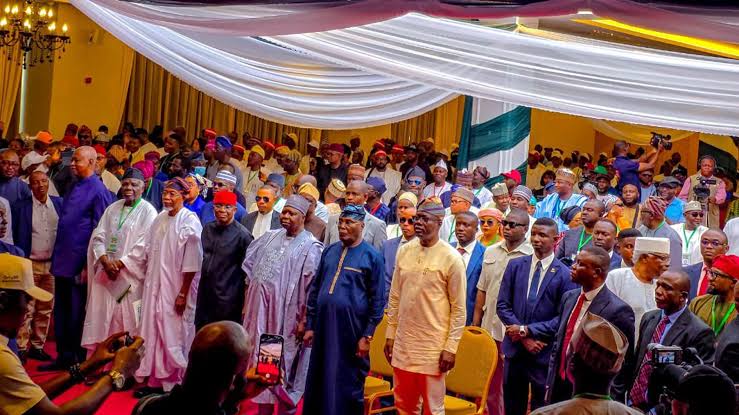
A major highlight of the summit was the plan to present a united front, as the parties announced: “We shall work towards fielding one Presidential Candidate for the 2027 elections, which shall be agreed and supported by all participating opposition parties to rescue our nation and her long suffering masses.”
Concerns were also raised about the electoral umpire, Independent National Electoral Commission(INEC), with the communiqué stating: “The INEC Chairman, Joash Ojo Amupitan, having shown bias and partisanship in favour of the ruling APC, should not conduct the 2027 general elections.”
It further warned that his continued stay in office “is vexatious and capable of triggering widespread crisis in our nation.”
The opposition also called on the National Assembly to urgently review the Electoral Act 2026, urging lawmakers to remove provisions they believe could undermine the integrity of future elections.
On political freedoms, the communiqué demanded the release of politicians allegedly facing harassment, stating: “All leading politicians that are being detained or harassed on bailable offences be released with immediate effect and allowed to exercise their fundamental rights.”
Earlier, the host governor of Oyo State, Seyi Makinde, warned that Nigeria’s democracy was facing gradual erosion due to increasing political concentration and a weakening opposition.
“Across Nigeria today, we are witnessing a level of political concentration that should concern all of us… taken together, they point to a pattern where the space for real political competition is disappearing,” he said.
Makinde stressed that democracy thrives on real alternatives, cautioning that without a strong opposition, the system risks becoming ineffective. He added that the summit was not targeted at any individual but focused on strengthening democratic principles.
Political economist Pat Utomi also painted a stark picture of Nigeria’s economic situation, highlighting the widening gap between living costs and citizens’ income.
He said: “Let me begin with a simple experience from yesterday. I set out to buy fuel, and by the time I was done, I had spent nearly 250,000 naira just to fill my tank.”
“At the same time, I came across a report showing that a large percentage of Nigerians live on less than 100,000 naira a month. That contrast is not just troubling, it is absurd. If that doesn’t reveal something fundamentally broken in our system, then nothing will.”
Utomi further stressed that rising food prices and insecurity were worsening living conditions, urging leaders to adopt policies that reflect Nigeria’s realities rather than relying on imported solutions.
Also speaking, National Chairman of the African Democratic Congress (ADC), David Mark, described the summit as a defining moment in Nigeria’s political history.
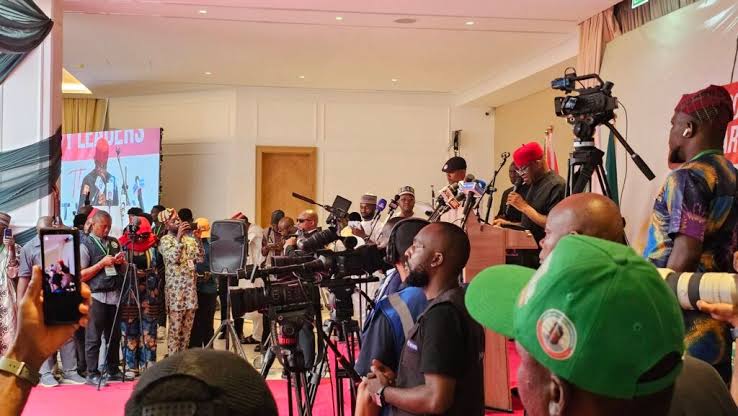
“My prayer is that history will remember us, that when the nation cried out to be rescued, we answered,” he said.
Mark raised concerns over insecurity, stating: “Across the length and breadth of our country, insecurity has become a defining feature of daily life. Nigeria faces a historic challenge.”
He cited figures indicating that in 2025 alone, more than 12,000 conflict-related deaths were recorded, adding that Nigeria ranks fourth on the global terrorism index.
Criticising the government’s response, he said: “We are a nation that is constantly in mourning, yet the APC-led government is behaving as if all is well.”
He further warned of a drift toward a one-party system, alleging that institutions meant to protect democracy were under pressure.
“This contest is between the ruling party APC, and the Nigerian people, we are on the side of the people,” Mark declared.
The summit concluded with a strong call for unity among opposition parties, with leaders agreeing that only a coordinated effort could effectively challenge the ruling party in the next general elections.
What you should know
The Ibadan opposition summit signals a major shift in Nigeria’s political landscape ahead of the 2027 elections, as key opposition figures move toward forming a united front.
Their proposal to field a single presidential candidate reflects growing concern over the dominance of the ruling APC and the perceived weakening of democratic competition. The meeting also highlights rising tensions over electoral credibility, economic hardship, and insecurity.
While no final coalition has been confirmed, the discussions suggest early groundwork for a broad alliance that could significantly reshape the dynamics of the next general elections.