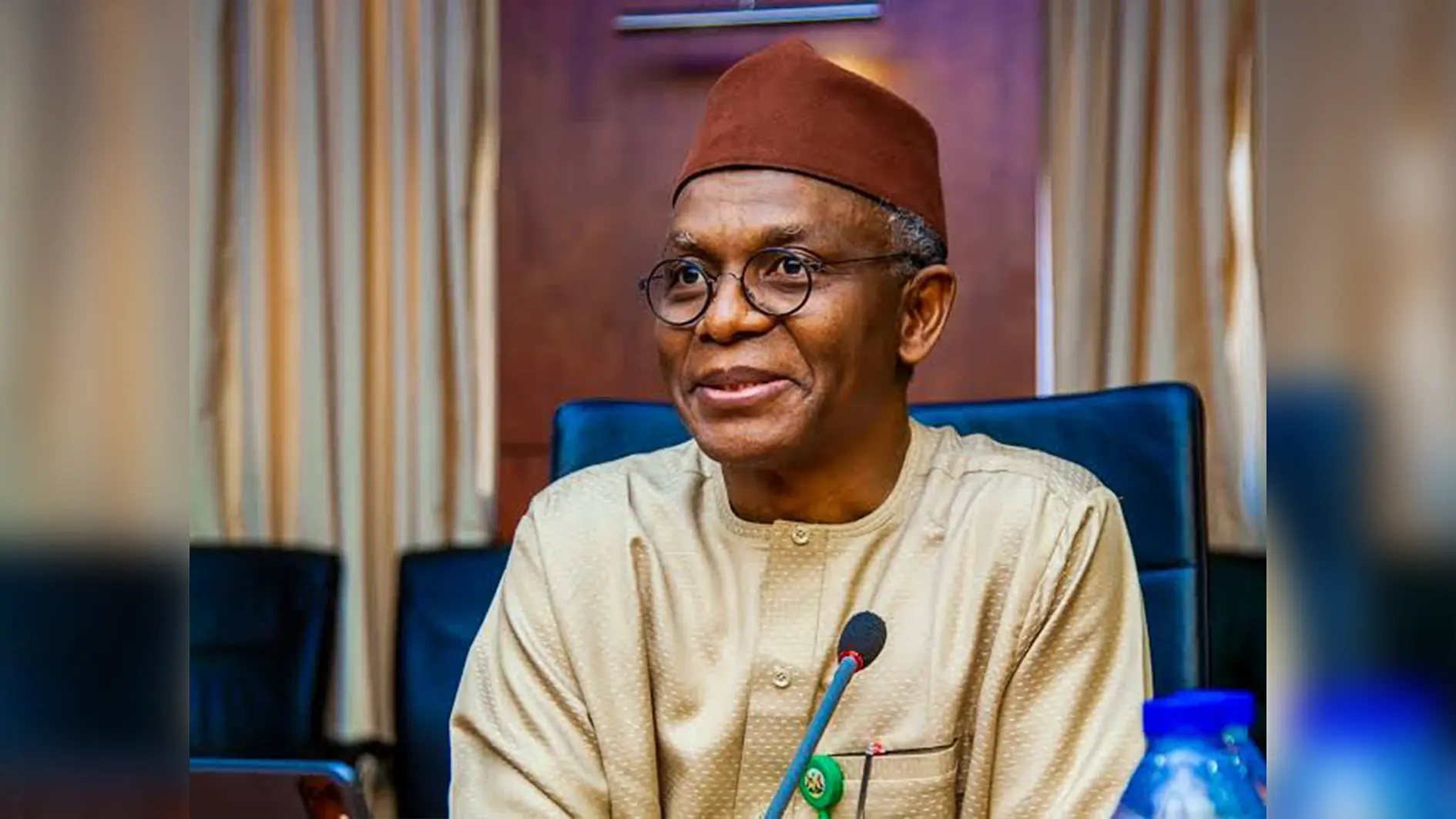
A Federal High Court in Kaduna State on Thursday arraigned former Governor Nasir El-Rufai and six co-defendants before Justice Hauwa’u Buhari over the alleged looting of N8.68 billion earmarked for a CCTV surveillance project in the state capital.
The Independent Corrupt Practices and Other Related Offences Commission, which filed the charges under case no. FHC/KD/93C/2026 brought the defendants before the court on an amended 11-count charge bordering on corruption, money laundering, and a battery of related financial crimes.
The courtroom proceedings mark a dramatic new chapter in the post-tenure scrutiny of El-Rufai, who governed Kaduna State from 2015 to 2023 and was once regarded as one of the most influential figures in former President Muhammadu Buhari’s administration.
Standing in the dock alongside the former governor was Jimi Lawal, his erstwhile senior special adviser and counselor, a man who, in the corridors of Lugard House, once wielded considerable influence over the administration’s inner workings.
Also listed in the charge sheet are five corporate entities: Singularity Network Security Limited, Solar Life Nigeria Limited, Knowledge Investment Nigeria Limited, Intercellular Nigeria Limited, and Noble Coast Resources Limited.
Perhaps most significantly, the ICPC has also named one Bashir El-Rufai, identified as an elder brother of the former governor in one of the eleven counts. Bashir El-Rufai is, according to the commission, presently at large, a development that will almost certainly intensify law enforcement efforts to bring him before the court ahead of the next hearing.
At the heart of the prosecution’s case is the award, in December 2015, of a contract for the procurement, survey planning, final design, and installation of a CCTV surveillance system across the Kaduna metropolis, a project valued at an eye-watering N8,682,574,054.94.
The ICPC alleges that Governor El-Rufai personally approved the award of this multibillion-naira contract to Singularity Network Security Limited, a company the commission says demonstrably lacked the requisite technical experience and qualifications to execute such a sensitive and complex security infrastructure project.
The first count spells out the commission’s case in unambiguous terms: that El-Rufai, in his capacity as executive governor, knowingly approved a contract to an unqualified firm, in brazen violation of existing procurement laws, an act the prosecution characterizes as a deliberate facilitation of corruption, contrary to Section 21(a) and punishable under Section 18(3) of the Money Laundering (Prevention and Prohibition) Act, 2022.
Prosecutors further allege that once the contract funds were released, they did not flow toward the installation of a single surveillance camera.
Instead, according to the ICPC, the money was routed through an elaborate web of companies and individuals, with the defendants collectively receiving and possessing funds in excess of N2 billion between 2017 and 2022 through a series of layered transactions. The commission contends that these funds were, by any reasonable assessment, proceeds of unlawful activity.
When the charges were read before Justice Buhari, both El-Rufai and Lawal entered pleas of not guilty, signaling what is expected to be a vigorous and protracted legal defence.
Their legal teams subsequently moved bail applications, and Justice Buhari adjourned proceedings until July 1, 2026, when she will deliver her ruling on whether the defendants will be remanded in custody or granted bail pending trial.
Sources close to the defence are expected to challenge the jurisdiction of the court and the admissibility of key evidence, while also contesting the ICPC’s characterization of the contract award process.
El-Rufai is separately embroiled in a case instituted by the Department of State Services, where he faces grave allegations of orchestrating the wiretapping of the National Security Adviser, Nuhu Ribadu’s phone, charges that, if proven, would implicate him in activities with national security dimensions far beyond financial wrongdoing.
Legal analysts have described the convergence of these prosecutions as politically charged, noting that El-Rufai has been one of the more vocal critics of the current administration of President Bola Tinubu since leaving office.
His supporters have been quick to characterize the charges as a persecution of a reformist governor who clashed with powerful interests during his tenure.
The ICPC and prosecuting authorities, for their part, maintain that the evidence is robust and that no individual, regardless of their political stature, is beyond the reach of the law.
As the case resumes on July 1, all eyes will be on Justice Buhari’s bail ruling, which will determine whether Nigeria’s most high-profile defendant of the moment remains free to coordinate his defence or faces the indignity of pre-trial detention.
Beyond that, the trial itself promises to be one of the most consequential anti-corruption proceedings in recent Nigerian judicial history, a test not only of El-Rufai’s legal fate but also of the nation’s commitment to holding its most powerful actors accountable.
WHAT YOU SHOULD KNOW
Former Kaduna State Governor Nasir El-Rufai has been arraigned by the ICPC alongside six others over an alleged N8.68 billion CCTV contract scandal, the central allegation being that he approved a multibillion-naira government contract to an unqualified company, after which over N2 billion in public funds was laundered through a network of private entities between 2017 and 2022.
Both El-Rufai and his co-defendant Jimi Lawal pleaded not guilty. With a bail ruling scheduled for July 1, 2026, and a separate DSS wiretapping case already hanging over him, the former governor faces the most serious legal reckoning of his post-office life, one that will ultimately test whether Nigeria’s anti-corruption institutions are truly powerful enough to hold its most influential figures to account.