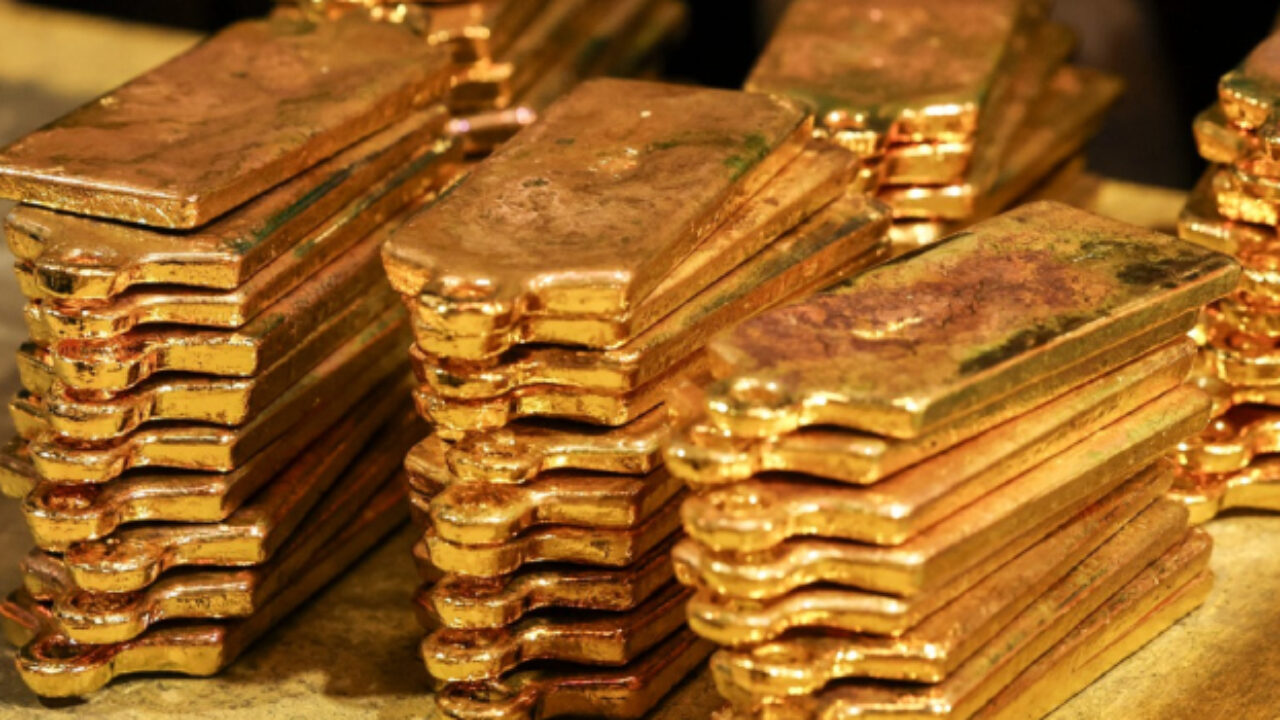
Gold partially recovered on Tuesday after cratering more than 2%, as investors wrestled with a worsening Middle East crisis and conflicting signals from U.S.-Iran diplomatic exchanges.
Spot gold clawed back some ground to trade down a more modest 0.2% at $3,396.74 per ounce, having earlier plunged to $4,097.99—its weakest reading since November 24—before buyers stepped in to cushion the fall. U.S. gold futures for April delivery were not as fortunate, sliding 1.5% to settle at $4,340.90 per ounce as the session wore on.
The turbulence marked yet another volatile chapter in what has been a deeply unsettled period for commodity markets since the United States and Israel launched military operations against Iran on February 28—a conflict that has now sent spot gold tumbling roughly 18% from its peak.
At the heart of Tuesday’s market chaos lay a diplomatic contradiction that traders found impossible to price. President Donald Trump had, in recent days, pulled back from an explicit threat to bomb Iran’s power grid, citing what he characterized as constructive back-channel conversations with unnamed Iranian officials—a claim that raised eyebrows in diplomatic circles and momentary hopes in financial markets.
Tehran, however, was swift and unambiguous in its rebuttal. Iranian officials flatly denied that any negotiations with Washington were underway, torpedoing whatever fragile optimism had briefly lifted sentiment.
Then, within hours, the situation on the ground took a dramatic turn for the worse. The Israeli military confirmed that Iran had launched multiple waves of ballistic missiles at Israel on Tuesday, further darkening the outlook and underscoring just how far the parties remain from any ceasefire or diplomatic off-ramp.
“It’s all about the event that is unfolding in this U.S.-Israel-Iran conflict,” said Kelvin Wong, a senior market analyst at OANDA. “Key stakeholders are not showing uniform messaging across the board over here… so what we see is that markets are in flux right now.”
Wong’s assessment captured the mood across trading floors with precision. When the world’s most powerful governments cannot agree on whether they are even talking to each other—let alone reaching any kind of accord—markets are left with little choice but to hedge against every possible outcome simultaneously, creating the kind of whipsaw price action witnessed on Tuesday.
Compounding the uncertainty in precious metals was the stubbornly elevated price of crude oil. Benchmark Brent crude held firmly above $100 a barrel on Tuesday, a psychological and economic threshold that carries significant consequences for the broader inflation picture.
Higher oil prices act as a tax on the entire global economy, pushing up transport costs, inflating manufacturing overheads, and ultimately feeding through to the consumer price index. In ordinary circumstances, such inflationary pressure would be a powerful tailwind for gold, which has historically served as a go-to inflation hedge for investors seeking to preserve purchasing power.
But these are far from ordinary circumstances. The same interest rate environment that central banks have constructed to combat inflation is now working against gold’s appeal. As a non-yielding asset—one that pays no dividends or interest—gold becomes a less attractive proposition when investors can park their money in bonds or money market funds offering meaningful returns. High rates, in short, raise the opportunity cost of holding gold.
This tension between gold’s role as an inflation hedge and the dampening effect of elevated interest rates has left the metal caught in a crossfire of competing forces, with neither bulls nor bears able to claim a decisive upper hand.
Analysts at Standard Chartered painted a sobering near-term picture for the yellow metal in a note to clients on Tuesday, warning that liquidity pressures could keep gold under the cosh for another four to six weeks, drawing on historical precedents from previous periods of acute geopolitical stress.
“Price risks tend to rise if oil shocks give way to inflation fears or rising debt or recession risks,” the bank’s analysts cautioned, flagging the multiple transmission channels through which the current crisis could further destabilize markets.
The bank’s note also pointed to the fraught policy dilemma now confronting the U.S. Federal Reserve and other major central banks. With markets simultaneously contending with the prospect of an inflation shock and a meaningful slowdown in economic output—a combination some fear could tip into stagflation—policymakers face a narrow and treacherous path.
“For now, however, markets are torn between inflation shocks and negative output growth and the risk of rate hikes,” Standard Chartered’s analysts wrote, reflecting the degree to which the conventional monetary policy playbook has been scrambled by the confluence of war, energy shock, and slowing growth.
Federal Reserve watchers will be monitoring the Fed Funds futures market closely in the days ahead for any repricing of rate hike expectations.
Gold was not alone in its suffering on Tuesday. The entire precious metals complex came under significant selling pressure, suggesting the moves were as much a function of broad-based risk aversion and forced liquidation as they were a specific referendum on gold’s fundamentals.
Spot silver bore the sharpest losses, shedding 3.4% to trade at $66.80 per ounce—a decline that reflected both silver’s industrial demand sensitivity and its tendency to amplify gold’s moves in periods of stress. Spot platinum fell 2.1% to $1,841.68, while palladium gave back 2.7% to $1,395.25, as investors across the board moved to de-risk portfolios amid the swirling uncertainty.
With no clear diplomatic resolution in sight, missile strikes continuing, and oil markets stretched, the path of least resistance for gold in the near term remains uncertain at best. Much will depend on whether Washington and Tehran can establish a credible communications channel—despite both sides currently disputing that one even exists—and whether the Federal Reserve signals any willingness to pause its tightening cycle in the face of deteriorating growth prospects.
For now, as Kelvin Wong at OANDA put it plainly, markets remain firmly in flux—and with them, one of the world’s oldest stores of value.
WHAT YOU SHOULD KNOW
The escalating U.S.-Israel-Iran conflict is the single most important factor driving today’s market turbulence. Contradictory diplomatic signals—with Washington claiming talks are underway while Tehran flatly denies it—combined with fresh Iranian missile strikes on Israel, have left investors with no reliable compass.
Gold, traditionally a haven in times of crisis, is paradoxically falling because high interest rates make holding it expensive, even as oil above $100 a barrel stokes the very inflation gold is meant to hedge against. The entire precious metals complex is bleeding, and analysts warn the pain could last another four to six weeks.