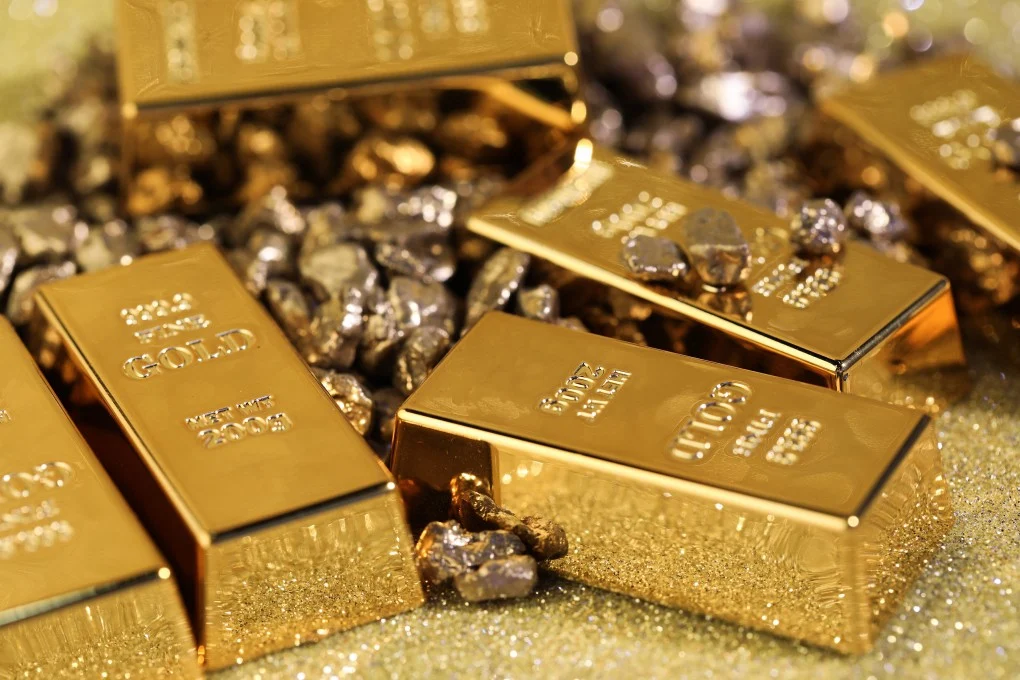
Gold prices retreated sharply on Monday as an escalating exchange of military strikes between the United States and Iran sent shockwaves through global markets, rekindling inflation anxieties that have long haunted bullion’s recovery prospects.
Spot gold slid 0.8% to $4,498.89 per ounce by 09:09 GMT, pulling back from a two-week high touched just Friday, while U.S. gold futures for August delivery shed a steeper 1.4%, settling at $4,528.90.
The losses capped a bruising May for the yellow metal, which finished the month down 0.9%, its fourth consecutive monthly decline, a streak that underscores just how persistently the macroeconomic headwinds have weighed on a commodity traditionally celebrated as a store of value in uncertain times.
The catalyst for Monday’s selloff was swift and unmistakable. Over the weekend, the United States confirmed it had struck Iranian military sites, and by Monday morning, Iran’s Revolutionary Guards announced retaliatory strikes on a U.S. base, the latest volley in a conflict now stretching into its third month, centered on the strategically vital Strait of Hormuz, through which roughly a fifth of the world’s seaborne oil trade flows.
The strikes effectively torched what little optimism had been building around diplomatic negotiations between Washington and Tehran.
“The optimism surrounding negotiations between the U.S. and Iran aimed at ending the standoff in the Strait of Hormuz faded over the weekend,” said Ricardo Evangelista, an analyst at ActivTrades. “As a result, energy prices rebounded, reviving inflation concerns and reinforcing hawkish Federal Reserve expectations.”
Brent crude oil surged more than 3% in the wake of the latest strikes, a development that, while bullish for energy markets, presents a thorny paradox for gold investors.
In almost any other era, the combination of military conflict, soaring oil prices, and geopolitical uncertainty would have sent gold soaring. Bullion has for centuries functioned as the world’s go-to haven, a refuge for capital when the world appears to be on fire.
Yet Monday’s price action illustrated starkly how the current interest rate environment has fundamentally complicated that relationship.
The logic runs as follows: higher oil prices drive up the cost of goods across the economy, reigniting inflationary pressures that markets had hoped were finally cooling.
Persistent inflation, in turn, forces the Federal Reserve to keep interest rates elevated or, increasingly, to consider raising them further. And in a world of high interest rates, gold, which pays no dividend, yields no coupon, and generates no income, becomes an increasingly unattractive place to park capital compared with yield-bearing assets like bonds.
The dollar, meanwhile, edged higher on Monday, adding another layer of pressure. Since gold is priced in greenbacks globally, a stronger dollar makes the metal more expensive for buyers holding other currencies, mechanically suppressing demand.
According to CME Group’s FedWatch tool, traders are now pricing in a 40% probability of a quarter-point Fed rate hike in December, a remarkable shift in sentiment that would have seemed improbable just months ago, when markets were broadly anticipating multiple rate cuts before year-end.
The implications for gold are significant. Every upward revision to the expected path of U.S. interest rates tightens the screws on bullion, increasing the opportunity cost of holding an asset that offers no return.
The coming week promises to be pivotal. A parade of Federal Reserve board members is scheduled to make public remarks, and their tone will be scrutinized by traders hungry for any signal about the central bank’s intentions.
The calendar also features the ISM manufacturing survey and, most critically, the May payrolls report on Friday, a release that has, in recent months, consistently had the power to reset market expectations with a single set of numbers.
“Traders will be closely watching this week’s key data releases as these have the potential to reshape expectations regarding the future path of Fed monetary policy, influencing demand for the U.S. dollar and, consequently, the performance of gold prices,” Evangelista warned.
Not all precious metals followed gold’s lead on Monday. Spot silver bucked the trend, rising 0.7% to $75.79 per ounce, buoyed, analysts note, by its dual identity as both a precious and an industrial metal, with ongoing demand from the solar panel and electronics manufacturing sectors providing a floor.
Platinum edged up 0.4% to $1,925.26, while palladium mirrored gold’s weakness, falling 0.8% to $1,343.55.
Gold finds itself in an uncomfortable no-man’s land. Geopolitical risk, the force that would ordinarily supercharge safe-haven demand, is being neutralized and, in some respects, actively undermined by the inflationary consequences of the very same conflict driving that risk.
Unless U.S.-Iran tensions de-escalate rapidly and oil prices retreat, the inflation narrative looks set to dominate, keeping the Federal Reserve in a hawkish posture and the dollar firm.
For gold bulls hoping that the fourth consecutive monthly loss marks a turning point, Friday’s payrolls report may prove to be the most important single data print of the year so far.
WHAT YOU SHOULD KNOW
Gold’s traditional role as a haven is being undermined by the very crises that should be driving investors toward it. Rising geopolitical tensions are a double-edged sword for bullion right now.
Yes, conflict breeds uncertainty, but when that conflict drives oil prices higher, it stokes inflation, forces the Federal Reserve toward higher interest rates, and ultimately makes gold, a non-yielding asset, less attractive than interest-bearing alternatives.
Until the Federal Reserve pivots away from its hawkish stance, or U.S.-Iran tensions ease enough to bring oil prices back down, gold’s path of least resistance remains downward, no matter how unstable the world looks.