The federal government on Wednesday announced the discovery of a world-class polymetallic mineral province in Kaduna State, containing some of the most strategically valuable materials fueling the global clean energy transition.
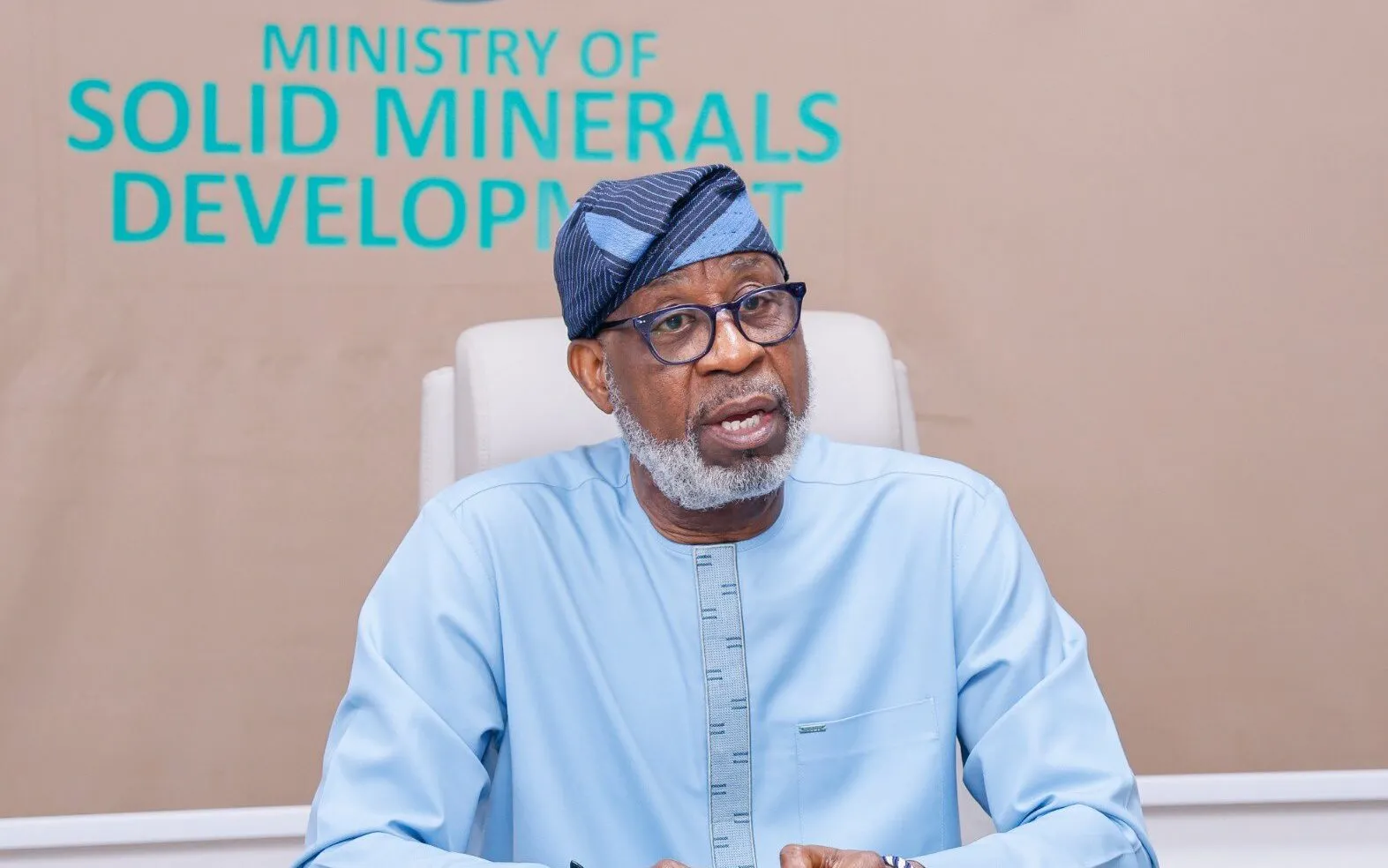
The announcement, made by Minister of Solid Minerals Development Dele Alake at the opening of the African Natural Resources and Energy Investment Summit (AFNIS) 2026 in Abuja, sent a clear signal to the international investment community: Nigeria is open for mining business, and it is sitting on a treasure chest.
The mineral province, verified by the Nigerian Geological Survey Agency (NGSA), was identified through exploration carried out by a private company working in collaboration with government geological authorities.
It contains deposits of platinum group metals, gold, nickel, copper, lithium, and rare earth elements, a combination that reads like a wish list for manufacturers of electric vehicles, semiconductors, and renewable energy infrastructure.
“This is the first time I am announcing this publicly,” Minister Alake told a gathering of government officials, investors, and industry stakeholders, underscoring the weight of the moment.
As wealthy nations race to secure supply chains for critical minerals essential to their green energy ambitions, resource-rich developing countries like Nigeria find themselves holding cards they have historically been unable to fully play. This discovery, if developed responsibly, could change that calculus dramatically.
To understand the significance of what lies beneath Kaduna’s earth, one must appreciate the fierce global competition now underway for exactly these materials.
Platinum group metals, which include platinum, palladium, and rhodium, are indispensable to catalytic converters, hydrogen fuel cells and a growing range of industrial applications.
They are currently dominated almost exclusively by South Africa and Russia on the global supply side, making any new significant deposit a matter of geopolitical as well as commercial interest.
Lithium and nickel, meanwhile, are the twin pillars of the modern battery economy. Every electric vehicle rolling off production lines in Detroit, Shanghai, or Stuttgart depends on a reliable supply of these elements.
Rare earth elements, for their part, are embedded in everything from wind turbines to guided missile systems, and China’s near-monopoly over their supply has made Western governments increasingly anxious.
A province containing all of these in “exceptionally high grades,” as the minister described, positions Nigeria not merely as a mining destination — but potentially as a strategic partner of choice for economies seeking to diversify their critical mineral supply chains away from traditional, politically volatile sources.
The announcement did not arrive in a vacuum. It comes against the backdrop of an aggressive reform agenda that the Tinubu administration has been quietly executing in the solid minerals sector, one that, by its own account, is beginning to yield tangible results.
Since taking office, the government has revoked more than 3,000 inactive and non-performing mineral titles, a move designed to flush out licence hoarders and speculators who had sat on mining rights without developing them, a long-standing affliction of Nigeria’s mining sector that had historically strangled genuine investment.
“We have focused on restoring discipline in licensing, strengthening compliance, improving transparency, and ensuring that mineral assets are held by operators with the capacity and intention to develop them,” Alake stated.
Annual mining sector revenue, which stood at a meager N6 billion before the current administration assumed office, climbed to more than N38 billion in 2024 and surpassed N70 billion by the close of 2025. That is more than an elevenfold increase in under three years, a figure that, if sustained and scaled, suggests the reforms are not merely cosmetic.
Even before Wednesday’s landmark announcement, foreign and domestic capital had begun flowing into Nigeria’s minerals space, buoyed by the government’s stated commitment to local value addition, a policy requiring mining lease applicants to submit concrete plans for processing minerals within Nigeria rather than simply digging them up and shipping raw ore abroad.
The results, according to the minister, are already visible. An $800 million lithium processing investment is underway. A $600 million lithium processing facility is taking shape in Nasarawa State.
A $200 million lithium plant near Abuja is awaiting commissioning. And in Kogi State, a $1 billion iron ore-to-steel project is in development, the kind of downstream industrial investment Nigeria has long struggled to attract.
These are not speculative figures whispered in investment forums. They represent committed capital, and they suggest that the global mining industry is already beginning to take Nigeria seriously in a way it has not before.
On the sidelines of AFNIS, summit participants were bused to a mining site in Abuja operated by Steron Mining and Company Limited, where the company’s Managing Director, Abu Omar, pulled back the curtain on an operation that tells a quietly remarkable story of indigenous enterprise.
What began as a granite quarry has evolved into a far more complex operation following the in-house discovery of lithium deposits. The company now runs both open-pit and underground mining activities and has since identified occurrences of tantalite, another mineral with significant commercial applications in electronics manufacturing.
The company’s geologist, Bello Damulak, provided the headline number: total mineral resources at the site of approximately 94.8 million metric tonnes, including an estimated 3.3 million metric tonnes of lithium reserves and around 91.4 million metric tonnes of granitic rock.
Critically, Steron processes its lithium ore locally before export, precisely the kind of behavior the government’s value-addition policy was designed to incentivize.
Nigeria has been here before, in spirit if not in substance. The country’s oil wealth, discovered in commercial quantities in the late 1950s, ultimately proved as much a curse as a blessing, fuelling corruption, environmental devastation, and economic dependency while failing to lift the majority of Nigerians out of poverty.
The solid minerals sector offers a different path, but only if the institutional frameworks, environmental safeguards, and revenue management systems are built with greater discipline than those that governed the oil era.
What is clear from Wednesday’s announcement is that the geological endowment is real, the policy intent is present, and the investment interest is growing. Whether Nigeria can convert all three into lasting prosperity for its citizens remains the defining question and one that the world will be watching closely.
The African Natural Resources and Energy Investment Summit (AFNIS) 2026 continues in Abuja, bringing together government officials, investors, financiers, and industry stakeholders to discuss mining, energy development, infrastructure financing, and investment opportunities across the continent.
WHAT YOU SHOULD KNOW
Nigeria’s discovery of a world-class polymetallic mineral province in Kaduna State, rich in lithium, gold, platinum group metals, nickel, copper, and rare earth elements, is potentially the most significant development in the country’s mining history.
Backed by genuine policy reform, an elevenfold rise in sector revenue, and billions of dollars in already-committed investments, Nigeria is positioning itself as a serious player in the global critical minerals race.