
Nigeria’s National Youth Service Corps (NYSC) is on the verge of shedding one of its most enduring symbols, the khaki uniform corps members have worn since the scheme’s founding, in favor of Adire, the country’s traditional resist-dyed fabric.
The announcement was made by the Minister of Youth Development, Ayodele Olawande, during an appearance on Channels Television’s The Morning Brief, where he framed the switch not merely as a cosmetic update but as a deliberate economic intervention.
Speaking plainly about the rationale, Olawande pointed to the fact that Adire production is already firmly rooted in Nigeria’s textile economy, with clusters of manufacturers in states such as Ogun and Kwara.
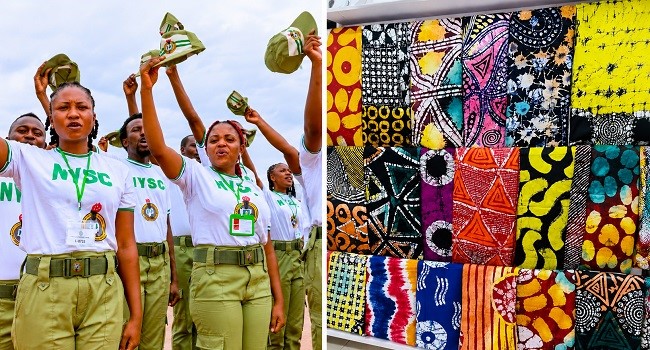
“Let’s put our money back into the country,” he said, positioning the change as a redirection of government procurement toward domestic industry rather than imported materials.
That framing places the uniform switch inside a much larger and more consequential undertaking: the Federal Executive Council has approved a civilian leadership structure and new uniform for the NYSC as part of seven key reforms aimed at repositioning the 53-year-old scheme for greater efficiency.
Olawande told State House correspondents that the council retained the scheme’s one-year duration while introducing skills-based training alongside digitalization and a shift in leadership from military to civilian control.
According to the minister, the reform process began in 2025 through an extensive multi-stakeholder review involving the Federal Ministry of Youth Development, the Federal Ministry of Education, and the Office of the Special Adviser to the President on Policy and Coordination. Officials describe it as the first holistic review of the NYSC since it was established in 1973.
Beyond fabric sourcing, the redesign is being pitched as an image overhaul. Reports indicate the plan is to discontinue the current white T-shirt and khaki combination entirely, replacing it with an Adire-designed outfit that retains the existing NYSC logo, while heavy jungle boots give way to Crocs and lighter training shoes. Olawande has described the redesign as intended to reflect “professionalism and national pride.”
The minister’s disclosure about restructuring how corps members are deployed fits into a broader push to make the scheme more economically purposeful. Among the reforms is a technology-driven call-up process, risk-sensitive deployment designed to better protect corps members, and skills-based primary assignments aligned with academic background and career pathways.
Special Adviser to the President on Policy Coordination, Hadiza Bala Usman, said the reform also reviews how corps members are posted across states, with greater weight given to prevailing security conditions in different parts of the country.
The orientation program itself is being extended from three weeks to six, broken into three two-week phases: the first devoted to civic responsibility and leadership development, the second to career mapping, basic accounting, financial literacy, and access to finance, with plans for a structured “career day” allowing corps members to engage directly with the public.
Government officials have consistently tied the reforms to President Bola Tinubu’s broader economic goals. Olawande described the approved changes as designed to “reposition the NYSC as a skills-driven, productivity-focused, and youth-empowering institution” aligned with the president’s vision of building a $1 trillion economy. He characterized the overhaul as “an investment in Nigeria’s greatest asset, our young people,” adding that the scheme’s future “begins now.”
FEC has directed the Attorney-General of the Federation, Lateef Fagbemi, working alongside the Ministry of Youth Development, to amend the NYSC Act and its regulations to give the changes legal force. Without that legislative backing, officials acknowledge, many of the reforms cannot be fully implemented.
The NYSC was established in 1973 by the military government of General Yakubu Gowon in the aftermath of the Nigerian Civil War, designed to promote national unity and reconciliation by requiring young graduates to serve outside their home regions.
In recent years, however, persistent security concerns, shifting labor-market demands, and calls for greater relevance have fueled pressure for an overhaul of the scheme, with some critics arguing it had outlived its usefulness altogether.
Whether the Adire uniform and accompanying reforms succeed in reshaping perceptions of the NYSC or simply modernize its aesthetics will likely depend on how quickly the legislative amendments move and how faithfully the skills-based posting system is implemented on the ground.
WHAT YOU SHOULD KNOW
This isn’t just a wardrobe change; it’s Nigeria using government procurement as economic policy.
By switching from khaki to locally made Adire, the federal government is redirecting public spending to support Nigerian textile industries directly, while bundling the move into a wider NYSC overhaul (civilian leadership, skills-based postings, and digital call-up systems) aimed at making the scheme more relevant to today’s job market.
None of it is final until the NYSC Act itself is amended, so the uniform swap, like the rest of the reforms, remains a policy in motion, not yet a done deal.
WATCH VIDEO: HERE