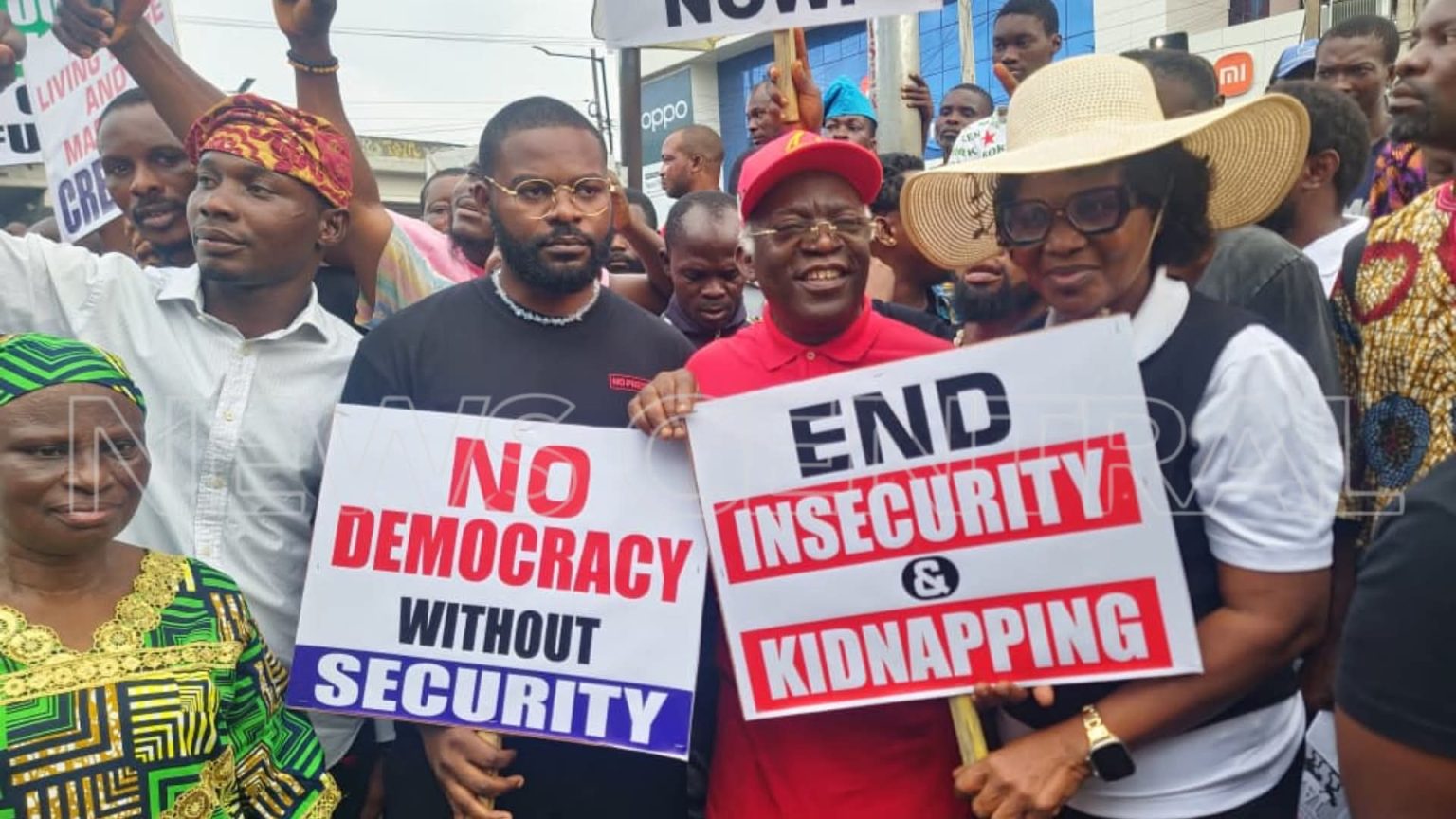
Lagos erupted in protest on Friday as Afrobeats star Falz joined thousands marking June 12, sending a clear warning to the federal government over Nigeria’s worsening security crisis and economic hardship.
The protest, part of a coordinated nationwide day of action, brought together an unusually broad coalition of civil society organizations, trade unions, youth movements, community associations, and faith-based groups united by a shared grievance: that ordinary Nigerians are bearing the brunt of insecurity and an unrelenting cost-of-living crisis while those in power appear unmoved.
Addressing the crowd, Falz did not mince words. Beyond what he called “insane corruption and gross mismanagement” of the nation’s resources, he pointed to a security situation he described as having become simply unbearable.
Citing a string of recent abductions of schoolchildren snatched from their classrooms to the kidnapping of a relative of a former minister in Oyo State, the singer argued that the randomness of these attacks exposed an uncomfortable truth: that no one, regardless of status or connections, is truly safe.
His message was one of equality in suffering and equality in worth. Every Nigerian life, he insisted, carries the same value, and every citizen deserves the same protection, a protection he said the government has consistently failed to provide.
He expressed particular alarm that schools remain open even as students continue to be targeted, calling for an immediate end to the cycle of kidnappings and killings that has left families across the country living in fear.
Pressed by reporters on what the unrest might mean for the ruling party’s prospects in the next general election, Falz was careful not to make predictions. But he didn’t need to spell out the depth of public dissatisfaction; he said it speaks for itself.
He laid the blame squarely at the feet of political leaders who, despite ample time in office, have shown little will to confront the country’s mounting challenges.
Friday’s demonstration was the visible face of a broader campaign declared by a coalition of civic and labor groups, who designated June 12, a date heavy with democratic symbolism in Nigeria, as a day of mass action against insecurity, economic hardship, and the eroding living standards of millions.
The call to action carried the signatures of some of the country’s most recognizable activist voices, including human rights lawyer Femi Falana (SAN), Committee for the Defense of Human Rights president Yinka Folarin, #EndBadGovernance Movement organizer Hassan Soweto, and Falz himself.
For all his criticism, Falz struck a note of democratic faith rather than despair.
Nigerians, he said, would ultimately channel their anger not through chaos but through the ballot box, a sentiment that captures a wider mood across the country as security and economic concerns harden into central themes likely to dominate political debate in the run-up to future elections.
WHAT YOU SHOULD KNOW
Nigerians are losing patience with a government they accuse of failing to protect lives and manage the economy, and while figures like Falz are channeling that anger toward the ballot box rather than chaos, the message to leaders is unmistakable: insecurity and hardship have reached a breaking point, and voters intend to hold those in power accountable come election time.