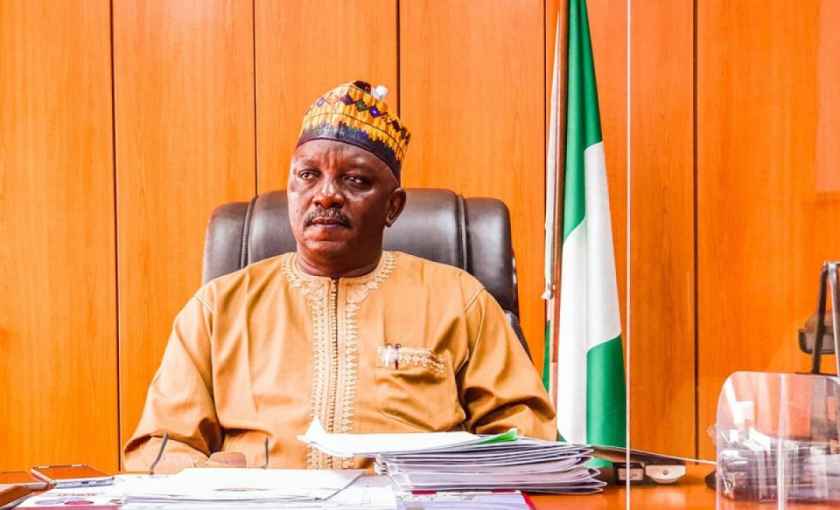
The Economic and Financial Crimes Commission (EFCC) has transferred former Minister of Power, Saleh Mamman, to the Nigeria Correctional Centre in Kuje, Abuja, following an order of the Federal High Court in Abuja for the commencement of his 75-year prison sentence.
Justice James Omotosho of the Federal High Court, Maitama, gave the directive on Tuesday after Mamman was brought before the court by the EFCC following his arrest in Kaduna State.
According to a statement issued by the EFCC spokesperson, Dele Oyewale, the court session also featured a fresh application by the anti-graft agency seeking the forfeiture of five additional properties allegedly linked to the former minister.
Counsel for the prosecution and Director of Public Prosecution of the Federation, Rotimi Oyedepo, informed the court that the application, dated May 25, 2026, requested an order forfeiting the properties to the Federal Government.
During the hearing, one Shamsudeen Mohammed, who identified himself as a relative of Mamman, told the court that the former minister travelled from Abuja to Kaduna by taxi after his conviction.
“My name is Shamsudeen Mohammed. He is my relative. He was sick, and I was helping him to take his traditional medicine. He was brought by a taxi from Abuja to Kaduna,” he said.
He further disclosed that he did not know the owner of the apartment where Mamman was allegedly staying in Rigasa, Kaduna State.
“I don’t know the owner of the apartment where he was staying. It was a rented one,” he added.
Justice Omotosho, while addressing Mamman in court, stated that the prison sentence officially commenced immediately.
“The sentence starts to run from today. You were in Abuja when the judgment was passed. You were in Abuja when the sentence was passed. You left alone in a taxi for Kaduna. I have done my work. I just have to inform you because today is the commencement of your sentence,” the judge said.
Mamman explained to the court that he failed to appear during the earlier proceedings because of health challenges.
The judge also revisited aspects of the May 7 judgment while considering the EFCC’s application for additional forfeitures.
The properties listed in the application include Walijam Apartments located at Plot 435 Lobito Crescent, Wuse 2, Abuja; Bloom Luxury Suites Nigeria Limited at No. 5 Amana Crescent, Unguwan Rimi, Kaduna State; mansions situated at Nos. 11 and 13 Misratah Street, Wuse 2, Abuja; and A.U.A. Plaza on Plot 734 Kade Street, Wuse 2, Abuja.
Mamman’s lawyer, Femi Atteh, was absent during the proceedings despite reportedly being informed of the forfeiture application by the prosecution team.
A lawyer believed to be representing him allegedly declined to accept the court documents before later leaving the courtroom without notifying either the court or the prosecution.
Responding to enquiries from the judge, Mamman said he had not spoken with his lawyer since his arrest by EFCC operatives on May 19, 2026.
Ruling on the forfeiture request, Justice Omotosho held that the matter needed to be adjourned to guarantee fair hearing for the former minister.
“For the forfeiture of additional properties, the court will give adjournment for hearing on it to enable the convict to defend himself,” the judge ruled.
The court subsequently directed that Mamman be personally served to enable him obtain legal representation of his choice and adjourned the matter until June 8, 2026, for hearing on the forfeiture application.
Saleh Mamman was sentenced on May 13, 2026, to 75 years imprisonment after being convicted over the diversion of public funds amounting to about ₦33.8 billion.
The former minister was sentenced in absentia after failing to appear for the conclusion of his trial before he was later arrested in Kaduna by EFCC operatives.
What You Should Know
Saleh Mamman served as Nigeria’s Minister of Power under President Bola Tinubu’s administration before his removal from office amid corruption investigations.
His conviction over the alleged diversion of ₦33.8 billion marks one of the most high-profile corruption cases involving a former cabinet member in recent years.
The EFCC has continued pursuing the recovery of assets believed to have been acquired with proceeds of crime, while the court proceedings surrounding additional property forfeitures are expected to continue.
The case has drawn national attention because of its scale, the prison sentence handed down, and the wider conversation around accountability in public office.