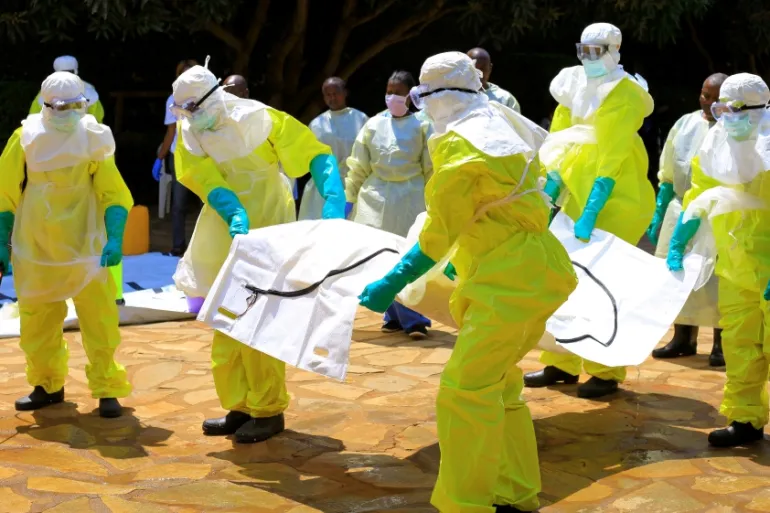
The death toll from the Ebola outbreak tearing through the eastern Democratic Republic of Congo has climbed past 1,000, a milestone reached faster than in any previous outbreak of the virus.
According to the DRC’s National Institute of Public Health, confirmed cases have now reached 2,536, with the death toll standing at 1,033, as the epidemic continues to push beyond its original epicenter in northeastern Ituri Province into at least four other provinces.
The figures mark a sharp escalation from just a week earlier, when confirmed deaths stood at 754 against 2,011 cases, a doubling that laid bare the accelerating trajectory of the outbreak across the region.
The current epidemic has surpassed 1,000 deaths in less than ten weeks, a pace that dwarfs the roughly eight months it took the 2013–2016 West Africa outbreak, history’s largest and deadliest, with more than 11,000 deaths among at least 28,000 cases, to reach the same toll. The comparison has become a grim refrain among health officials trying to convey the urgency of the moment.
The current outbreak also crossed 1,000 confirmed cases within roughly 40 days of response activation, compared with approximately 235 days for the 2018 North Kivu outbreak in DRC to hit the same case count.
That speed is being attributed in part to the outbreak’s unusually broad geographic footprint from the outset and to a virus strain, the Bundibugyo species of Ebola, that has never before triggered an outbreak of this scale, leaving responders with fewer proven medical tools at their disposal.
Speaking at a health summit in Accra, Ghana, Jean Kaseya, director-general of the Africa Centres for Disease Control and Prevention, delivered a stark assessment of the response gap. Kaseya said people were dying because responders lacked vaccines, medicine, and funding to fight the virus. He has separately cautioned that without an urgent turnaround, the outbreak risks becoming one of the worst ever documented.
Compounding the challenge, the Bundibugyo strain currently has no approved vaccine, unlike the strains responsible for previous major multinational Ebola outbreaks, leaving healthcare workers with limited tools to contain its spread.
Aid workers on the ground describe an outbreak that has, from its earliest days, defied conventional containment strategies. Trish Newport, emergency program manager for Doctors Without Borders in Congo, noted that no prior Ebola outbreak has begun with such a large caseload before being identified, and described the situation as one in which the outbreak appears to be outrunning the response effort.
The World Health Organization has echoed that sense of being perpetually on the back foot. Officials have said the epidemic remains ahead of containment efforts even as treatment centers, referral systems, and safe burial teams continue to expand.
Underscoring the scale of the undetected spread, health officials have found that around 80% of new cases are emerging outside known chains of transmission, a sign the outbreak is moving faster than surveillance teams can follow it.
That blind spot is also reflected in where deaths are occurring. Of the latest deaths recorded, more than half were reported in communities rather than in treatment centers, evidence that a substantial number of infected patients are dying before they can be identified, isolated, or treated, according to health authorities.
The outbreak, first declared on May 15, 2026, after a cluster of deaths in Ituri Province, has emerged in a country already contending with overlapping humanitarian crises.
Eastern DRC continues to grapple with chronic insecurity and militia violence even as it fights the Ebola outbreak, alongside persistent burdens from cholera, measles, mpox, and other infectious diseases, a combination that has stretched an already fragile healthcare system to its limits.
The DRC’s Ministry of Health has said hundreds of patients remain in isolation or under hospital care, while the government has moved to train tens of thousands of additional personnel to bolster surveillance and response capacity as the epidemic continues to spread into new territory.
WHO officials have also flagged a troubling rise in the case fatality rate, which climbed to 37% from 32% just a week prior. Crucially, health agencies have attributed the increase not to any change in the virus’s inherent lethality but to persistent delays in detecting infections, isolating patients, and delivering timely treatment, delays that experts say are symptomatic of a health system struggling to keep pace with the outbreak’s spread.
University of Pittsburgh epidemiologist Dr. Jean Nachega, who is advising African health authorities, has offered a note of cautious perspective amid the alarming figures, saying he does not expect the outbreak to reach worst-case projections, while still acknowledging that the obstacles ahead remain formidable.
With the outbreak declared a public health emergency of international concern by the WHO, international attention and funding is likely to intensify in the coming weeks.
But for now, the numbers continue to climb, and health workers on the front lines in Ituri and beyond are left racing against a virus that, by nearly every measure, is moving faster than they are.
WHAT YOU SHOULD KNOW
The DRC’s Ebola outbreak has now killed over 1,000 people faster than any Ebola epidemic in history, and the real scale is likely much worse than reported, since roughly 80% of new infections are surfacing outside known contact networks.
The core problem isn’t a deadlier virus; it’s a response that’s structurally behind the outbreak, hampered by no approved vaccine for this strain and a severe shortage of funding and medicine. Until detection and treatment catch up with transmission, the death toll will keep climbing.