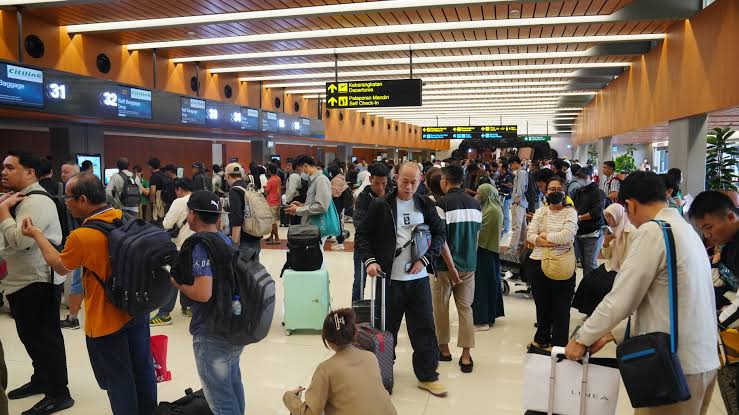
Indonesia’s busiest gateway ground to a halt on Sunday as authorities scrambled to contain the fallout from an erupting volcano, stranding tens of thousands of travelers and rerouting hundreds of flights across the archipelago.
Soekarno-Hatta International Airport, the sprawling hub serving greater Jakarta, suspended all operations after volcanic ash from Anak Krakatoa, a volcano rising from the Sunda Strait more than 150 kilometers away, drifted into surrounding airspace, rendering conditions too hazardous for takeoffs and landings.
The disruption traces back to Saturday, when Mount Anak Krakatoa erupted violently, sending a fountain of molten lava skyward and unleashing thunderous booms that rattled communities as far as several hundred kilometers away, according to Indonesia’s geology agency.
The mountain wasn’t finished: volcanologists recorded two further eruptions on Sunday, a sign that the volcano’s unrest was far from settling.
As ash plumes spread into the flight paths above one of Southeast Asia’s busiest air corridors, officials moved quickly. Soekarno-Hatta first grounded flights at 1:30 am Sunday, initially expecting a brief four-hour pause until 5:30 am. But the volcano had other plans.
Authorities extended the closure three separate times as conditions worsened, with the airport ultimately citing “increased eruptive activity” in a social media statement announcing the suspension would run until 5:30 pm.
The chaos was not confined to the capital. Transportation Minister Dudy Purwagandhi confirmed that six airports altogether had been forced to halt operations, including Hussein Sastranegara in Bandung and Radin Inten II near Bandar Lampung on the island of Sumatra.
In response, aviation officials designated airports in Semarang and Surabaya as emergency landing alternatives for diverted aircraft.
By Sunday, the human toll of the shutdown was coming into sharp focus. The transportation ministry reported that more than 22,000 passengers had been affected, with 209 flights disrupted, a number weighted heavily toward routes connecting Jakarta with Singapore.
International services to Doha, Sydney, and Kuala Lumpur were also thrown into disarray, while at least 16 domestic flights linking the capital with the resort island of Bali were scrapped outright.
For those caught in the upheaval, the day brought a mix of frustration and resignation. Henny Yensan, a 44-year-old businesswoman hoping to fly home with her mother, described a terminal full of disappointed but understanding passengers.
“Everybody was disappointed,” she told AFP, adding that despite the inconvenience, “no one flew into a rage, because after all, this is due to a natural disaster.” Yensan said she had rebooked her journey for Tuesday.
Not everyone had the luxury of simply waiting it out closer to home. Samuel Guiberteau, a 47-year-old executive with the food company Danone, had been on a business trip to the resort island of Lombok since Friday and found himself hunting for a way back to Jakarta with no clear options.
“Nothing is certain for the moment,” he said by phone, recounting how a backup booking on budget carrier Citilink had also fallen through. With few alternatives left, Guiberteau said he would simply have to remain in Lombok until the skies cleared.
Anak Krakatoa, Indonesian for “child of Krakatoa,” sits in the Sunda Strait between Java and Sumatra, occupying the caldera left behind after the catastrophic 1883 eruption of its parent volcano, Krakatoa, which killed an estimated 35,000 people in one of history’s deadliest natural disasters.
The younger volcano first broke the surface of the sea in the early twentieth century and has erupted sporadically ever since.
The current unrest is not without precedent for tragedy: in 2018, a partial collapse of Anak Krakatoa triggered a devastating tsunami that killed 429 people and displaced thousands more along the coastlines of Java and Sumatra, a disaster still fresh in the memory of communities near the strait.
Geology agency head Lana Saria said monitoring data pointed to significant subsurface movement. “Seismic activity indicates the movement or release of volcanic fluids within the volcanic system,” she said, while cautioning that scientists could not forecast precisely when or how forcefully the volcano might erupt next. “The timing, magnitude, and nature of the next eruption cannot be precisely predicted,” she added.
Lana urged the public to stay well clear of the volcano, warning that ejected material posed a direct danger to anyone within the restricted zone. She offered some reassurance on one front, however, stating that the current eruptive sequence did not, for now, carry the risk of triggering another tsunami.
Beyond the aviation sector, port authorities issued a heightened vigilance advisory for vessels transiting the Sunda Strait, warning that volcanic activity could endanger navigation. Ships were explicitly barred from entering a three-kilometer exclusion zone encircling the volcano.
The episode is a stark reminder of Indonesia’s geological volatility. The vast archipelago nation straddles the Pacific Ring of Fire, the horseshoe-shaped belt where colliding tectonic plates generate some of the planet’s most intense volcanic and seismic activity, a geography that has repeatedly tested the country’s infrastructure, emergency planning, and the patience of travelers caught in nature’s path.
WHAT YOU SHOULD KNOW
Anak Krakatoa’s eruption on Saturday, followed by two more blasts Sunday, forced Indonesia to shut down Jakarta’s main airport and five others, stranding over 22,000 passengers across 209 flights.
While travel chaos dominated the headlines, the single most important factor for the public is safety: officials have enforced a strict 3-kilometer exclusion zone around the volcano and warned ships and residents to stay clear, even as they confirmed there is currently no tsunami risk.
Given the volcano’s history, including a deadly 2018 tsunami and its origins in the catastrophic 1883 Krakatoa eruption, the key takeaway is that eruptive activity remains unpredictable, and authorities’ top priority is keeping people out of harm’s way while flights resume once conditions allow.