More than a week after a wall of ice, rock, and meltwater tore through the mountains straddling the China-Nepal border, rescue teams are still combing riverbanks for the dead, and the human cost of the disaster continues to climb with grim inevitability.
Nepal’s disaster management authority confirmed Friday that the death toll on its side of the border has reached at least 1,287, with 5,083 people still listed as missing, a number so large that officials privately concede many of those unaccounted for will never be found.
Across the frontier in the Tibet Autonomous Region, Chinese state media reported 21 confirmed deaths and 541 missing, pushing the combined toll from the catastrophe to 1,308 dead and 5,624 missing.
Adding to the grim accounting, authorities in India say at least 17 bodies have been recovered from rivers downstream, believed to have been carried more than 150 miles from the disaster zone by the sheer force of the floodwaters. Those victims have not yet been added to the official toll, pending identification and confirmation of where they died.
The catastrophe began in the early morning hours of August 26, when a section of glacier near Langtang Lirung, a 23,000-foot peak already scarred by a deadly 2015 collapse, sheared away from the mountainside.
The initial rupture was so violent that seismographs operated by the U.S. Geological Survey first mistook it for a magnitude 4.4 earthquake; scientists later revised their assessment, attributing the tremor to the landslide itself, which ultimately registered as a magnitude 5.2 seismic event.
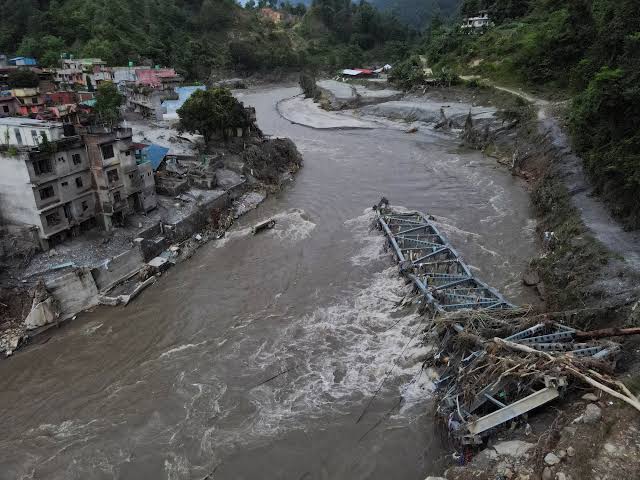
The resulting torrent of ice, mud, and boulders obliterated the Gyirong border checkpoint on the Chinese side before thundering down the Lhende Khola into the Bhote Koshi and, finally, the Trishuli River, which carried the devastation more than 40 miles through Nepal’s Rasuwa, Nuwakot, and Dhading districts.
Witnesses described the Trishuli’s water level rising by as much as 30 feet in half an hour, enough to erase entire village blocks, sweep away bridges, and bury classrooms and homes under feet of grey sludge.
Geologists studying satellite imagery in the disaster’s aftermath have pointed to an ominous pattern: unusually warm conditions and thinning snow cover around the glacier in the weeks before it failed, consistent with the broader destabilization of Himalayan slopes as the region warms.
Whether climate change played a direct role remains under study, but scientists have been unequivocal that the risk of similar “cascading” disasters where glacial and landslide hazards combine with heavy rainfall is rising across the range.
Among the most agonizing threads of the disaster is the fate of the more than 800 foreign nationals still unaccounted for.
The missing include trekkers who had set out into Nepal’s Himalayan trails and pilgrims who had traveled to Tibet’s Mount Kailash, revered by Hindus, Buddhists, Jains, and followers of the Bon tradition as one of the most sacred sites on Earth.
Embassies from multiple countries have dispatched officials to the region, though damaged roads, downed communications infrastructure, and the sheer remoteness of the affected valleys have slowed the search.
The danger has not passed. Chinese authorities have issued repeated warnings about barrier lakes that formed in the wake of the initial collapse: pools of meltwater and debris dammed behind unstable rock and ice, with the potential to burst and unleash a second wave of flooding downstream.
One such lake, near the confluence of the Chhochen Khola and Purepu Tsangpo rivers, was estimated to hold roughly 2 million cubic meters of water, with officials warning of a “high risk” of breach as further inflow was expected.
United Nations officials have said satellite monitoring is being used to track the lakes in real time, calling on communities in the flood’s path to remain on alert even as recovery efforts continue elsewhere.
In Nepal, the scale of the identification effort has forced authorities to resort to mass burials for unidentified victims, with numbered markers placed over graves in the hope that DNA testing may one day allow families some closure.
Thousands of soldiers and police officers have been deployed nationwide in the search-and-recovery operation, working alongside international rescue teams in terrain where helicopters remain the only reliable way in or out.
As the toll continues to rise and the monsoon-swollen rivers of the Himalaya remain unpredictable, officials in both Kathmandu and Beijing have cautioned that the full scope of the tragedy and its final death toll may not be known for weeks or longer.
WHAT YOU SHOULD KNOW
The Himalayan floods of August 26 killed at least 1,308 people across Nepal and Tibet, with over 5,600 still missing, and the crisis isn’t over.
The unstable glacial lakes still loom over the region, threatening a second wave of flooding, while scientists warn this kind of disaster will become more common as climate change destabilizes Himalayan slopes. The mountains people live beneath are no longer as predictable as they once were.