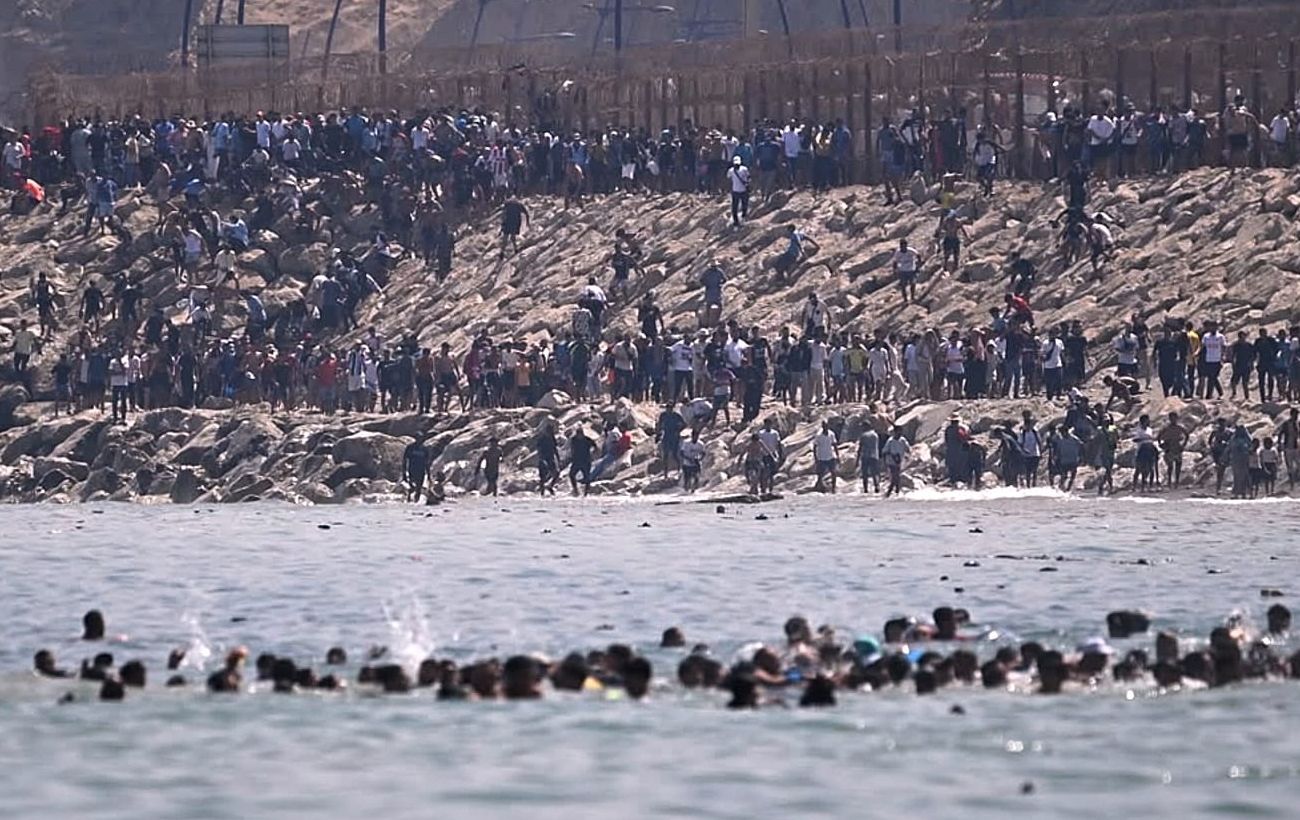
Spain’s small North African enclave of Ceuta woke on Friday to scenes locals struggled to put into words, after tens of thousands of migrants swam, waded, and scrambled across the border from Morocco overnight, a surge that sent Prime Minister Pedro Sánchez rushing to the territory in person.
Police sources put the total number of crossings over the preceding days at around 40,000, a staggering figure for an enclave whose entire resident population is roughly 80,000.
Spain’s Interior Ministry said Friday that almost 49,000 migrants had crossed into Ceuta over the past 24 hours alone, a scale that dwarfs even the previous record-setting crisis of 2021.
The human toll has already begun to mount. At least nine people have died in the attempt to reach the enclave, according to authorities managing the response, with fears the toll could climb further as search efforts continue along the coastline.
Witnesses described a relentless, hours-long procession through the darkness. “There was a steady stream of people all night long,” one police source told reporters, adding that arrivals showed no sign of slowing even as dawn broke Friday.
AFP correspondents on the ground watched hundreds of men, women, and children emerge from the water near the border barrier, discarding flotation rings, inflatable rings, and soaked clothing on the sand as they pressed onward into Spanish territory.
By Thursday, jubilant new arrivals were seen walking through Ceuta’s streets, thanking startled Spanish police officers, chanting “Bye bye Morocco, hello Spain.” Officers on the ground appeared largely unable or unwilling to physically block the tide, with many instead redirecting people toward the local migrant reception center rather than attempting mass intervention.
Local authorities in Ceuta have pointed to a Spanish Supreme Court ruling handed down earlier this month, which found that migrants arriving by sea cannot be summarily pushed back across the border without due process, unlike those who scale the land fence.
Some activists in Morocco, however, have voiced skepticism that the ruling itself triggered the surge, arguing most people attempting the crossing would have not know a foreign court’s legal reasoning. What exactly ignited this particular wave remains officially unconfirmed.
Spain announced it would deploy the armed forces to help the Civil Guard restore order in the city, with Sánchez set to visit Ceuta’s Tarajal border crossing alongside Interior Minister Fernando Grande-Marlaska.
Ceuta’s regional president, Juan Jesús Vivas, had gone further, formally requesting that Madrid declare a national emergency, a request the central government declined. One local Civil Guard union representative described the scene bluntly as “absolute chaos.”
The crisis has rippled well beyond Spain’s borders. Italy called Thursday for Spain to be suspended from the Schengen open-borders zone, a demand Madrid rejected furiously, summoning Rome’s ambassador and accusing the Italian government of exploiting the tragedy for domestic political gain.
France, meanwhile, moved to tighten checks along its own border with Spain, wary of secondary movement further into the continent.
In Washington, the White House weighed in forcefully, with the administration accusing Spain’s government of enabling “mass migration” through “far-left, globalist policies” and warning European governments to reverse course “or risk their own demise.”
The scale of this week’s crossings recalls and vastly exceeds the crisis of May 2021, when roughly 8,000 to 10,000 migrants crossed into Ceuta over a matter of days after Moroccan border guards appeared to stand aside amid a diplomatic rupture between Rabat and Madrid.
That earlier standoff was triggered by Spain’s decision to provide hospital treatment to Polisario Front leader Brahim Ghali, infuriating Morocco, which considers the Western Sahara independence movement an existential challenge to its territorial claims.
That dispute was eventually resolved in 2022, when Madrid abandoned its historic neutrality on Western Sahara and backed Morocco’s autonomy plan for the region, a reversal that in turn strained relations with Algeria, Rabat’s regional rival and a longtime Polisario backer.
Notably, Sánchez traveled to Algiers on July 20, his first such visit in four years, in what was widely read as an effort to mend that relationship, a thaw that now unfolds against the backdrop of this fresh crisis on Spain’s southern frontier.
Rabat has yet to issue a formal public statement on the surge, though a Moroccan official, speaking anonymously, confirmed that the two governments have been in contact over the matter.
With Sánchez now on the ground in Ceuta and pressure mounting from allies and rivals alike, Spain faces the delicate task of processing an overwhelmed enclave, managing an international backlash, and answering the still-open question of what, precisely, set off one of the largest single migration surges Europe’s only land borders with Africa have ever seen.
WHAT YOU SHOULD KNOW
Ceuta is facing the largest migration surge in its history, nearly 50,000 crossings in 24 hours, dwarfing the 2021 crisis with at least nine dead.
This isn’t just a humanitarian emergency, it’s rapidly becoming a geopolitical flashpoint, with Italy, France, and the White House all weighing in and turning Ceuta into a proxy battle over European migration policy, even as the actual trigger for the surge remains unconfirmed.