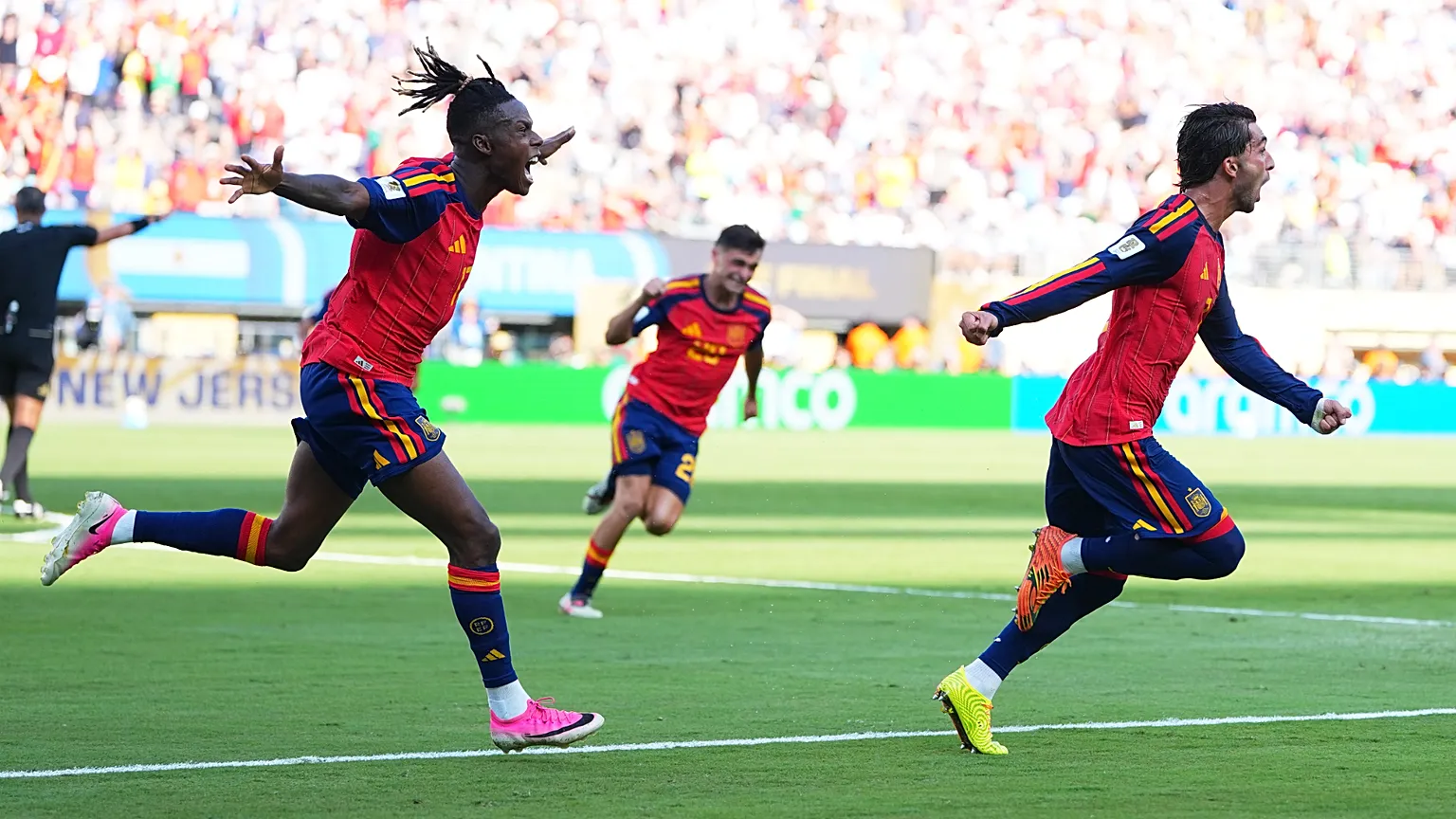
Spain is world champion once more. La Roja defeated defending champions Argentina 1-0 after extra time on Sunday to lift the FIFA World Cup for the second time in the nation’s history, capping an unbeaten run through the tournament with the coolest of finishing touches when it mattered most.
The match itself was a tense, low-scoring affair that lived up to its billing as a clash between the two form teams of the tournament. Spain broke the deadlock through Ferran Torres in the 106th minute of extra time, sealing a narrow but deserved victory over Lionel Messi’s Argentina.
Spain controlled the match from start to finish, delivering a dominant performance and not allowing Argentina a single shot on goal throughout the contest, a remarkable defensive display against a side that had scored freely throughout the tournament.
Spain’s path to the title ran through some of the tournament’s biggest names. La Roja overcame France in Dallas in the semi-final to book their place in the showpiece decider, continuing the momentum they’d built since their Euro 2024 triumph and confirming themselves as the team to beat on the global stage.
Argentina, for their part, advanced by coming from behind to break England’s hearts in stoppage time, a semi-final for the ages that saw England manager Thomas Tuchel’s late substitutions backfire dramatically.
The two semi-final losers, France and England, met in a wild third-place play-off, which England won 6-4 in a match befitting the tournament’s freewheeling character.
This was no ordinary World Cup. The 2026 edition marked the first with an expanded 48-team format, featuring an unprecedented 104 matches spread across three host nations: the United States, Canada, and Mexico.
No previous World Cup had featured as many teams or been played across as many host nations, making it, by most measures, the largest and most-watched sporting event in history.
Eleven American cities hosted matches including Atlanta, Boston, Dallas, Houston, Kansas City, Los Angeles, Miami, the New York/New Jersey area, Philadelphia, the San Francisco Bay Area, and Seattle with the United States staging every match from the quarter-finals onward, culminating in Sunday’s final at MetLife Stadium.
The final also carried symbolic weight as a passing-of-the-torch moment. Lionel Messi, still leading the line for Argentina at the tournament, faced off against Spain’s teenage sensation Lamine Yamal two generational talents on opposite sides of the pitch in New Jersey.
For Argentina, the defeat ends their reign as world champions after their dramatic penalty-shootout triumph over France in Qatar back in 2022.
For Spain, this second star adds to the one earned in 2010, cementing coach’s tactical philosophy and a golden generation featuring Yamal as a team capable of grinding out results even when the goals aren’t flowing freely.
Their unbeaten run through a grueling, expanded 48-team format will likely be remembered as one of the most complete championship campaigns of the modern era.
As confetti fell over MetLife Stadium, Spanish players and staff spilled onto the pitch in celebration, their triumph a fitting exclamation point on a tournament that redefined the scale and perhaps the spectacle of the world’s game.
WHAT YOU SHOULD KNOW
Spain are the 2026 FIFA World Cup champions, defeating defending champions Argentina 1-0 in extra time thanks to a Ferran Torres goal in the 106th minute.
The standout factor: Spain’s suffocating defense didn’t allow Argentina a single shot on goal in the entire final a statement performance that capped a fully unbeaten tournament run and delivered the nation’s second World Cup title.