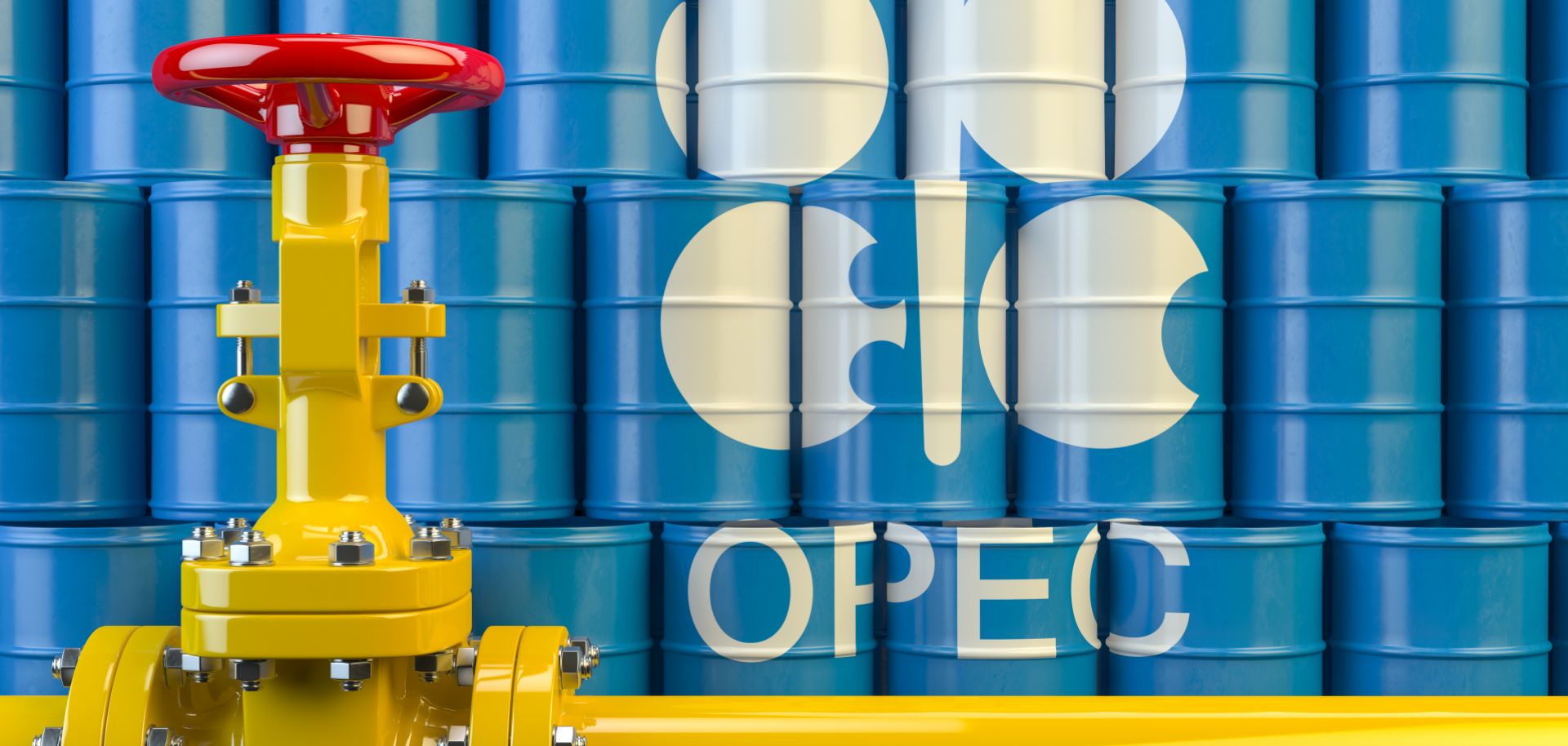
Eight key members of OPEC+ agreed on Sunday to raise their collective May production quotas by 206,000 barrels per day, the cartel said in a statement following a virtual ministerial meeting.
The increase — identical to the one the same group approved for April at its March 1 gathering, just as fighting erupted — amounts to little more than a rounding error against the backdrop of the worst oil supply disruption in history.
Analysts estimate the U.S.-Israeli war with Iran has slashed global crude availability by 12 to 15 million barrels per day, or as much as 15 percent of worldwide supply, by effectively sealing the Strait of Hormuz since late February.
The waterway, which normally carries roughly one-fifth of the planet’s seaborne oil, remains closed to routine tanker traffic because of missile and drone attacks on Gulf energy infrastructure. Saudi Arabia, the United Arab Emirates, Kuwait and Iraq — the only OPEC+ producers with meaningful spare capacity before the conflict — have seen their exports severed.
Damage to terminals, pipelines and loading facilities has been severe, Gulf officials privately acknowledge. Even if hostilities cease and the strait reopens tomorrow, it will take months to restore full operations and hit pre-war production targets.
“The modest rise will largely exist on paper,” one senior OPEC+ source familiar with the deliberations told Reuters on condition of anonymity. Key members simply cannot pump more amid the chaos.
A parallel session of the Joint Ministerial Monitoring Committee voiced alarm over the attacks on energy assets, describing repairs as “expensive and time-consuming” and warning that prolonged damage would continue to crimp supply well beyond any ceasefire.
Iran, for its part, signaled a partial easing of tensions on Saturday by declaring that Iraqi tankers were free to transit the strait. Shipping trackers confirmed one vessel carrying Iraqi crude successfully passed through on Sunday. Yet industry sources stressed that confidence remains fragile. “It remains to be seen if more vessels will take the risk involved,” a person close to the shipping industry said.
Crude prices have already reacted with predictable fury. Benchmark futures have climbed to a four-year high near $120 a barrel, pushing pump prices for gasoline, diesel and jet fuel sharply higher across Europe, Asia and North America.
Governments from India to Germany are scrambling to implement conservation measures — everything from speed limits on highways to strategic reserve releases — as the cost-of-living pain ripples through factories, farms and household budgets.
The 206,000 bpd quota bump represents less than 2 percent of the volume now missing from the market. Yet OPEC+ insiders framed it as a deliberate message: the group stands ready to flood the market the moment the Hormuz chokepoint reopens.
The eight producers — which include Saudi Arabia, Russia, Iraq, the UAE, Kuwait, Kazakhstan, Algeria and Oman — have spent the past year methodically unwinding earlier output cuts. Between April and December 2025 they added roughly 2.9 million bpd to regain market share before pausing the ramp-up for the first quarter of 2026.
Russia itself cannot contribute to any near-term relief. Western sanctions and infrastructure damage sustained during the ongoing Ukraine conflict have left Moscow’s export machine hobbled.
OPEC+, which formally groups 22 nations including Iran, has in practice delegated monthly quota decisions to this core eight-country bloc in recent years. The next formal meeting is scheduled for May 3 — by which time the market may be facing an even starker choice.
Investment bank JPMorgan warned Thursday that if Hormuz remains blocked into mid-May, prices could spike beyond $150 a barrel, eclipsing the all-time nominal record set in 2008.
For now, the cartel’s Sunday decision changes little on the ground. It does, however, keep the machinery of managed supply in motion while the world holds its breath over whether diplomacy, or further escalation, will pry open the strait that supplies the lifeblood of the global economy. Until then, every additional day of closure writes another chapter in what is already the largest single oil shock the industry has ever recorded.
WHAT YOU SHOULD KNOW
The closure of the Strait of Hormuz due to the U.S.-Israeli conflict with Iran has triggered the largest oil supply shock in history, removing up to 15 million barrels per day from global markets.
OPEC+’s response is negligible. With oil already near $120/barrel and potentially headed past $150, the only real solution is reopening the strait — everything else is noise.