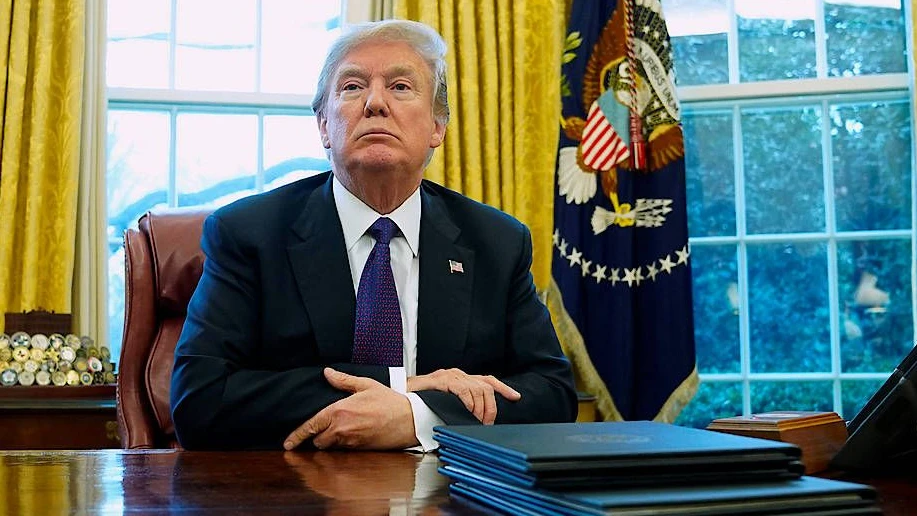
President Donald Trump issued a stark 48-hour ultimatum to Iran on Saturday, March 21, 2026, demanding the immediate and unconditional reopening of the “Strait of Hormuz” or face devastating U.S. military strikes on its power plants.
Posting directly from his Truth Social account at approximately 11:44 p.m. GMT, Trump declared, “If Iran doesn’t FULLY OPEN, WITHOUT THREAT, the Strait of Hormuz within 48 HOURS from this exact point in time, the United States of America will hit and obliterate their various POWER PLANTS, STARTING WITH THE BIGGEST ONE FIRST!”
The message, which was quickly reposted by the official White House account on X (formerly Twitter), marks one of the most aggressive public threats issued by the Trump administration amid the ongoing U.S.-Israeli military campaign against Iran, now in its fourth week.
The Strait of Hormuz, the narrow chokepoint connecting the Persian Gulf to the Gulf of Oman, has remained effectively closed to commercial traffic since the conflict erupted on February 28, 2026.
Iran has enforced a de facto blockade through a combination of explicit threats, missile and drone attacks on vessels, and selective disruptions that have slashed tanker transits by more than 90% in recent weeks.
Roughly one-fifth of the world’s daily oil consumption and substantial liquefied natural gas volumes normally flow through this vital artery, and its closure has already driven crude prices surging and contributed to widespread fears of energy shortages, particularly in Asia and Europe.
The blockade began almost immediately after U.S. and Israeli forces launched Operation Epic Fury, a coordinated air and missile campaign targeting Iranian military, nuclear, and leadership sites—including the reported killing of Supreme Leader Ali Khamenei.
In retaliation, Iran unleashed waves of missiles and drones against U.S. bases, Israeli cities, and regional allies, while the Islamic Revolutionary Guard Corps (IRGC) warned that any unauthorized passage through the strait would be treated as hostile.
Early U.S. efforts to counter the blockade included naval escorts announced by Trump on March 3, coupled with political risk insurance from the U.S. Development Finance Corporation (DFC) to encourage shipping companies.
On March 14, Trump publicly urged allies—including China, France, Japan, South Korea, and the United Kingdom—to contribute naval forces to secure the waterway. Despite these measures and reported U.S. strikes on Iranian mine-laying vessels and naval assets, the strait has remained largely impassable for commercial shipping.
Major marine insurers, such as Gard, Skuld, NorthStandard, the London P&I Club, and the American Club, withdrew war risk coverage for Gulf waters as early as March 1, further deterring vessels from attempting the transit.
Trump’s ultimatum represents a sharp pivot from comments just a day earlier suggesting a possible winding down of operations and a shift of responsibility to international partners.
By threatening strikes on civilian-critical infrastructure—starting with Iran’s largest power facility, widely believed to be the Damavand Combined Cycle Power Plant near Tehran—the president has expanded the potential scope of U.S. military action beyond purely military targets to elements affecting everyday Iranian life.
Iranian officials responded swiftly and defiantly. The IRGC’s Khatam Al-Anbiya operational command warned that any attack on Iran’s energy infrastructure would trigger retaliation against all U.S. and allied energy assets in the region, including desalination plants, information technology facilities, and oil installations. Iranian media quoted military spokespersons vowing a broad response if the ultimatum is enforced.
The deadline set by Trump’s post expires around 11:44 p.m. GMT on Monday, March 23, 2026 (early Tuesday in Tehran), leaving a narrow window for de-escalation or further confrontation.
Analysts warn that any U.S. strikes on power plants could plunge large parts of Iran into darkness, exacerbate humanitarian conditions amid ongoing conflict, and provoke asymmetric Iranian reprisals that widen the war. Global oil markets, already volatile, reacted immediately to the news with futures climbing sharply in after-hours trading.
As the clock ticks, the world watches to see whether diplomacy—perhaps through back channels or reluctant intermediaries—or military force will determine the fate of one of the planet’s most critical maritime arteries. For now, the Strait of Hormuz remains a flashpoint capable of igniting broader economic and geopolitical chaos.
WHAT YOU SHOULD KNOW
President Trump has given Iran a 48-hour ultimatum (expiring ~11:44 p.m. GMT Monday, March 23, 2026) to fully reopen the Strait of Hormuz without threats—or the U.S. will strike and destroy Iranian power plants, starting with the largest.
The strait, carrying ~20% of global oil, has been blocked for weeks amid the U.S.-Israel-Iran war. Its continued closure threatens worldwide energy supplies and prices. Iran vows retaliation if attacked. The next few hours will decide whether diplomacy prevails or the conflict escalates dramatically.